



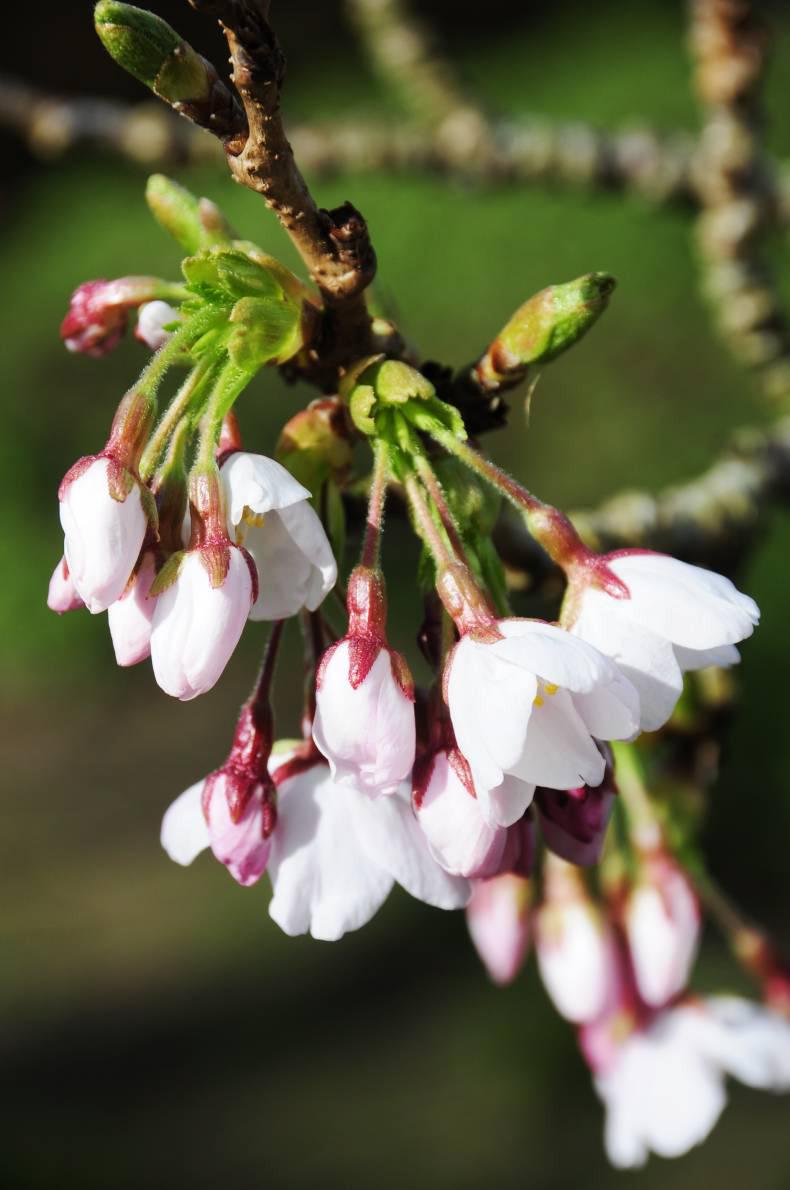
The Yoshino cherry is in flower these days. It is the main early flowering cherry, flowering in March, while most others flower in April or even early May. There are others that flower earlier, but none of them delivers the flower power of this magnificent tree.
An established tree of about 20 years old looks like a floating cloud of blossoms, a sight to see and, while other cherries have their charm, the Yoshino cherry is hard to beat for delicacy and grace.
These qualities are not simply attributable to having lots of blossoms, which it does, but to the way the blossoms are carried on the twigs and even how the branches are carried on the trees. In outline, from a little distance, the Yoshino cherry has a somewhat flat top, not quite flat, more ascending and become arching as the tree ages and the weight of the branches becomes greater, pulling them back to earth. These trees sometimes even have their branches come back to rest on the soil. But that only happens to very old trees. The ascending flat top is more common to see, and this lends distinction to the tree.
The flowers are very pretty, emerging in clusters from the large, rounded buds. The flower buds at first are pink and fade to soft pink-white as they open and later to white before the petals fall.
As it emerges from the bud, each flower has a stalk that quickly elongates, and the flower is then carried dangling in clusters of flowers of pale blush pink.
Each petal has a little notch and this gives the cluster a slightly frilled appearance. The flowers are quite large, three centimetres across when fully open on a sunny day.
The base of the flower, the calyx that holds the petals, holds a reddish colour that makes a lovely contrast and, looking into the flower, the base of the petals has a dark pink mark. The flowers are sweetly scented, especially on a warm spring day.
The Yoshino cherry has long been popular in its native Japan, where it is widely grown as a decorative tree. It is a hydrid of unknown origin, a garden tree and not a wild species. Being a hybrid, it is more floriferous than most species and has bigger flowers, without losing any of its natural grace.
Its botanical name is Prunus x yedoensis, Edo or Yedo being an old name for Tokyo. It was brought to Europe in 1902 and quickly became popular. It is widely planted around the world in temperate areas for its outstanding display of flowers.
A good aspect of the Yoshino cherry is that it grows very fast when young and quickly makes a tree of reasonable size and flowers well as a young tree. Flowering increases as it ages, every twig carrying flower clusters. It does not make a very big tree, about four or five metres high and about twice that in width, too big for very small gardens, and it best where it has space to grow and to be seen.
It likes good soil that does not get wet in winter or too dry in summer. It needs full sunshine to flower best. Sometimes, after a heavy flower year, it might take a rest and not flower as well, but it resumes again the following year.
Especially lovely in spring, it makes a very fine display of autumn colour foliage in shades of yellow, orange and red. It is widely available for sale, but avoid the weeping form called pendula or ‘Shidare-yoshino’, as they are next to useless for flowering.
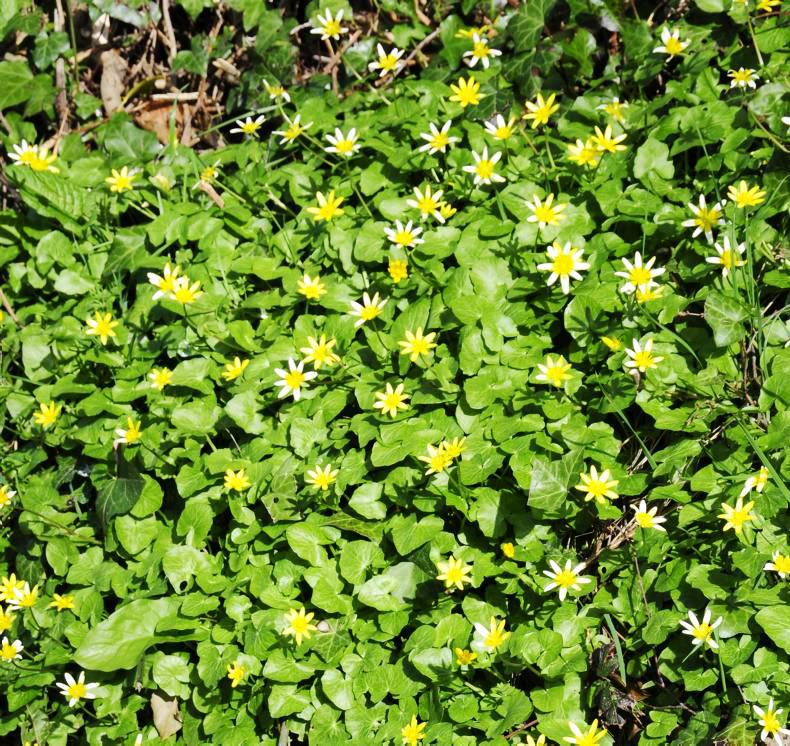
Bright yellow celandines
Early spring sees the bright yellow flowers of the lesser celandines appearing in damp areas. The flowers look like buttercups, to which they are related, but the lesser celandine flowers earlier on low plants with a mass of small heart-shaped leaves. There exists also a greater celandine, to add to the confusion, a member of the poppy family, not related to the lesser celandine at all.
Lesser celandines can be a terrible weed, as they drop little tubers when they are disturbed when digging or weeding, and they establish readily from the tubers. But it is a pretty little weed and celandines can be left to grow in a semi-wild garden, or controlled with a directed spray of Roundup or similar if not wanted.
>> This week
Fruit, vegetables and herbs
If not done already, pruning of apple and pear trees and blackcurrant bushes should be completed this week, because buds are opening. Be ready to sow vegetable seeds of most kinds as soon as soil conditions allow. Onion sets can be put in and potatoes planted.
Trees, shrubs and roses
Bush roses and repeat-flowering climbers are growing strongly and should be sprayed against blackspot disease. Apply fertiliser to rose bushes. Feed young shrubs and trees with some general fertiliser to get a boost of growth. Control weeds around the base of young trees.
Lawns
Lawns grew well in the early winter, but in early spring it was difficult to mow because of very wet weather. The recent dry spell offered a chance to catch up on mowing. It is still a bit cold for applying feed to a lawn, but moss control can be applied and worn patches over-sown.
Flowers
Sow a few sweet pea seeds for scented, colourful flowers in summer. Gladiolus can be planted directly outdoors from now on. So too can lilies, which can also be potted up for summer flowers. Although it is getting late, it is still possible to divide and plant perennial flowers.
Greenhouse and house plants
Feed and water all greenhouse plants. Sow seeds of tomatoes for greenhouse growing, without delay, also sweet peppers and chilli peppers, or wait to use purchased plants. Sow basil seeds indoors. Re-pot house plants that need it. Clean dust off house plants and feed.


SHARING OPTIONS