


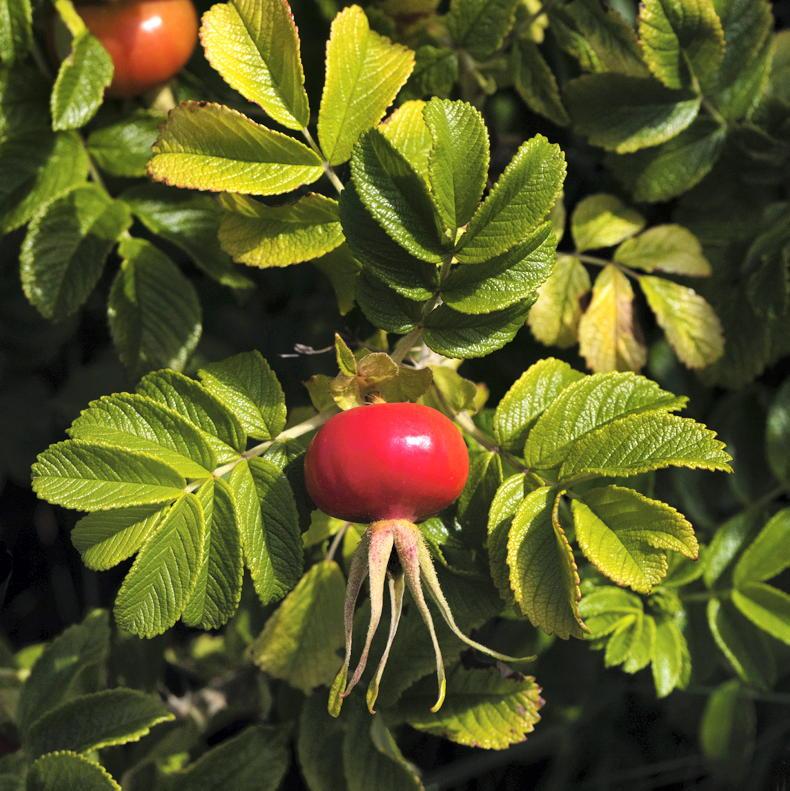

‘When summer’s roses fold away, and drifting petals leave the briar, bright rose hips kindle autumns day, like scattered beads of hidden fire,” as the verse goes. The lines aptly capture the appeal of roses at this season, when their colourful hips prolong the display long after the flowers have faded.
We plant our gardens for many reasons but I would say, mainly for colour. Roses are one of the very best at providing different shades and scent and we love them for that.
I have for a long time loved the late autumn and early winter for the display of rose hips. Some, however, produce better hips than others and these are the ones I want to focus on.
A rose hip is a fleshy capsule full of seed after summer’s pollination. The red, orange or black hips are round often held on bare stems. They persist into winter with interest for the gardener and food for birds and wildlife.
At this time of year, the Irish countryside is brightened with the red hips of Rosa canina, the dog rose, after the summer flowering, with soft pink mildly fragrant flowers.
Also seen in the wild is R. rugosa used along coastlines in sandy soil, to which it is well suited. With its rich pink single flowers and textured wrinkled leaves, it displays strikingly large red hips.
It suckers though and is a concern in terms of the possibility of it becoming invasive so care is needed in terms of placing it.
Rosa rugosa ‘Fru Dagmar Hastrup’ is similar but has single pale pink flowers with wrinkled leaves and large hips almost like small tomatoes which are striking and beautiful. Such is its beauty that it was awarded a Royal Horticultural Society Award of Garden Merit. Another rugose rose is R. ‘Hansa’ with double purplish-pink flowers and a lovely fragrance. The hips are large and scarlet-red in colour.
If a white rose is your preference go for R. rugosa ‘Alba’ with large single white silky textured flowers. It has a strong old rose fragrance with large orange-red hips.
Rosa moyesii ‘Geranium’ is a large bulky rose, 2m by 2m, with fresh green leaves. The flowers are rich red appearing in June into August, after which it produces its large flask shaped scarlet-coloured hips lasting until Christmas time.
Rosa ‘Penelope’
One of my favourite shrub roses is Rosa glauca. The foliage has a grey hue throughout the summer held on dark chocolate coloured, almost thornless stems. The flowers are clear pink with a white centre and golden stamens. Its hips are wine red complementing the dark stems. It can achieve up to 2m in height and spread.
Rosa ‘Penelope’ is also a large strong branching shrub of slightly smaller proportions, with dark green foliage and plum-red stems. The creamy white semi-double flowers have slightly frilled petals and last through summer into autumn. These are followed by coral-pink hips to take you into winter.
Rosa ‘Morning Mist’ has large single light pink flowers with a large clump of yellow stamens in the centre, growing to a height and width of 1.8m. It produces a good crop of large orange hips.
Roses are not often thought of as ground cover plants, but if it is what you are after, grow Rosa ‘Partridge’ flowers over a long period. It will cover an area of 3 sq m to a height of 30-40cm. Ideal for bare banks where planting is often difficult.
Rosa ‘Tottering-By-Gently’; I just love the name, has masses of single light-yellow flowers fading to cream, held in large open clusters. They are lightly fragrant, held over a long period on a medium sized shrub 1.5m x 1.5m. The hips are orange red.
When growing roses specifically for their hips, you must not dead-head as you would others roses. Allow the plant to continue producing flowers and therefore rose hips.
Adhere to all other guidelines for rose growing such as good soil preparation, adding well-rotted compost in advance of planting. The plants also benefit from annual feeding as flowering to produce hips uses up masses of energy.
How do I protect my Dicksonia tree fern? It is my first time to grow one and I don’t want to lose it. – Helen, Co Wexford.
Dicksonia antarctica is a woodland plant that prefers light shade and a moist atmosphere. They can be protected from harsh winter weather by filling the crown or growth point with straw and tying it into place. This allows protection from frost while allowing moisture in.
I also suggest loosely tying the fronds together to avoid wind damage. If you are in an exposed garden, wrap the entire plant in horticultural fleece, which is available from your local garden centre.
Avoid using plastic, as this creates temperature fluctuations, which is not good for the plant.
Tender plants: move any potted tender plants into sheltered areas. Use pot blocks to raise pots from the ground.
Greenhouse: it should be filling up now with tender plants, make sure that all plants being stored are disease-free. Ventilate on bright sunny days for brief periods. Check watering.
Pots and planters: monitor all planters for water as they can dry out over winter. Remove emerging weeds. Bulbs will soon be starting into growth.
Trees and shrubs: now is a good time to prune or transplant trees and shrubs.

