


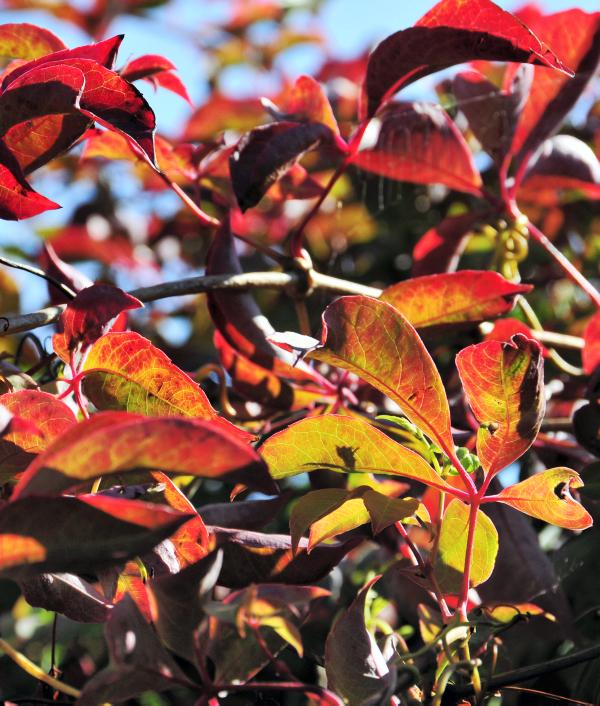
Virginia creeper is familiar to most people, although much of what is called Virginia creeper is actually Boston ivy, which, to add more confusion is neither from Boston nor is it ivy. The plants called Virginia creeper and Boston ivy are closely related and more or less interchangeable in their use, so the use of a wrong name does not make much difference. They are both members of the grapevine family and they sometimes produce tiny berry fruits that look like small grapes but are not edible.
They are grown for their foliage, which is their crowning glory, especially in the autumn period. The leaves are already beginning to change colour here, with the darker red and purple pigments gathering in the sun-touched leaves. Over the next few weeks, the green chlorophyll will be dissolved and washed out of the leaves as growth slows down and then the red and purple colours will be revealed. The sight of a mature Virginia creeper on a house in full colour in October is one of the most outstanding views to be seen in any garden.
Virginia creeper can easily grow to over 20 metres high and wide and in nature they grow up trees in forests and on rock faces, scrambling up and over smaller plants.
In some city locations, old plants have grown across entire terraces of houses from a single stem, often making well over 30 metres. Both Virginia creeper and Boston ivy are capable of making this size. Even though they look very alike from a distance, up close they are easily distinguished.
The botanical name for Virginia creeper is Parthenocissus quinquefolia. The “parthen” part of the name is Greek for virgin, a reference to Elizabeth I of England, who was known as the virgin queen, and for whom Virginia was named. The “quinquefolia” part means five-leaved and each leaf is divided into five separate leaflets.
Boston ivy is Parthenocissus tricuspidata, the second part of the name meaning divided in three points, and the leaves have three pointed lobes but are not split all the way to the leaf stalk, like the Virginia creeper.
The Viriginia creeper is from Virginia and all of the east coast of North America. The Boston ivy is from China, Korea and Japan but gained its link with Boston because of its use on houses in that city.
There is another of these creepers from China, Parthenocissus henryana, that is a real beauty but not that often seen. It is not as hardy as the other two and can suffer from late spring frost in cooler inland areas. But it can be grown in milder areas. It has the striking addition of silver veining on the leaves, while it has the same five separated leaflets as the Virginia creeper. It does not grow as big as the others and would suit a smaller wall. The autumn colour is a blaze of red.
Any of these creepers is easy to grow. They like good, well-drained soil. Ground that gets waterlogged can cause the roots to rot and severe dieback of the top of the creeper can result. The plant can grow quite large and the root system needs room to grow too, so the spot chosen must allow for future root expansion. Pin down the plant at soil level and let it find its own grip, which it does with its self-clinging tendril suckers. It needs no supports. Control the spread of the creeper around windows, doors and the roof-line as it will happily grow over the roof if allowed. Although it can be planted at any time from a pot, autumn is a good time to plant as it gets well established before the next growing season. CL
Remove any rotten apples
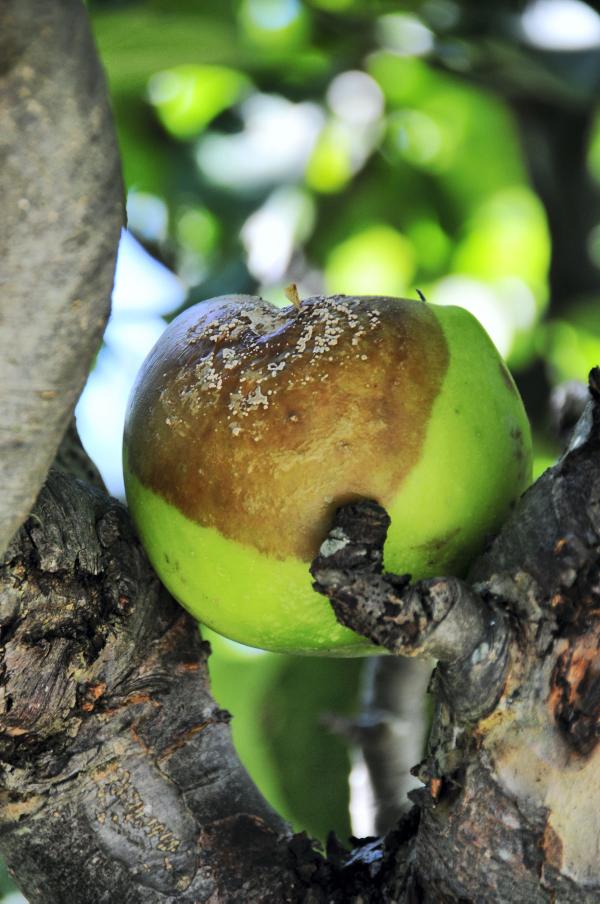
Given the mixture of sunshine and showers over recent weeks, it is not surprising that there is quite a lot of fruit rot about. A lot of plums were lost as brown rot attacked them and apples are being attacked now too. The rot is caused by a fungus which gets in through the skin and causes a characteristic brown rotting with circles of white spores being produced. These spores can start rots on neighbouring fruit and on other trees. To reduce the numbers of fruit damaged, the first rotted fruits should be picked off the tree and off the ground to reduce spore transfer. The rotted fruit should be buried as they can continue emitting spores if just left on the soil.
Trees, shrubs & roses
It is only a few weeks to the traditional planting season for trees, hedges and shelter belts. Plant evergreen kinds from October and deciduous kinds from November onwards. Young trees struggle with grass and weeds and the ground should be cleared first or sprayed with glyphosate to kill perennial weeds.
Fruit, veg & herbs
Pick apples when they are ripe – the earlier varieties do not keep for more than a few days. Clear any vegetable crops that have gone over. Onions should be pulled and allowed to ripen for a couple of weeks. Leaving them too late can affect storage quality. Parsley and chives can be potted up and grown on under glass or plastic.
Flowers
Seeds of some of the easier hardy annual flowers, such as calendula, candytuft, California poppy and limnanthes, can be sown where they will flower next summer. Spring bulbs can be planted at any time now, and for Christmas flowering hyacinths in bowls should be potted up by the end of next week.
Lawn
Grass has grown strongly this summer. It has not been necessary to feed lawns in most cases as they were getting showers. For a best quality lawn, an application of autumn lawn fertilizer would be beneficial. Moss will soon start to reassert itself and lawn moss killer treatment might be considered in the coming weeks.
Greenhouse
Make sure to pick tomatoes as soon as they ripen to encourage the later ones to turn. The same is true of greenhouse grapes – pick them when they are ready and the growth will go into the remaining bunches. Stop feeding greenhouse plants and reduce watering significantly, avoiding wetting the ground or foliage if possible.


SHARING OPTIONS