


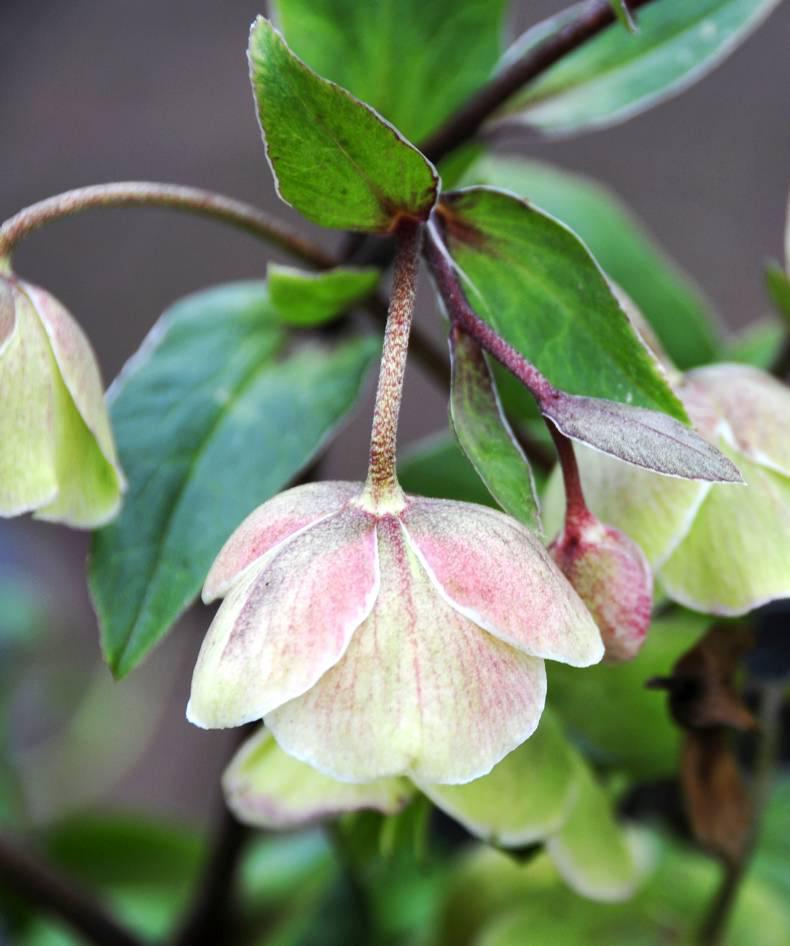
Winter Bells is a catchy name, easily remembered and descriptive of a new kind of hellebore. This new plant was only recently launched and it will be interesting to see if it catches on. It certainly has the potential to do so.
This new hellebore variety is very pretty, with large branching stems of drooping bell-like flowers. The flowers are pale green and flushed with red. They are attractively carried – each one on a short, slightly arching stem. The effect of several layers of flowers is a cascade from top, right down to ground level, even drooping over the edge of the pot in some instances.
This new plant is a hybrid between two excellent and widely grown hellebore species, namely the stinking hellebore, Helleborus foetidus, and the Christmas rose, Helleborus niger.
The stinking hellebore gets its unflattering common name from the fact that the foliage when crushed has an unpleasant, musty smell. It is native to Europe but not to Ireland. However, it thrives here so well that it might as well be native.
It has leafy stems that last over winter and offer good ground cover in a shady spot under trees. It is somewhat coarse and dark, but it does a good job in places that very few plants enjoy.
Unfortunately, its flowers are not outstanding. It forms a fairly tight group of small rounded, bell-like flowers, often with a red rim around the tip of the bell. The flowers open in mild winter weather, slowly into March. It is about 80cm tall.
The Christmas rose hellebore is not a rose, but it has rose-like white flowers, sometimes pink-flushed with a boss of bright yellow flowers at the centre. It generally does not flower for Christmas except in a mild winter and in a mild area, and it did so in some places this year. It was, once upon a time, forced in greenhouses in pots for the Christmas market. The Christmas rose is a relatively low plant, only 30cm tall, with broad, dark leathery leaves. It is not as robust as the stinking hellebore but its flowers are larger and far more beautiful.
The flowers are attractive to bees, especially bumblebees in early spring, and the pollen is carried from flower to flower. Seedling hellebores are commonly found growing close to the parent plants. So it seemed like a good idea to cross these two fine plants, the aim being to raise a larger plant with some of the stinking hellebores size, robust stems and foliage, but with some of the genes of the Christmas rose to improve the size of the flowers, as those of the stinking hellebore are relatively small.
However, it proved to be a very difficult task to hybridise the stinking hellebore with the Christmas rose. Many breeders tried and failed. However, one seedling was raised by a Dutch breeder and the result of this cross is a new plant, a garden hybrid, and it is a superb garden flower.
It is propagated from the original seedling, which arose in 2004, by micro-propagation in the laboratory and, of course, it is patented and, therefore, it costs a bit more.
Many people will find it worth the expense though as it is likely to be a great addition to many gardens.
Of course, it is very early days and it has yet to prove itself in a wide range of garden conditions, climatic challenges and pest and disease exposure. But it may become a useful item for winter and early spring and will look great with spring bulbs of all kinds. CL
Early Camellias
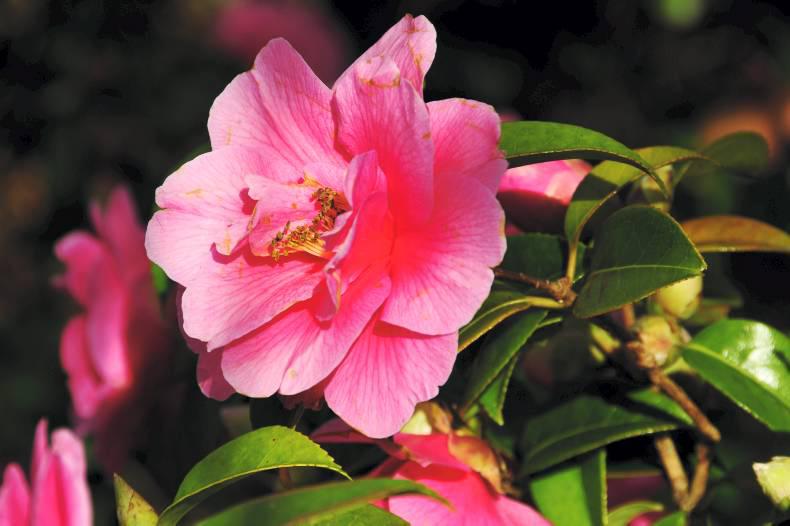
Camellias came into flower very early this year in many places around the country. While they might be expected to be in flower by this time of year, some are in flower for weeks and even months at this stage. Many people have remarked on this early flowering, which was only slowed down by a lengthy period of low temperatures. The very late autumn and relatively mild winter brought on camellias much earlier than usual and the Williamsii types are the most likely to respond to mild weather. They are also the sort of camellia that is mostly sold now. Unfortunately, the early flowers have been caught out by frost and turned brown in some places, but more buds will open.
This week
Fruit, veg & herbs
If the weather picks up and the soil dries out, dig ground not already dug over and break the big lumps on soil dug some time ago. Sow seeds of early varieties of cabbage, cauliflower, carrots, lettuce and onions in a tunnel or glasshouse for early crops. Plant garlic and shallot sets if the ground is dry enough to cultivate.
Lawns
On a dry day, give a first mowing if not already done. Grass growth was affected by cold weather. Apply sulphate of iron as a lawn mosskiller if there is heavy moss growth. It is too early for lawn feeding. If new areas of lawn are to be sown, the ground should be cultivated, if possible, by hoeing out weeds or using a weed killer.
Trees, shrubs & roses
Deciduous trees can be moved even though the season is a bit late now. There is plenty of time to plant evergreens. Bush roses and repeat-flowering climbers should be pruned in the next two weeks, if not already done. Rose bushes can still be planted from pots. Prune buddleja and fuschia if they were too big last year.
Flowers
This is the best time to move perennial flowers in gardens on heavy soil as they will re-start growth right away. It is getting late for sowing seeds of the slow developers – geraniums, lobelia, busy lizzie and bedding begonias. These should be sown by now and certainly not delayed much longer or flowering will be seriously delayed.
Greenhouse and house plants
Most potted greenhouse plants will benefit from increased watering as growth begins. Sow seeds of tomatoes, peppers and chillies. Delayed sowing will delay cropping and ripening of the tail-end of the crop next October. Greenhouse camellias in pots will be showing superb flowers.



SHARING OPTIONS