


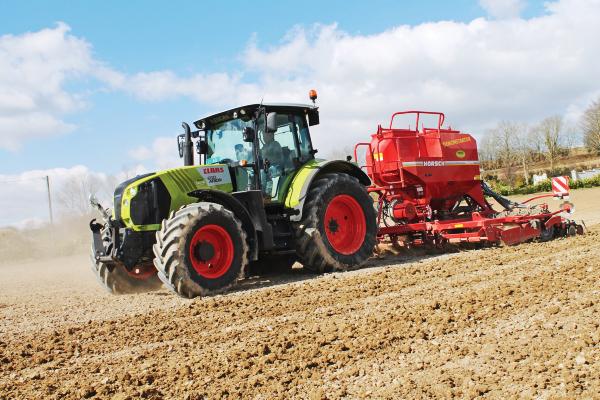
This spring, Kelly’s of Borris left us with a new demonstrator Claas Arion 650 and a 4m, Horsch Pronto 4DC seed and fertilizer drill. Unfortunately, it was just for the day though and not for life! That didn’t stop us working the socks off it though on what was one of the very few excellent spring days we had.
A little history first. In 2003, Claas acquired a majority stake in the French Renault tractor business. The Arion 500 and 600 series was launched in 2007 and it is now the most popular Claas tractor range sold in Ireland.
There are seven models in the new 500 and 600 series. The 500s are all four-cylinder models, while the 600s are six-cylinder models. Everything else is the same across both ranges. The maximum power is quoted as 145hp on the Arion 530, the smallest of the new models, while the largest model, the Arion 650 develops a maximum of 184hp. And that’s the tractor that we had for the Irish Farmers Journal test.
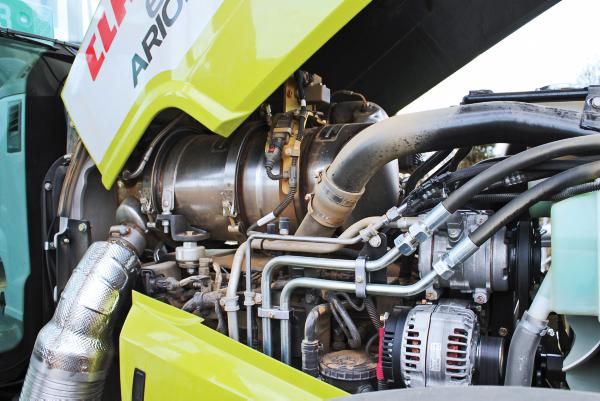
Under the new styled and sculpted bonnet is a Tier4I (Interim) DPS engine, which is fitted with a Diesel Particulate Filter (DPF) and combines EGR with variable geometry turbocharger to control exhaust emissions. Claas feels that this non-AdBlue approach is the appropriate solution for this class and size of tractor.
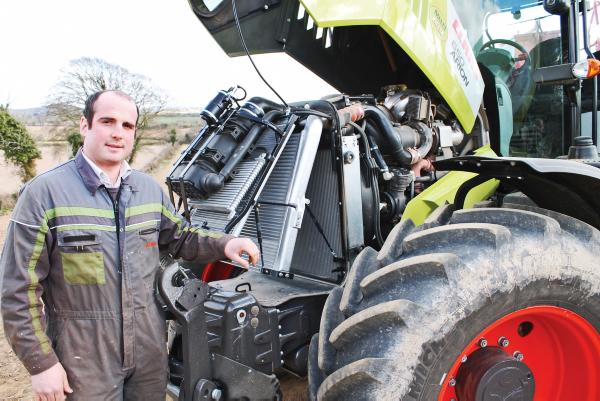
With the bonnet lifted, Kelly’s of Borris salesman and demonstrator Johnny Leech points out that the Deere Power Systems (DPS) engine is controlled by an engine management system developed in-house by CPS-Claas Power Systems. There is no power-boost facility; all of the power developed by the engine is available all of the time.
Claas adopts a different cooling system to Deere with an electronically controlled Visctronic fan, providing the airflow for cooling through a Claas developed accessible cooling package.
Our tractor was equipped with front linkage and a Carraro suspended front axle which works harder to provide a softer suspension than the older versions according to Johnny. Engine side rails make it very easy to retrofit a loader.
Claas has retained the firm’s power-shuttle, 24x24, HEXASHIFT transmission which features six powershift and four ranges in the tractors. There is a new heavy duty rear axle from the 540 up that enables 710/60 R38 rear tyres to be fitted.
Lift capacity has been increased to eight tonnes on the Arion 640 and 650, while the smaller 530 and 630 have a lift capacity of 6.9 tonnes. All models are now fitted with 110-litre/minute load sensing hydraulic system. There is now front axle braking on 50kph models.
Cab
The new cab gets five pillars and a smaller left-hand door. The smaller door is a practical consideration to allow easier access in a restricted environment, such as a feed passage in a shed.
The right hand door is also fully functional though. Inside, there are lots of changes — some small, some big.
Plastic mouldings are now produced differently and visibility is enhanced with a full glass windscreen from roof to floor and the new sculpted bonnet. Up into the cab, access is good through the wide left hand door which swings on the cabs only B-pillar. Not being the full side of the cab makes it easier to handle and the window behind it opens for some worldwide ventilation. The right hand door is a full door should it ever be needed.
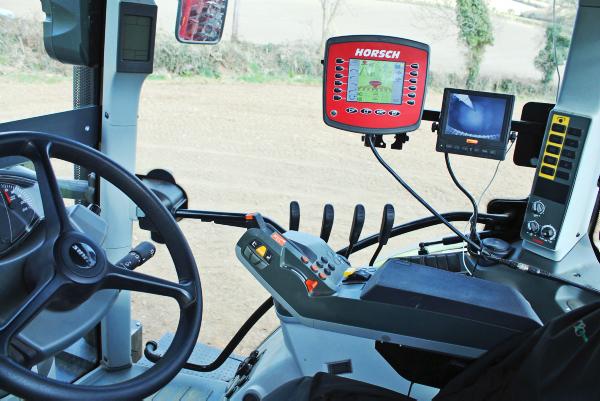
Our tractor is the CIS spec version so has the standard version of armrest controller which is relatively uncluttered. It incorporates most of the functions you would expect it to; transmission control, lift control, throttle, pto and more, but not four wheel drive and diff-lock.
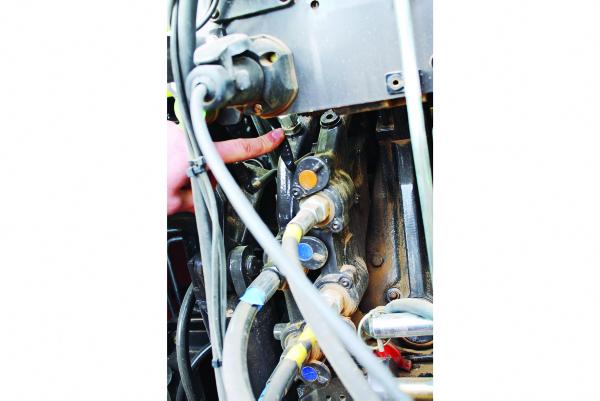
The latter two are on the right-hand console. In front of them are the four spool valve levers, within easy reach and incorporating twist type locks to lock levers in or out of position. All four levers/services were occupied by the Horsch drill, including the first one for operating the hydraulically-driven fan on the drill.
The little transmission control pedestal or pillar switch is at the head of the armrest controller. This allows the driver to make both powershift and range changes.
A little ‘tap’ forwards or backwards changes powershift speeds or a full shove changes ranges. A Dromone hitch is also standard; we didn’t get to use it in this test.
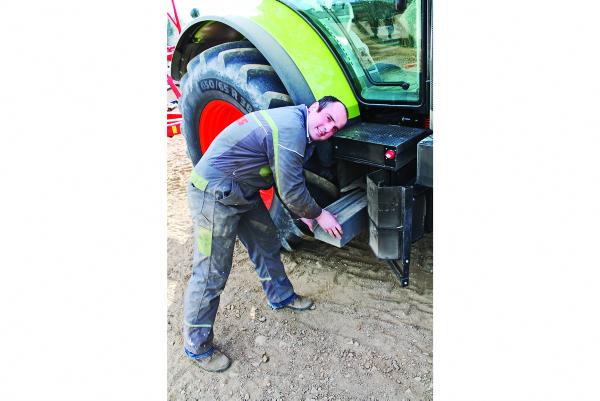
The Arion has some nice little features throughout. This included a spool valve ‘unloading’ lever on each valve to make it easier to plug in and out hydraulic pipes, a cool box under the passenger seat and my favourite, a place for a Claas tool box on the right hand side.
Pronto 4DC grain and fertilizer drill
Horsch importers Kelly’s of Borris claim that there is a trend back towards seed and fertilizer drills. They report that these combined drills now account for the larger proportion of drill sales.
Johnny Leech runs through the features of the Horsch drill before we do some sowing ourselves. The Horsch Pronto series is available is different configurations largely for different markets.
For Ireland, Johnny explains: “The standard configuration Pronto drill we bring includes track eradicators and pre-emergence markers on the back. Options include a levelling bar in the middle (approximately €5,000, plus VAT) which sells well in Ireland, especially for contractors. It does nice work and finishes off the ground nicely,” he says.
From front to back, two track eradicators per wheel are followed by two rows of discs whose depth can be changed hydraulically from the cab.
Discs are very curved but enter the ground straight, says Johnny, and by the time the clay leaves the disc it is roughly sitting at the angle of a plough.
The second set of discs throws the clay back the other way to mix the soil well. Each one of the discs has a sealed hub to keep lubrication in and clay out, pretty much a lifetime solution, according to Johnny.
The levelling bar is next. This is also hydraulically adjustable from cab and followed by a row of press wheels, each 7.50 x 16 in size.
Johnny says: “The machine is easy to pull because there is good clearance between the press wheel tyres. This allows the clay to get away rather than making a bow wave in front of a big wide wheel which the machine has to push to one side or climb over.
“The wheels are self-cleaning. Conditions have to be very poor before clay will build up on the wheels, and if it gets to that stage then it’s time to stop anyway,” says Johnny.
There are two seed coulters behind each press wheel and the coulters are always sowing in consolidated ground, according to Johnny. The small press wheel on the back helps control the depth of the sowing coulters, while the actual depth of the machine is controlled by spacer-stops on the hydraulic ram raising it in and out of work.
Coulters are twin disc units. “They are both the same size, so you don’t have one wearing out before the other,” says Johnny.
A little plastic finger called a uniformer runs after seed placement, smooths and presses the seed into the furrow created by the discs before the coulters press wheels closes up the furrow and the levelling harrow fingers level out the ground.
According to Johnny, the Horsch Pronto will work equally well on eco-tilled or ploughed ground.
The Horsch Pronto 4DC has a 3,800-litre hopper split 40/60, according to Johnny. “In real terms, that equates to about one tonne of wheat seed and a handy two tonnes of fertilizer. If it’s barley, about 800kg to 850kg loaded up the drill will sow about 12 to 13 acres on a fill,” claims Johnny.
The demo drill was fitted with the optional seed flow sensors, costing just under €3,000, plus VAT. An infrared light detects the seed passing by on each outlet. If a blockage occurs on a pipe, then that the operator is informed. All of the pipes are numbered, so you just walk to the back of the machine and deal with that blocked one.
“We recommend them on a seed and fertilizer drill,” states Johnny, adding: “Because it gives peace of mind with different fertilizer qualities. We’re supplying them now on seed only drills as well.”
Drilling with Horsch Pronto & Claas Arion 650
During seed loading, we found that even with the drill lowered to the ground, the hopper is very high and a very big stretch for any tractor and loader. A D-shackle through the end of the pallet forks was the only way we could safely load the unit, plus the sides had to be folded up so the tractor could get close enough.
The hoppers are pressurised to ensure even seed flow, so care has to be taken not to damage the lids when loading.
Johnny calibrated the drill for the variety of barley we were sowing. This was done quickly and easily, and well worth the effort.
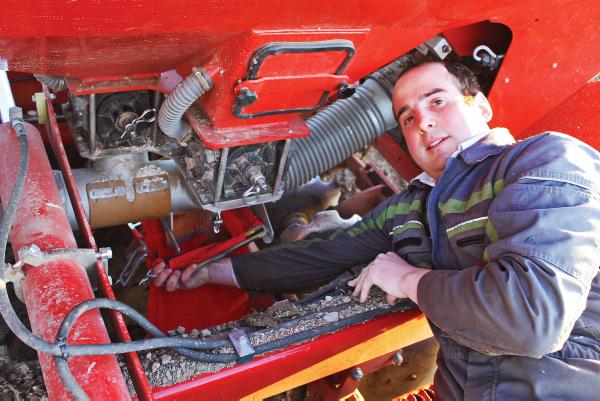
Access to metering wheels is very easy for inspection or changing, literally by removing an R-clip. Kelly’s added a camera (€400, plus VAT) in both the seed and fertilizer hopper, which is a great idea to monitor usage.
Johnny then ran through the drills control box functions. Horsch uses a Muller control unit.
It took me a little time to get my head around all the functions but I got in on it after Johnny left. I just had to. It was relatively easy to use with three main screens and rows of buttons either side to operate various functions indicated in smaller boxes on the main screen.
For drilling one hydraulic lever raised and lowered the drill in and out, operating on the press wheels. The drill is a trailed machine where the drawbar is carried on the tractor’s three-point linkage. This provides the necessary weight transfer for traction. Two pointers on the drill indicate the depth of both the discs and levelling paddles.
Into work and we started sowing on the hilly side of the field. With a full hopper and steep hill, the Arion performed well.
There were no weights or weight block on the front but traction and control was excellent. Turning on the side of the brow was no problem either but it can be a bit hair-raising for the driver.
The lower half of this field is marly soil and had been rolled/pressed twice to try and break up the lumps. The discs, paddles and press wheels left a very nice finish across all soil types in the field. Only time would tell how the crop would perform though.
Pulling through tough spots and up hills really tested the Arion’s mettle. With six powershift speeds on tap, no range changes were needed even when the going got tough in either wet spots up the steep hills.
You do have to be gentle when changing power-shifts speed or you end up pushing the lever too far and changing a range. And that does not work with a soil engaging implement, requiring reversing and restarting to iron out any misses while also not forgetting to re-set the tramline count. Only did it twice overall.
Manoeuvring on headlands was no problem. The steering lock and turning circle was good (5.6m) despite the tractor’s long wheelbase (2.82m).
Front suspension was provided by a Carraro axle which you could really see working, even in the field. Michelin tyres were fitted all round, 650/65R38s on the rear and 540/65R28s on the front.
For the operator, the cab environment is excellent. It is well laid out and super comfortable with four-point cab suspension, visibility good and almost enough pockets. Claas has excelled here; the cab is well thought out and put together.
During our test, we sowed around 30 acres and used a little over a gallon per acre drilling. The only problem was actually sourcing low sulphur diesel which the DPF-equipped, DPS engine needed. Despite legislation, it is most definitely not widely available yet.
DRILL FACTS
Horsch Pronto 4DC:
Working width: 4m
Transport width: 3m
Length: 6.9m
Weight: 5.45 tonnes
Filling height: 2.9m
Number of coulters: 28
Seed flow sensor option: Yes
Hydraulic spools required: Four
Hopper capacity: 3,800 litres 60/40 of fert/seed.
Price: €78,000, plus VAT.
TRACTOR FACTS — ARION 650
Engine: DPS-Deere Power Systems Tier4I, 6.8 litre six-cylinder with four-valve technology, common rail fuel injection and Diesel Particulate Filter.
Power: 175hp at rated speed of 2,200rpm, max 184 at 2,000rpm.
Transmission: Power-shuttle, 24x24, HEXASHIFT (six powershift speeds through four-ranges)
Hydraulics: 110 litres/min load sensing. Pre-plumbed for power-beyond hydraulic operation of implements.
Lift capacity: Eight tonnes rear and four tonnes front.
Comfort suspension on all four corners and options of Grammer or Sears seats.
Specification: CIS spec with mechanical spool valves.
Spool valves: Four rear and two front.
Hitch: Dromone.
Wheels: 650/65R38s on the rear and 540/65R28s on the front.
GPS/ISOBUS: Numerous monitoring/GPS options, including auto headland turning, CAM Pilot camera-based, auto-steering system and much more.
Wheelbase: 2.82m
Turning radius: 5.6m.
Weight: 6.82 tonnes.
Price: €90,000, plus VAT.
Thanks to Johnny Leech and Kelly’s of Borris for the use of both tractor and drill for this Irish Farmers Journal test report.


SHARING OPTIONS