



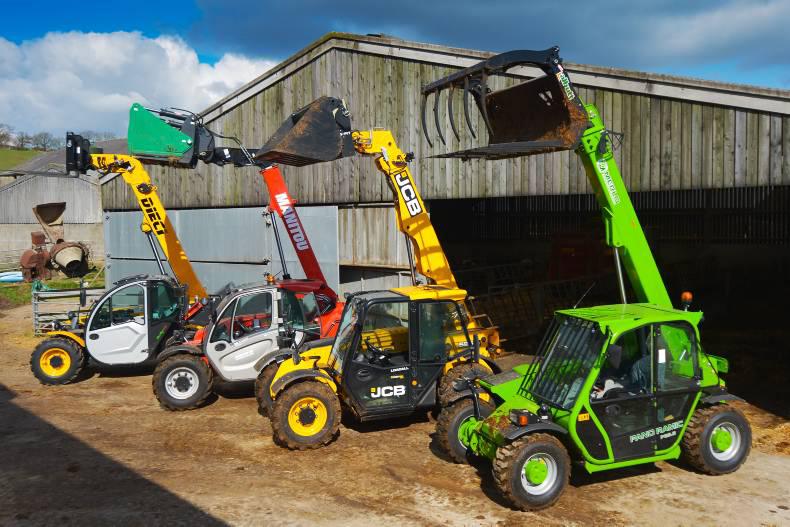
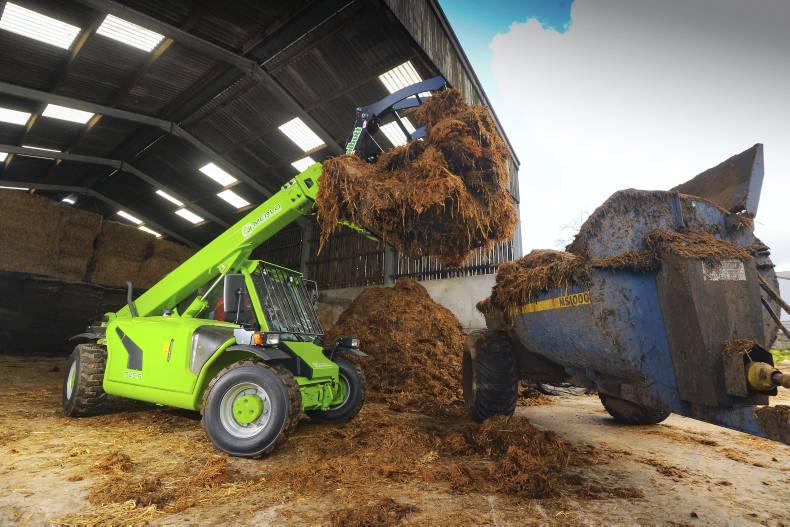
In total, four compact telehandlers were tested, with the aim of assessing what they had to offer for farmers. Their performance while completing a variety of agricultural jobs was assessed.
Tasks included cleaning out sheds, handling bales, using a shear grab and lifting bags of fertiliser. Compact telehandlers were kindly supplied by Manitou, JCB, Merlo and Dieci, so there was one French, one British and two Italian machines in the lineup. The model numbers were Manitou MLT625-75H, Merlo P25.6, Dieci Mini Agri 25.6 and JCB 525-60 Agri.
1) Manitou MLT625-75H
Background
Manitou has been manufacturing the MLT625-75H for around three years. The model on test is the latest generation machine. Manitou says it is a very popular product in the construction sector and one of Manitou UK’s best sellers.
Cab and controls
There are two base specification levels of the 625; Classic and Premium with air-conditioning, air seat and an easy connect system being the main differences between them. The cab trim is also different. One or all of the Premium options can be specified on the Classic variant.
The MLT625-75H was perhaps the most like its larger siblings of the machines on test, with the appearance that it had been shrunk to its compact dimensions.
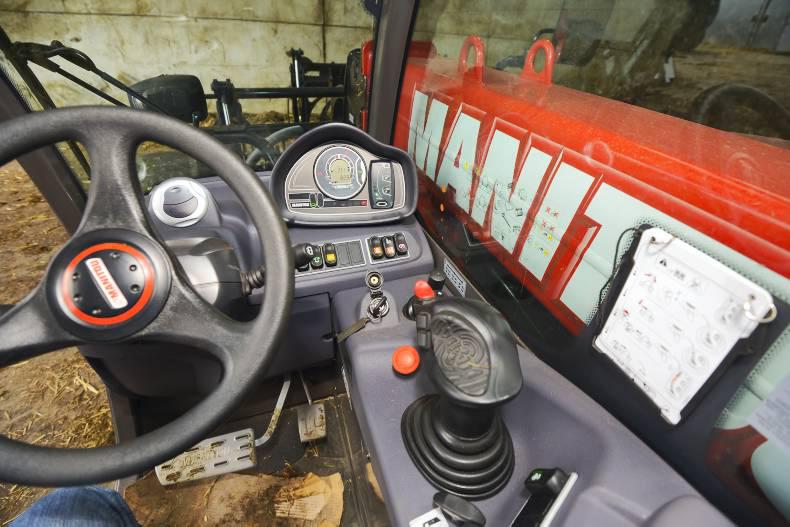
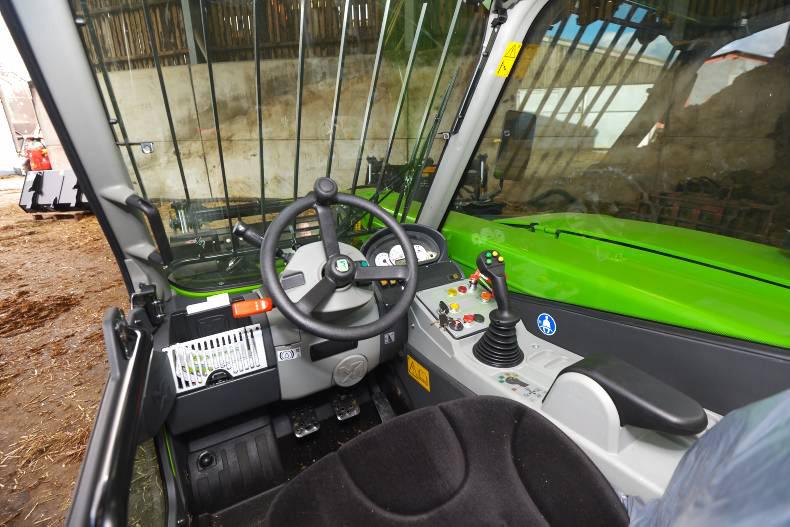
Inside the cab, design is very sleek and modern with digital display and Manitou’s Joystick Switch & Move (JSM) dominates the cab landscape. The JSM is perhaps the heart of any Manitou loader.
The design allows the operator to perform front/rear shuttle function with one finger, while operating boom in/out or third-service function with the thumb. There are others on the market that group the shuttle function with the hydraulic controls. With one finger, the operator cannot shuttle and operate boom function at the same time.
Visibility out of the cab and around the machine is generally good. Views to the right rear quarter are hampered slightly by the boom but not as drastically as with the Dieci.
Its cab is the narrowest out of the four, which is most apparent around the shoulders and elbows area, but it still offers a relatively comfortable driving position.
Powertrain
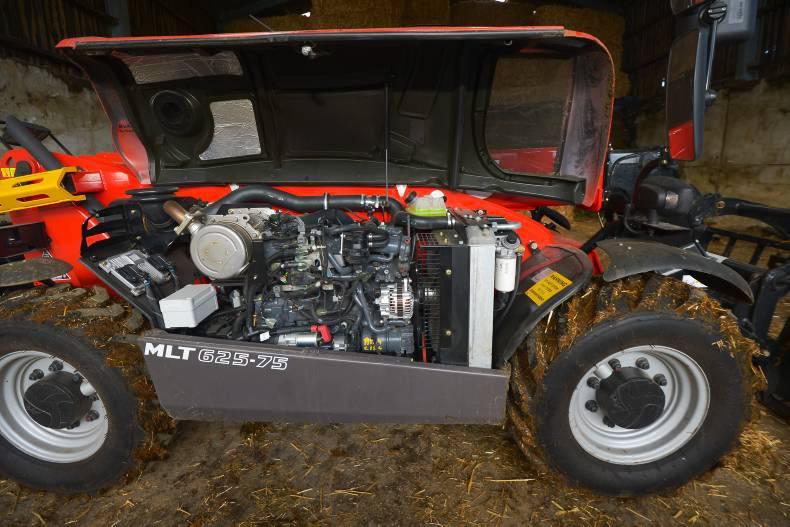
Under the hood is a four-cylinder, Stage 3B/Tier IV final Kubota engine which develops 75hp. To meet emission regulations, it incorporates cooled exhaust gas recirculation (EGR) and a diesel particulate filter (DPF) unit.
Manitou manages to squeeze the engine, hydro-drive, large radiators and DPF unit under the hood.
Cooling air comes in the front top and is expelled through the back of the engine compartment above the rear right-hand wheel.
The cooling fan is hydraulically driven and, in dusty or trashy conditions, the fan can be reversed to clear the radiator’s induction grills. When the reverse function is activated, it runs for 15 seconds every three minutes to keep the induction grills clear. The hydraulic pump supplying the fan motor is driven off the engine’s fan belt. The engine hood is sculpted to help provide the operator with a view of the right side and wheels. A cyclonic air pre-filter is mounted on the rear of the engine hood to catch larger dirt particles before they get to the air filter. This is helpful in very dusty conditions.
The MLT625 features a hydrostatic transmission, which the manufacturer says allows it to keep the engine and driveline very compact. The engine compartment does not look cluttered considering what is hiding in there.
The transmission is a single-stage hydrostatic unit with two virtual speeds. These have respective maximum speeds of 12.5km/h and 30km/h. There is the option of an ECO 25km/h transmission. The advantage of a single-stage hydro, according to Manitou, is that it can keep the same amount of torque in both ranges.
It has a refined transmission too. It is responsive and controllable and its shuttle is snappy without being neck-braking.
For certain applications, low range could do with being a bit faster, rather than having to use high range. Perhaps three ranges might be an idea – a 16km/h middle range would be welcome.
Like the JCB, the 625’s braking pedal incorporates an inching function, useful for more precise movements. It also helps when decelerating because it tells the transmission to back off, giving some engine-braking.
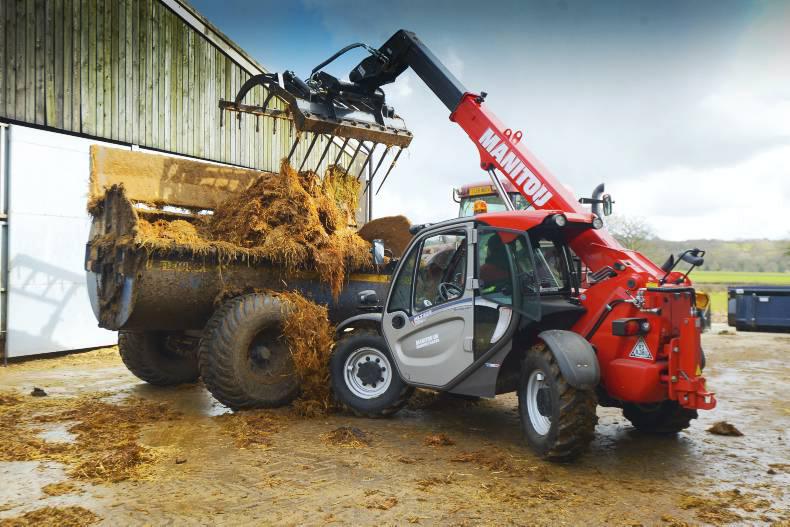
Building on its electric park brake is an automatic function, which applies the brake every time the machine is put into neutral. It is a nice feature and one which can help with certain loader applications such as filling a muck spreader.
The MLT625 is a two-pedal machine, one for the accelerator and the larger one incorporating both braking and inching functions. Brakes are fitted on the front-axle only, but a permanent connection between axles effectively gives four-wheel braking.
Hydraulics and handling
Supplying oil for all boom and steering functions on the Manitou MLT625-75H is an 87-litre/minute gear pump. With a generous flow, boom function is fairly swift. However, while your fingers might be able to carry out multiple tasks via the JSM, don’t always expect the machine’s hydraulic performance to keep up.
Adding functionality to the 625 is the ability to alter oil flow of the third service, which can be done through the dash. Also, if the constant flow option is specified, four preset flows can be set for different attachments.
Complementing the 625’s decent hydraulic performance is good manoeuvrability. Yes, that might sacrifice a bit of stability, but it was able to run rings around the JCB and Dieci, particularly in some of the tighter buildings.
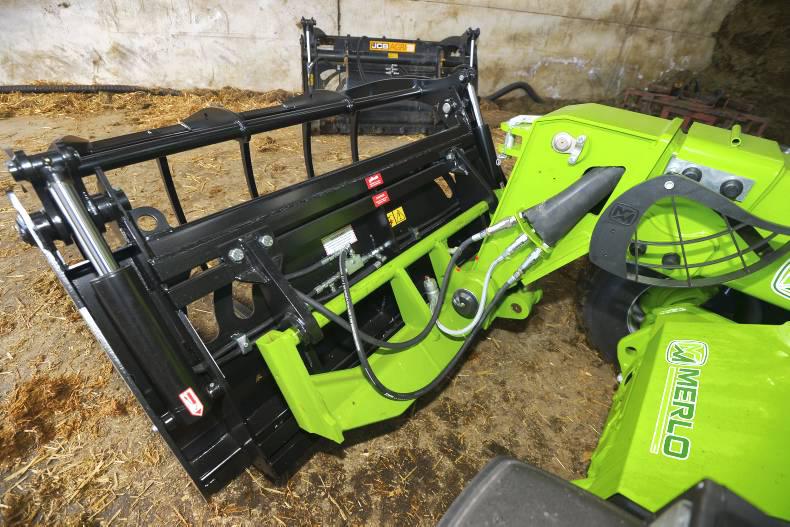
Up front at the implement end is a standard Manitou headstock. This is useful if the machine is replacing an older Manitou or if there is a second Manitou on the farm.
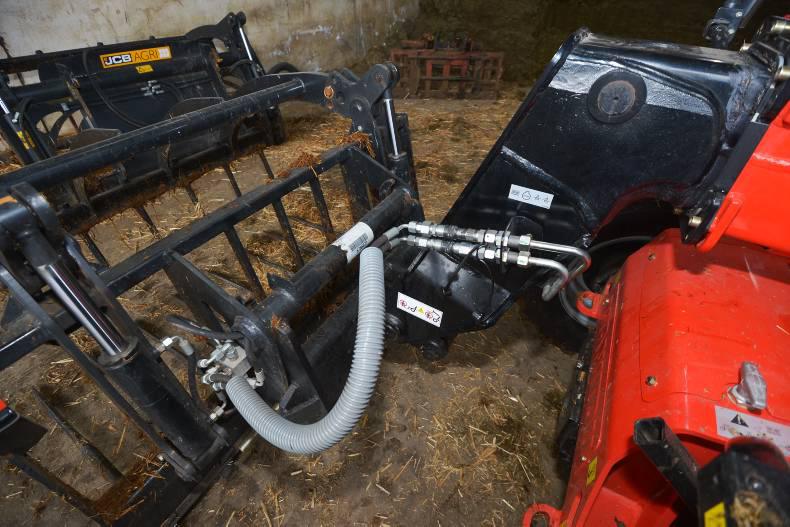
Manitou incorporates an hydraulic pump function under the left-hand headlight. This is called the easy connect system (ECS) and it unloads the third service hydraulic quick couplers to allow hydraulic pipes to be easily connected or disconnected.
On the boom, there are replaceable wear pads and a brush to keep dirt out. For safe boom operation, there are three modes; handling, bucket and suspended load.
Handling mode is the MLT625’s default mode and if the safe handling limit is exceeded, the telehandler’s controls system will cut all functions to the boom except boom raise and retract. The raise and retract functions move the load being carried closer to the machine, bringing it back within safe operating limits.
In bucket mode, the telehandler’s control system will allow the operator to tip the load in addition to raise and boom retraction.
Suspended mode is the same as bucket mode, but the limit is reduced to 90% of the bucket mode’s limit to allow for some swinging/movement of the suspended item.
Comfort ride control and boom suspension is available as an option, but was not fitted to our test machine.
The test machine was fitted with the optional pickup hitch.
This is available as a factory option only and not as a dealer retro-fit option.
The Manitou MLT625-75H is clearly a well planned and designed machine. Practical and modern, its design is very smart. Despite its compact stature, it brings with it many features found on its larger siblings. It also appears well engineered.
We liked its auto-handbrake function which automatically holds the MLT625 with the foot lifted off the throttle and allows the driver to operate boom functions in comfort.
Manitou’s JSM is perhaps the best in the industry. Our test machine also featured the firm’s ECS to aid easy attachment or the release of implement hydraulic pipes.
The cab was the narrowest on test but even these large testers couldn’t complain.
The transmission and its control was excellent, but we felt the low gear’s top speed should be set higher. On our hill climb test, it performed well, second only to the Merlo.
Visibility is not as good to the blind side as on the JCB or Merlo, but criticisms are few, so you can almost forgive that. Steering puts up a bit of a fight and could do with being lighter.
2) Merlo P25.6
Background
From Italy, Merlo’s P25.6 has been on the market in the UK and Ireland for over four years. Our test machine features the firm’s old-style cab, but the manufacturers say it is soon to be refreshed.
The P25.6 is the smallest telehandler available in two build variants. With compact dimensions, the standard P25.6 has a width of 1.8 metres and a height of 1.92 metres. The ‘‘L’’ version of the Merlo P25.6 is the same width as the standard P25.6. It is considerably lower though at 1.77 metres in height.
Cab and controls
Without even having to get the measuring tape out, it is clear that the Merlo P25.6 had the widest cab of all the compact telehandlers we tested. However, while it has a wide cab, head room is not the greatest and the driving position is not as natural as the other machines.
Visibility-wise, the P25.6 scores very highly, certainly living up to its ‘‘panoramic’’ name. Over on the right rear-quarter of the machine, the boom is kept very low, which helps you to see clearly what is going on. It features little or no electrics other than the power shuttle lever and control. There is also the option of two proportional roller controls on the joystick, but that is it.
The cab layout is also clear and simple. A bright instrument cluster incorporates four analogue gauges, a digital display and warning lights. There are a few switches under this for lights and other features, as well a boom control panel.
The Merlo has some decent storage space to the left of the steering wheel for the tools of the trade. Overall, the cab was sparsely populated but practical.
Powertrain
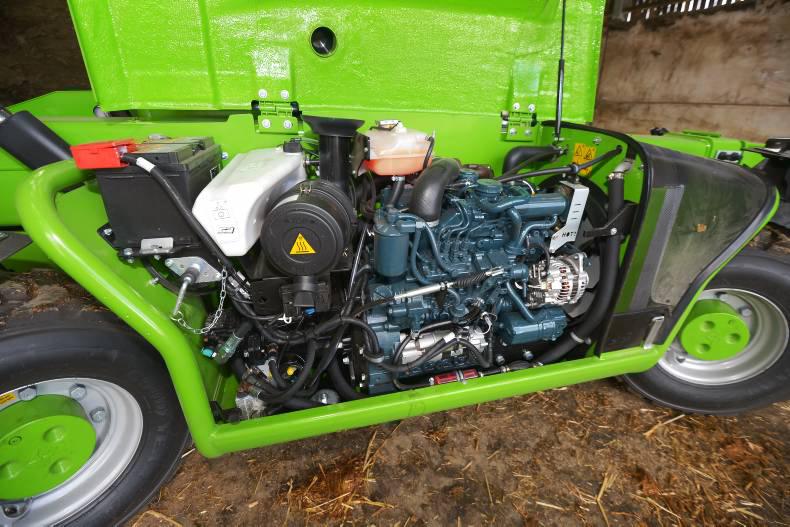
The P25.6 on test featured a 75hp, Tier3a-compliant, Kubota engine with cooled EGR. The cooling fan is driven directly off the front of the engine and radiators are in the traditional vertical configuration. Hot air is exhausted out through the rear corner of the engine cover and below the engine.
The transmission features the same pump and motor which Merlo has used since the mid-90s. Merlo says: “It’s robust and works without the worry of electrics.” Recent upgrades to the motor now afford faster transport speeds and more grunt. It comprises a single-stage hydrostatic pump with the driving motor fitted on the rear axle. There are no ranges to select like the JCB and Manitou – just rev and go. However, it requires a few revs to get going – about 1,200rpm – but the payoff is accurate control of speed and good engine braking.
A propshaft connects the rear and front axles, both of which are manufactured by Merlo. The top speed is 40km/h, so it is the faster of the compact machines tested.
The hydraulic pump for boom and steering function piggybacks on the P25.6’s transmission hydraulic pump. On earlier versions, this pump was mounted directly on the side of the engine.
The oil for the transmission’s hydraulic system and the boom/steering hydraulic systems are separate. There are separate tanks for both systems. Merlo says it reduces the risk of contaminating the sensitive hydro-drive with dirt from third-service connection or implements. Both systems use the same specification hydraulic oil, HV46. Both axles are brakes with two external discs each, operating on all four half-shafts. These are protected with covers, but the brake pads are easy to inspect.
There is no limited slip diff. Instead, Merlo has opted for locking diffs on both axles. These are foot-operated by a floor-mounted button. Both diffs lock simultaneously and will only lock below 10km/h. Above 10km/h, they will auto-disengage. There are three usual steering modes of front-axle, all-wheel steer and crab steer. To equalise wheels in four-wheel steering mode, a poppet valve on the steering ram allows wheels to equalise by steering lock to lock. Merlo says this can be useful to offset its wheels on purpose to clean beside walls while keeping the body of the telehandler away from the wall.
The P25.6 has a seat safety switch. The telehandler will not drive if there is no one parked in the seat.
Hydraulics and handling
Hydraulic oil for the boom-and-steering function is supplied by an 80-litre/min gear pump. Implements can be driven off the telehandlers third service but there is no option to vary the oil flow rate. A fourth hydraulic service can be added up front with an electro-hydraulic diverter.
In keeping with the machine’s simple design philosophy, the joystick is connected directly to the loader’s valve chest. As a result, you get a cracking feel of hydraulics and the ability to give attachments a proper shake. While it does not have the highest hydraulic flow rate in the group, hydraulic performance is certainly no slouch.
For safety, and to comply with the EN15000 technical standard, the P25.6 has a boom overload system. The boom control system is key-operated with a safe position, boom isolation position (no function) and a spring-loaded override position.
If overloaded to the point of losing function, the control system allows the boom only to be retracted in safe mode. Once within safe operating parameters, all boom functions return.
A dig function allows the telehandler to flex its muscles with the boom fully retracted, without cutting out boom function. Unfortunately, boom suspension is not currently an option on the P25.6. There is also a consent switch incorporated into the P25.6’s joystick. This is required as part of the current safety legislation in relation to telehandler use – to protect against involuntary movement. The headstock frame is Merlo’s own with a spring-loaded central locking pin to lock the attachment safely in place. Only a Merlo frame is available.
To operate a third hydraulic service, the pipe for the headstock quick-attach system has to be disconnected to allow a double-acting service to be connected to the loader. Merlo says, from a safety perspective, it prefers customers to remove this pipe and put it in the storage position.
Equipped with the smallest wheels in the group (16.5in), the P25.6 has the agility and get up and go of a cheetah. No wonder it is the poultry farmer’s favourite.
It is a little dated and industrial-looking, but as a predominantly mechanical telehandler with great visibility, it will be attractive to many customers. The all-mechanical Merlo had the largest cab of all the compact telehandlers on test. Its boom sits down the lowest and visibility is excellent for a side-boom machine. It is the best of the bunch in that regard.
The boom control joystick is directly connected to the valve chest, but it is still light to operate.
One advantage of this setup is that you can rattle the bucket or fork if you need to. Faster boom hydraulics would be nice though.
The transmission is almost fully mechanical and one of the simplest to operate with a good amount of driveability, although it needs a few revs to make it work.
Boom suspension is not an option at the moment. This will be a big disappointment for Irish customers – 40km/h on our roads without boom suspension is not a good idea.


SHARING OPTIONS