


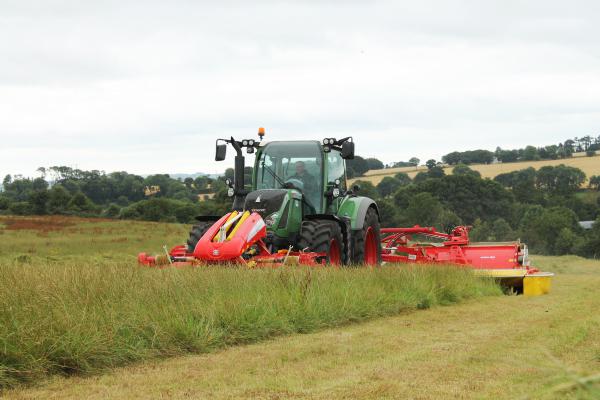
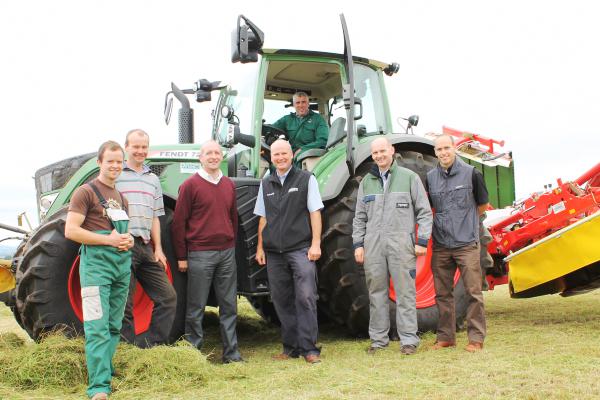
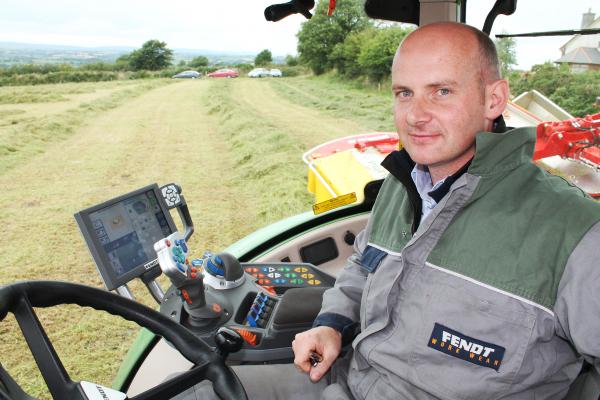
Earlier this year, we explored the combined potential of a Fendt 724 tractor driving a Pottinger 8.3-metre butterfly mower. Operating through Fendt dealers Atkins of Cork and organised by Sean Gorman from Fendt, we spent some time with the new Fendt 724 and Pottinger mower just outside of Cork.
Fendt 724 Vario
The Fendt 724 Vario is a middle-weight tractor with a six-cylinder Deutz engine developing a maximum 240hp while rated power is quoted at 220hp. It has an unladen weight of 7.9 tonnes and is the smallest of the Fendts available in this power category.
In the 724 is a 6.056-litre unit with four valves per cylinder, common-rail fuel injection and utilises selective catalytic reduction (AdBlue) to comply with Stage 3b (Tier 4 interim) exhaust emission regulations.
It is quite a compact tractor with a wheelbase of 2,783mm and the manufacturer quotes a minimum turning circle of 5.5 metres on 540/65-R30 front tyres. The test tractor was equipped with Trelleborg’s all-round 650/65-R42 on the rear. The front axle features suspension as does the cab with two airbags at the rear.
In the looks department, the 700 series features the firm’s new VisioPlus. The high visibility VisioPlus design is useful with a loader. While practical, this cab is a bit like Marmite; you either love it or hate it.
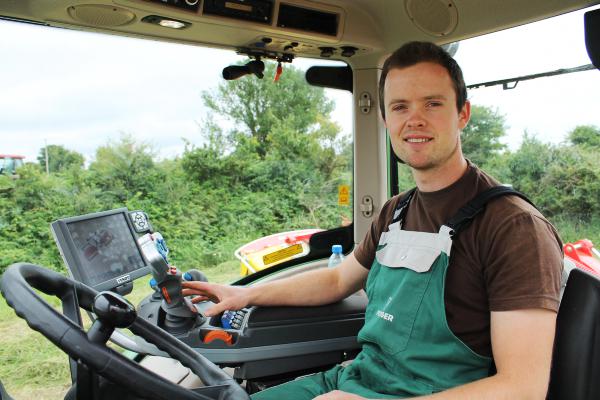
It is practical with its five-pillar design. The extra pillar is on the left-hand door, making it easier to handle. The right-hand side is completely clear of pillars except at the corners. To keep the operator cool, air conditioning is standard and full climate control is optional.
Our tractor was equipped with VarioGuide GPS steering system which was set up to use the standard Egnos signal at 25cm accuracy, just fine for mowing. Anyone using GPS for tillage operations will opt for higher accuracy.
Our tractor also had VarioActive steering which amplified the movement of the steering wheel by three times, potentially speeding up headland manoeuvres.
That is, one turn of the wheel in this mode is equal to three turns under normal circumstances. This effect is reduced above 10km/h before it is completely cancelled out by the time the tractor reaches 20km/h.
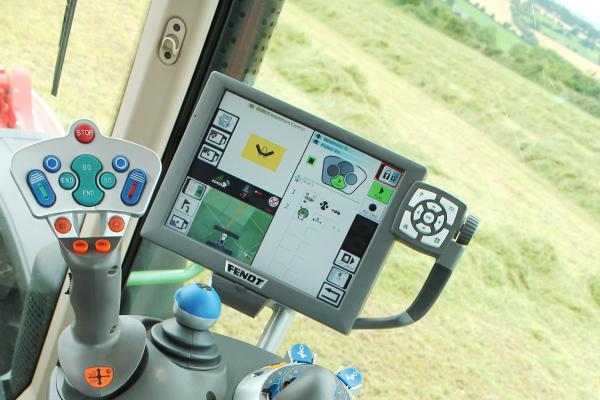
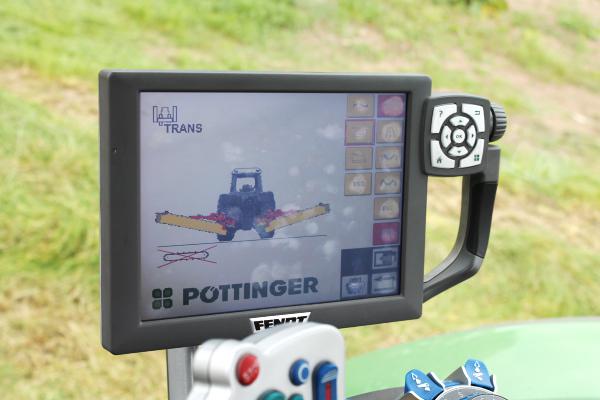
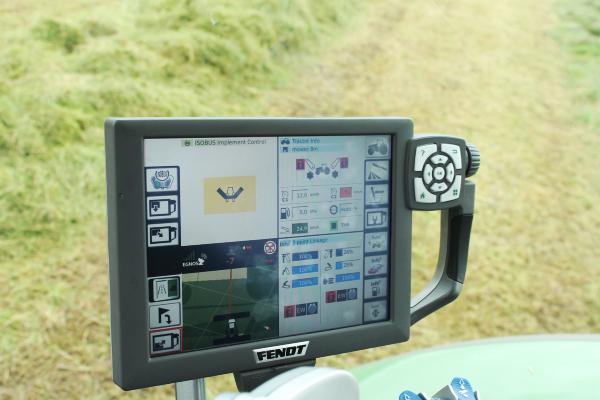
There are two control terminal options, a 7.4-inch or 10.4-inch Varioterminal; our tractor had the larger version.
The screen could be configured in a variety of ways to display different information in quarter sections, half sections or full screen mode. Ours was set up to display the mower information in the top-left corner, GPS guidance in the bottom-left and tractor information to the right.
Setting up the guidance, mower and headland operations of the two rear mowers and one front-mounted mower could all be done on the Variotronic terminal either thought its touch screen facility or keypad and dial on the top-right of the terminal.
The buttons on the multi-function joystick are where it is all at. A large number of headland sequences can be programmed into the ‘go’ and ‘end’ buttons, such as raise lift, stop pto, hydraulic services and so on.
There are two basic ways to set up what is a very sophisticated headland management and driving system. In our case, the first was to set-up the mower control ‘offline’, essentially programming what you want to happen, going into work and then leaving work using the ‘go’ and ‘end’ buttons on the multi-function lever.
The rear butterfly units were being operated by the smaller buttons on the joystick. They could be fully integrated as well.
The second method of setting up a sequence of operation is to manually operate all functions on the first run and then save these operations to a sequence for operation by the ‘go’ and ‘end’ buttons. Either way, setting up is not for the faint-hearted but is well worth the effort when it is complete.
Anyone who has ever operated a front and rear mowing combination can testify that there is a lot going on.
With headland sequences incorporated into single buttons and VarioGuide steering the tractor, this frees up the operator to just monitor what was going on and what was ahead, very stress-free.
In operation, the Fendt 724 Vario had loads of power and no problem handling the Pöttinger combination. If anything, it was a bit light on the front end with the rear mowers raised and turning up a hill, but manageable.
Visibility was excellent from the VisioPlus cab and with help from the GPS steering system and integrated controls, there was time to appreciate it and look around.
List price of the Fendt 724 Vario was quoted at €216,334 plus VAT but does not include the front PTO or guidance system, both of which were retrofitted. These add €4,832 and €6,626, respectively, to the tractor’s price.
Pöttinger butterfly
Pöttinger’s triple mower, butterfly combination features a Pöttinger Novacat310ED Alpha Motion front mower while on the rear is the firm’s Novacat X8 ED Collector.
The mowing unit has a combined working width of 8.3 metres. V-tine conditioners are used on the front and rear mowing units while ‘collectors’, as Pottinger calls them, group the outside mowers crop onto the middle swath.
An interesting feature of this combination is that the ‘collectors’ can be removed relatively easily from the Novacat X8, according to the manufacturer, substantially reducing the combination’s overall weight.
Each ‘collector’ has its own independent hydraulic system and belt speeds can be varied independent of each other on the control terminal.
Up front, the Pöttinger Novacat310ED Alpha Motion mower has been designed to cope well with undulating ground.
It has substantial scope for vertical and lateral contouring, 250mm above or below the tractor’s wheel level (500mm in total) and a lateral movement of +/- 16°.
All with the aim or producing a contaminant-free swath. Suspension on the rear units in adjusted hydraulically again with the aim of contouring without skinning the ground.
ISOBUS control
While our experience was brief, this combination of Fendt 724 and Pöttinger mower demonstrated the real benefits of ISOBUS control, both tractor and machine functions in the one place, on the one screen and controlled by a single multi-function joystick.
It was easy to use, relatively speaking, once you got used to navigating the Fendt menu system. Sometimes ‘agricultural’ fingers struggle with touch screens so being able to navigate using buttons and dials is a plus for some.
It is clear, though, that all this technology is not for everyone. Understanding and setting up the Fendt controls are challenging enough and do take practice to understand and use correctly to maximise potential.
But, to get the best out of what would be a substantial investment, it is necessary to maximise the tractor and machine’s capabilities.
In this instance, at least, the Fendt multi-control joystick and its buttons’ programmability provided huge scope to maximise the potential of both tractor and machine.
Our tractor’s VarioGuide GPS steering system made the job a whole lot easier and also played a big part in maximising the combination’s potential while also significantly reducing the demands on the operator.
The VarioGuide GPS steering system freed up the operator to monitor the mowing ‘environment’ and take in some of the scenery in Cork!


SHARING OPTIONS