


If you break or lose a flail, the rotor goes out of balance. And you instantly know there is a problem because it sets up vibration in the rotor head. This is fixed by fitting a new flail or flail assembly, either individually or paired with a new one opposite to keep the rotor in balance.
Anything spinning at high speed needs to be balanced or will vibrate from mildly to violently, depending on how far out of balance it may be. This effect is similar to a car’s wheel being out of balance; it can cause quite a serious vibration at certain speeds on the road. With a car, speeding up or more sensibly, slowing down will cause this vibration to cease. It can be corrected when the car’s wheels are balanced.
A hedgecutter rotor is driven at a constant speed so if there is a vibration in the head it will not go away until the problem causing the vibration has been rectified. Even mild vibration can cause problems with loosening bolts on the hedgecutter head and boom. More serious vibration will literally shake the hedgecutter to pieces, wreck the hood and generally make it a dangerous machine to be around.
Sometimes the rotor may be knocked out for balance for other reasons. This could be because it had been bent or maybe a flail mounting lug has broken off. If you cannot get it right, then a new rotor could set you back more than €2,000.
Balance
There aren’t many people with the equipment or expertise capable of rectifying an out of balance rotor. One of the few is Nicholas Gainford, trading as Nicholas Gainford Ltd who runs his business from just outside of Killane, Enniscorthy, Co Wexford. Nicholas is heading for almost three decades of experience working on agricultural machinery, including hedgecutters.
In 2007, Nicholas bought a German-built Schenck balancing machine. This unit balanced rotors dynamically that is when running, but required the rotor to be completely stripped of flails to do so.
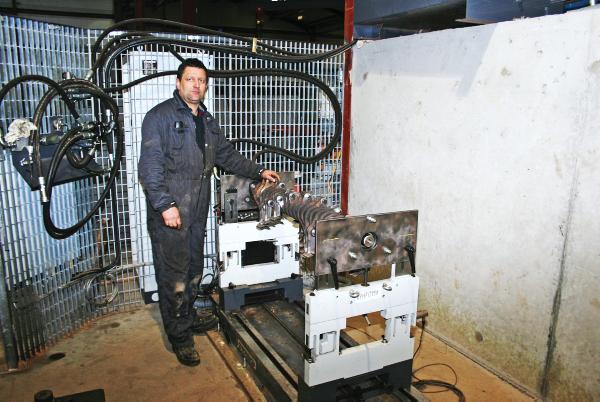
Though it worked well, Nicholas was not entirely satisfied with this arrangement because the dynamics of a rotor can change with all the flails bolted in place. So, in 2011, Nicholas decided to invest in another new Schenck balancing machine that was capable of balancing a rotor with its flails on and enabling balancing closer to working conditions.
Nicholas has invested around €100,000 in the new Schenck dynamic balancing machine. It can handle not just hedgecutter rotors but any type of rotor, drum, cylinder, conditioner, etc. up to 5m end to end, three tonnes weight and up to 1.6m in diameter.
Hedgecutter rotor balancing remains the core business though for the balancing machine, “At the moment, we have seven rotors on the ground to be done,” Nicholas added.
What’s involved in balancing a rotor with flails on?
Nicholas explained: “We can balance a rotor in working conditions with the flails on. Balancing this way allows for any twist, wear or misalignment in the rotor flail brackets. Balancing is done with a test set of flails which are all of the same type from the same manufacturer,” he added.
“The rotor has to be right first or balancing alone is not going to fix it,” according to Nicholas. The holes in the brackets for mounting the flails are checked. These holes are built up if needed and drilled out to the correct diameter. Damaged brackets are replaced with new ones made from mild steel or Hardox steel cut in-house on Nicholas’s ESAB plasma profiler.
The rotor is placed in a lathe and checked for alignment. “If it’s bent, we can straighten it though there are some you won’t get right no matter what,” said Nicholas.
The rotor is checked for cracks around the flail brackets. If cracks are found, the rotor is scrapped. The rotor is fitted with new bearings, a test set of flails and then installed in the balancer.
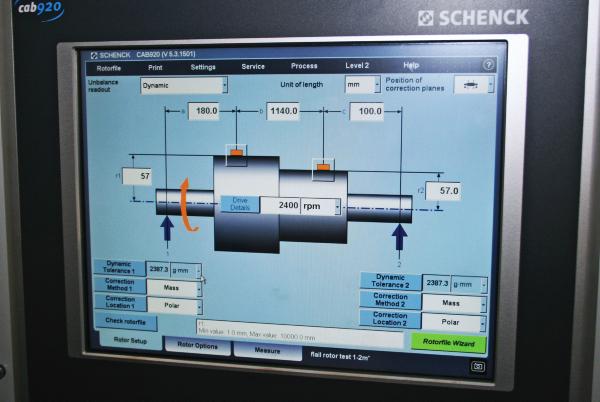
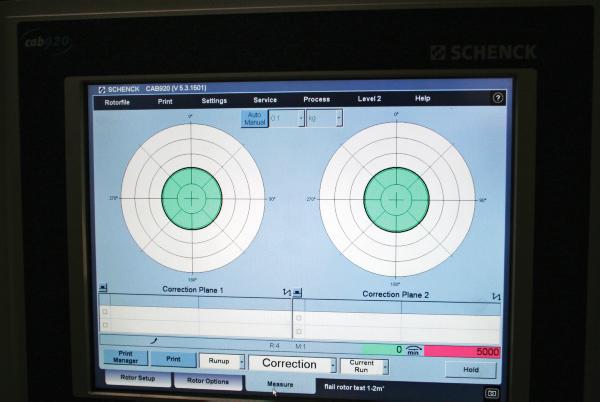
The rotor is initially run up at low speed and any major imbalance is corrected. Then it is run up to test speed and imbalance corrected by welding weight to the rotor at an angle and weight prescribed by Schenck balancing machine. “We balance a hedgecutter rotor at 2,500 rpm, we can go faster but there is no need to.
Balancing though is not altogether black and white,” as Nicholas added.
“You have to incorporate your own experience and judgment as well into the balancing process. Every rotor is different, what will cure one may not cure the other. We’re a long time at hedgecutters and we are still learning,” said Nicholas.
Once the rotor is balanced, it is then stripped. If the customer wants to refit the old flails, they can by matching old with old or new with new, opposite each other, advised Nicholas.


SHARING OPTIONS