


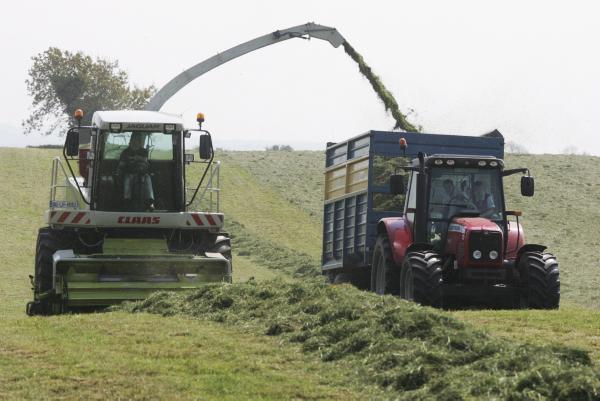
Silage harvesting is among the operations in farming with the highest energy requirement.
Diesel consumption at silage harvesting is high so fuel-saving strategies have to be fully exploited. The price of diesel cannot be influenced by the driver, but the level of consumption can be. At current prices, a savings potential of even 10% creates a significant reduction in the fuel bill.
Tractors
Make sure the tractor has sufficient power for the work being done, but over-sizing the tractor can bring significant running costs.
A power increase from 100hp to 136hp increases fuel consumption by 26.2% when loaded and by 19.8% when empty at the same 30km/h forward speed and at 1800 rpm engine speed (source AFPF). Aim to use an engine speed between 1700rpm and 1800rpm for most fuel efficiency.
Tyre choice has a greater impact on fuel efficiency than you would think. On the road, tractor tyres should be sufficiently inflated to limit sidewall deformation.
Trials have shown that when using a 100hp tractor and a 12t trailer on the road, a tyre pressure increase of 1.2 to 3 bars will reduce fuel consumption by 15%. On the other hand, driving on land, reducing the tyre pressure by 1.2 to 3 bars saves 16% in fuel usage. So while it is not practical to keep changing tractor tyre pressures, there is some scope to set the pressures daily depending on whether road or field work will dominate the day.
And lastly, turn the tractor engine off when not working. Idling accounts for 6% of fuel usage, which is equivalent to close to €200 per year.
Silage harvesters
To increase fuel efficiency, the driver must achieve high chopping throughputs by picking up wide/large grass swaths. The level of throughput influences fuel consumption by up to 20%.
If the harvester is picking up a single swath and not loaded near machine capacity it will not only take longer to harvest the crop but this approach also wastes fuel.
Reducing the forward speed of the harvester and tractors by 5km/h by having wider swaths can lower the overall fuel consumption of the harvester by up to 30%. Going from 30km/h to 40km/h with a 100hp tractor will increase average fuel consumption by 35.8% with a full load and by 16.5% when empty.
Length of chop
Increasing the length of cut reduces fuel consumption but must be weighed against the nutritional requirements of the animals and storage facility. If you have a choice, longer length cuts will save energy and money.
Knife sharpness
The driver’s main focus must be the efficiency of the harvester’s chopper unit. The operator determines fuel consumption by knife sharpness and shear-bar to knife clearance in the chopper area. Roughly 40% of the energy used by a harvester is consumed by the chopper, so dull knives and worn shear-bars can have a considerable effect on fuel consumption. Knives need to be sharpened several times each day.
Every driver has to develop their appropriate grinding strategy depending on the quality of their used knives and the operating conditions. This requires regular monitoring of the cutter-head. A look at the knives and a strip of the thumb on the blade can give conclusions to the sharpness of knives.
More cutting energy can be wasted with a large shear-bar to knife clearance than with dull knives. Sharp knives, and correct clearance from the shear-bar, reduce the energy needed to chop and help to produce good quality silage. You need to adjust the shear-bar clearance after at least every second sharpening.


SHARING OPTIONS