


JCB has just released three new wheeled loader models. These machines are primarily aimed at the larger agricultural user such as agri contractors or grain merchants and co-ops.
Having to comply with the latest emissions regulations, JCB took the opportunity to revamp various other aspects of their wheeled loader in order to increase performance, comfort, efficiency and reliability.
In 1968, JCB started to produce the hydraulic wheeled loading shovels after they purchased Lancashire’s Chaseside Engineering Company which was producing a wheeled loader at the time. This event marked the birth of the JCB wheeled loader range, which has since been sold in every corner of the globe in vast numbers.
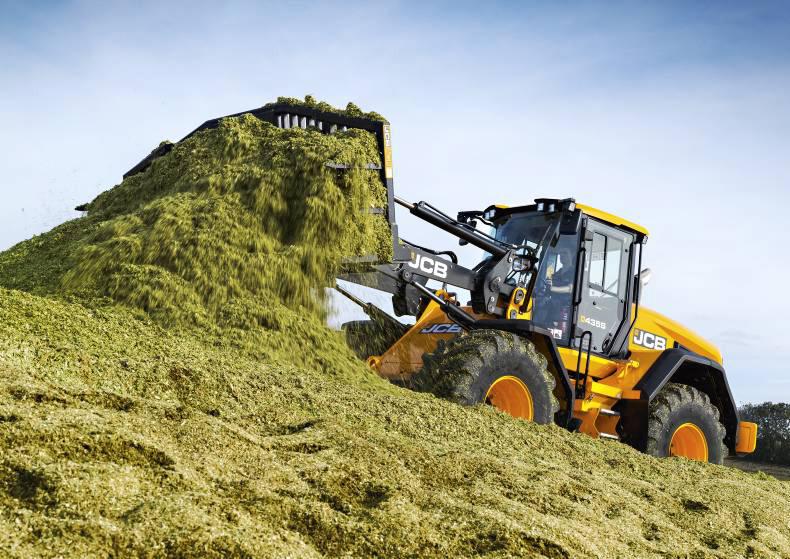
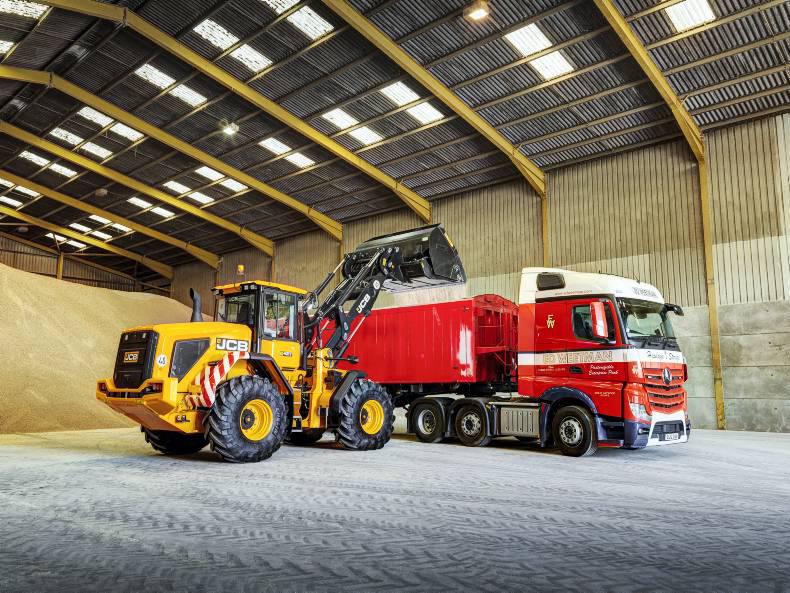
The latest wheeled loader models to be released at JCB HQ this year are the 427 Agri, 437 Agri and the flagship of the range, the 435S Agri. These three machines offer a host of new features in order to make them more comfortable for the operator while also increasing performance and efficiency. The 427 and 437 Agri are primarily designed for bulk handling in grain or fertiliser stores where as the high-performance 435S Agri is designed for heavy duty agri contracting work, earning it the affectionate title of “King of the Clamp” at JCB.
Engine
In order to comply with the latest Tier 4 Final emission regulations, the new models are fitted with the latest 6.7-litre Cummins QSB turbocharged diesel engines. The emissions requirements are met by incorporating the latest efficient selective catalytic reduction (SCR) system along with a diesel oxidation catalyst (DOC). Because particulates are dealt with through efficient combustion, there is no need for a costly DPF filter and its attendant burn-off or regeneration and servicing requirements.
Peak power outputs are up by 4% on the 427 Agri, producing 179hp at just 1,700rpm, while the 437 Agri produces 183hp at 2,000rpm. The increased performance is further complemented by increased torque, which is consistently above the previous engine’s torque curve and 5% higher at its 841Nm peak at 1,500rpm.
The 435S Agri, which represents high performance, retains its exceptional power-to-weight ratio producing 230hp.
Fuel tank capacities are increased on all models, with the 427 and 437 Agri increased 7% to 290 litres while the 435S Agri is now up to 400 litres which keeps downtime refuelling to a minimum. Access to the engine is achieved via a power-operated one-piece engine hood with a separate fuel and diesel engine fluid (DEF) access panel.
Transmission
As the 427 and 437 Agri are primarily designed for hard surface bulk handling, there are a number of transmission and axle configurations available to suit different applications, including a new six-speed powershift transmission for the 427 Agri as an alternative to the existing four-speed auto option. A torque converter lock-up ensures optimum power-efficiency when travelling between sites.
In operation, a new intelligent clutch cut-off (ICCO) feature responds to brake pedal pressure by progressively disconnecting the drive clutch. This avoids unnecessary brake wear and tear; this also allows the engine revs to be used to extract the optimum power and flow from the 264-litre/min twin piston pump hydraulics package fitted to the 427 and 437 Agri.
As standard, the 427 and 437 Agri come with open differential axles front and rear, although an auto-locking differential at the front or a limited slip differential at either end can be installed as an option for applications where traction may be an issue.
The 435S Agri has a six-speed ZF powershift transmission with torque lock-up in every gear which ensures optimum power efficiency when climbing the steepest silage pits. As with the 427 and 437, the 435S features the new ICCO feature and the 264-litre/min twin piston pump hydraulics package.
The 435S can be tailored to any application with various axle options. There are open differentials for hard ground, limited slip differentials for soft, muddy terrain, and open differentials with an automatic locking front axle diff for varied conditions.
JCB claims the 435S is proficient at towing and offers the option of a 15t Rockinger hitch.
Cab
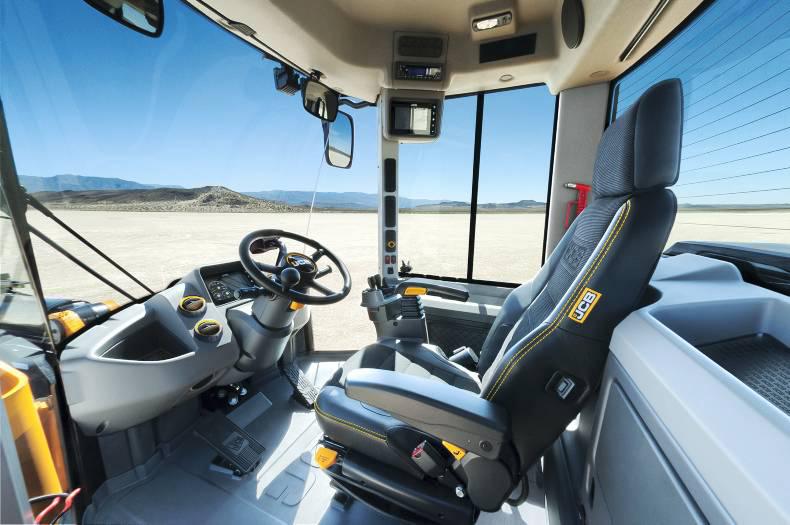
The most noticeable improvement with the new models is the new CommandPlus cab. This cab is more spacious and boasts improved visibility, reduced noise levels, improved ventilation with climate-controlled air conditioning, along with more storage compartments, making a great improvement on operator comfort.
Another new feature is the “set and forget” adjustable steering column that returns to the operator’s preferred position after being pushed forward in order to ease cab entry and exit. There is the option to fit a large electric cool box and even deep pile carpet to add to the ultimate in cab comfort.
Operators can choose from a one-piece handheld servo joystick or new fingertip electro-hydraulic multi-lever controls. Both options are now seat-mounted as standard.
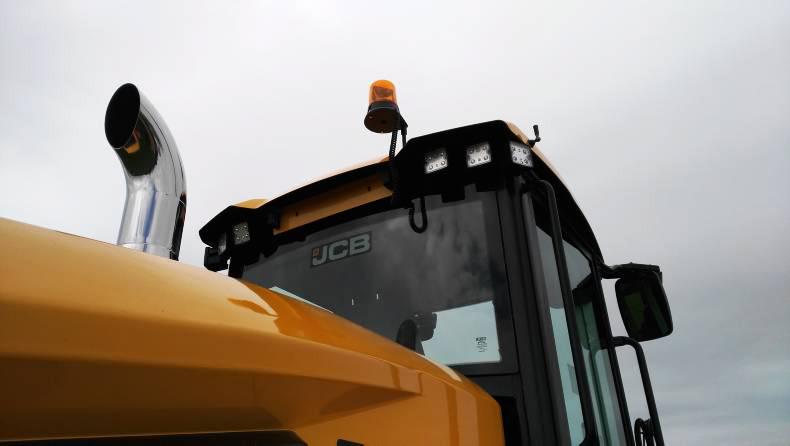
There are two equipment levels available to choose from. As standard, the cab is fitted with an adjustable steering column, air suspension seat, a single instrument display, windscreen roller blind, heated mirrors and a 12v power socket. The high-spec version has a deluxe heated air suspension seat with adjustable headrest which can be further upgraded to a half leather ventilated Super Deluxe seat with adjustable damping. There are also twin sun blinds and a USB multimedia connection in addition to a second power socket. Safety is improved when operating in the dark with new 360-degree LED lighting packages greatly improving visibility.
Operators are kept better informed by new instruments in the cab. An LCD display provides routine vehicle information, help menus, reversing camera display and daily service checks such as engine oil and diesel engine fluid (DEF) levels. There is now a secondary screen which acts as a command centre, enabling the operator to optimise the machine for different applications such as adjusting the variable auxiliary hydraulic flow rate, loader arm suspension engagement speed, auto engine shut-off timer and engine fan reversing intervals, giving greater control to the operator, allowing them to fine tune the machine for each application, ensuring performance and efficiency.


SHARING OPTIONS