


Climbing heights is a well-identified safety risk in farmyards and other workplaces. On many farms, the diesel tank is at a height, sitting on anything from a concrete block base to an old trailer or shed roof.
This was done because tractors had their diesel tanks at bonnet height or – more particularly – because there was a combine on the farm. An advantage of having the farm tank up high was that it reduced the chance of it being hit by a machine. However, refilling the empty tank required a long ladder and a head for heights.
Most modern tractors have their diesel tank lower, under cab floor level. This means the farm tank can now be lower than before. (Ironically, the tractor tank is then at greater risk and many farmers have suffered the hassle of piercing a tank from underneath after driving over a branch or piece of angle iron, etc.) However, when it comes to refilling, the tank filling lid can still be high off the ground.
Some farmers chose to keep their diesel tank at ground level. An electric pump is then required and the tank must be protected from impact. A number of concrete manufacturers offer diesel tanks inside a concrete casing. The tank is then secure against theft as well as physical damage.
For those who want to have the tank off the ground and avail of gravity flow, Co Longford-based Mervyn Greene Engineering offers a clever alternative which keeps the tank at a height but eliminates the health and safety risk when the tank is being refilled. It’s a secure metal stand for the diesel tank with access steps and a safe standing platform for the delivery man. The platform can be fabricated to hold any common size or shape of diesel tank or combination of two, three or more tanks.
Mervyn Greene calls his product the Multi Safe Tank Stand and manufactures it at his engineering works outside Granard.
Picture one
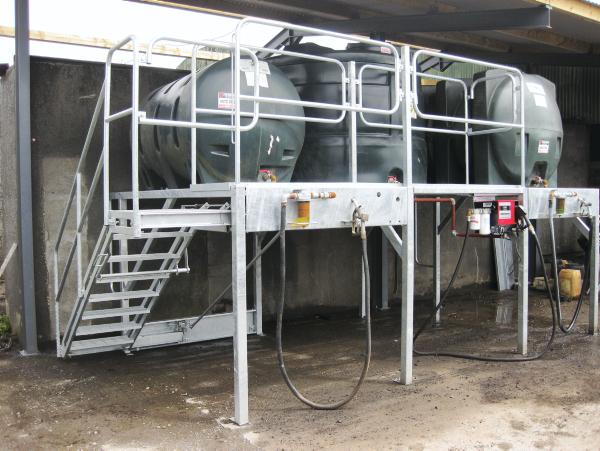
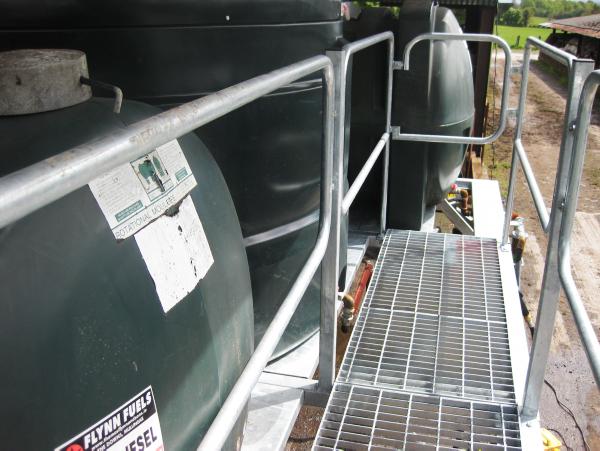
This triple unit is on the farm of Fred Murray of Bunbrosna, Co Westmeath. Two of these tanks are for green tractor diesel – one each for Fred and his father Alan as they farm independently. The third is for white diesel for the farm jeep.
At the centre of the tank stand is a raised base to hold the diesel tank, standing at 1.6m on sturdy 70mm x 70mm box legs. Running in front of the tank is a standing area where the delivery man can work safely while filling the tank. There are barriers on the sides of this standing area. The base is high enough to gravity-fill most tractors.
Access to the standing area and the top of the tanks is via the steps. Interestingly, the steps slide back under the tank when not in use. This, Mervyn Greene told me, is to keep the steps out of the way of machinery and also to keep children from climbing up on top of the tanks. In this picture, the steps are pulled out into their working position. We can see the sliding runner at the top which moves into a channel under the tank. There is a similar arrangement at the bottom.
Picture two
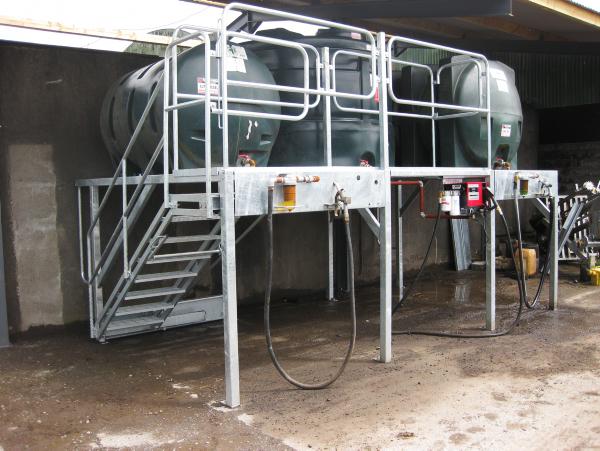
Here, the steps have been rolled in under the tank and out of the way.
The barrier on the steps has closed in against the tank body, too.
The tank stand has a holding point for the hose nozzle or can hold an electric pump as we see here on the middle tank.
Picture three
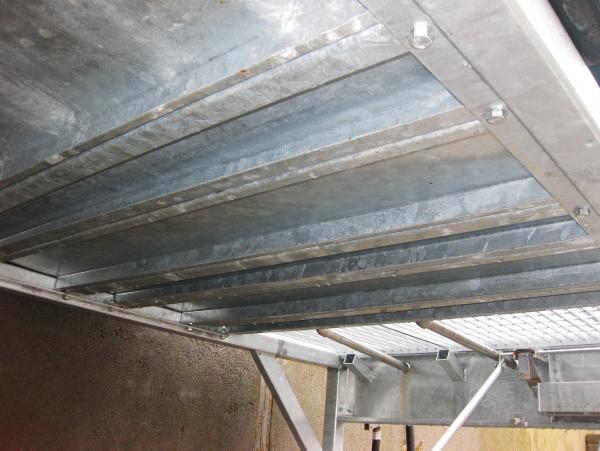
The tank base is a solid sheet of metal without gaps or slots, etc.
This is because the plastic tanks now commonly used to store fuel need continuous, unbroken support under their bottom surfaces. If the base had open-mesh or widely spaced slats, etc, then over time the bottom of the plastic tank could sag in areas without support and there could be risk of the bottom eventually cracking, resulting in loss of diesel.
Picture four
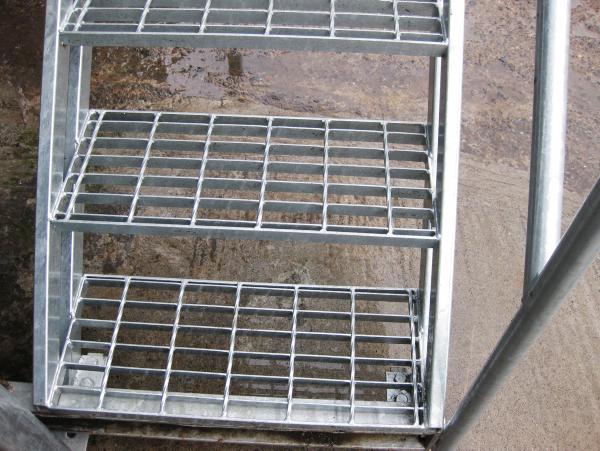
The steps and the standing area are made with an open mesh which gives very sure grip under work boots, even in wet weather. There is no back to the steps, which allows surer footing.
Picture five
The standing area also has open mesh for grip. It has safety railing on all sides. It is 1.1m high and has two rails.
Picture six
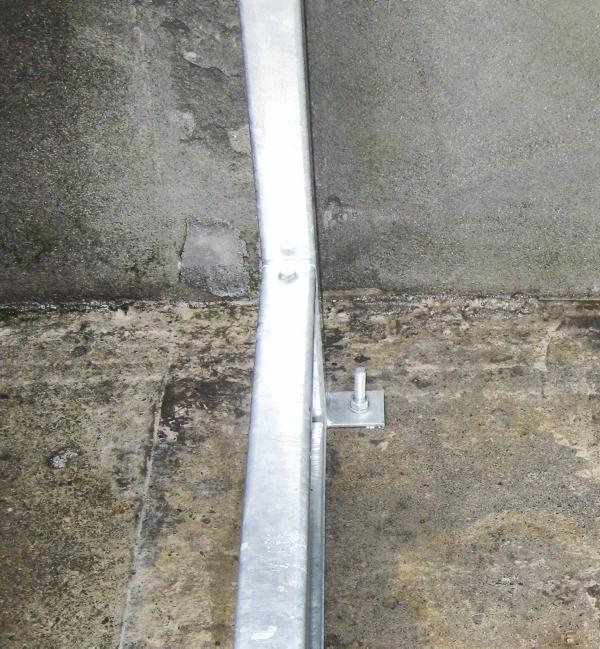
The whole unit is fixed to the concrete slab using anchor bolts. This makes the tank secure against being blown down during high winds, when empty.
Picture seven
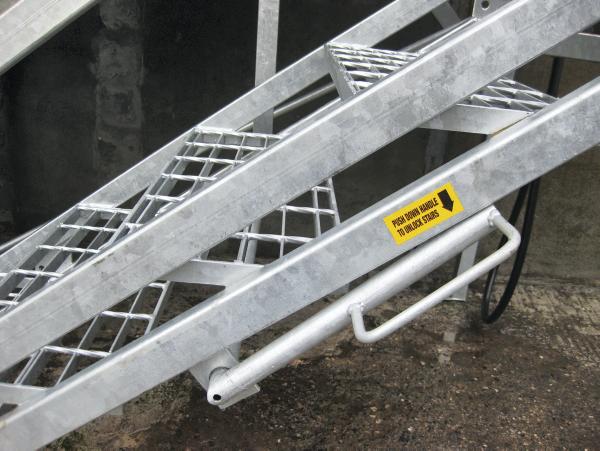
For safety the steps lock, in both open and closed positions. This handle is pushed down to allow the steps be slid in or out.
Picture eight
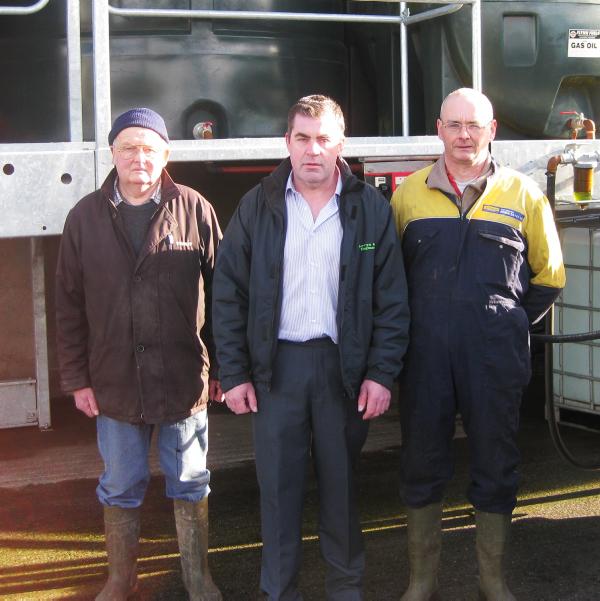
Fred Murray (right) is pleased with his diesel filling point which, he says, is secure and safe.
“The tanks needed changing. They were sitting on concrete blocks, so we decided to do everything together.’’
He is pictured with his father Alan (left) and Mervyn Greene of Mervyn Greene Engineering (centre).
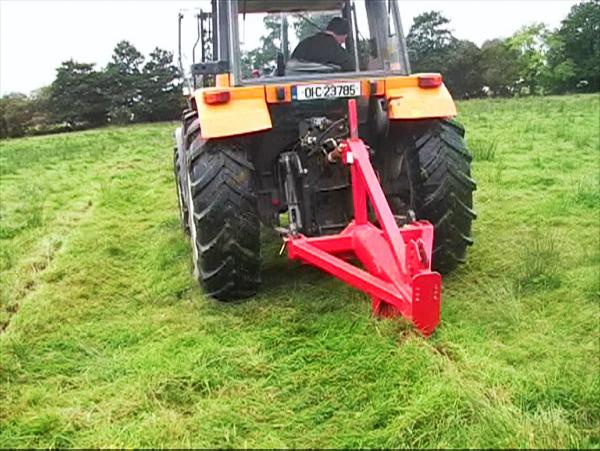
O’Keeffe Engineering, Newmarket
In last week’s supplement on drainage I put equipment manufactured by O’Keeffe Engineering in the wrong section.
The firm, based in Newmarket, Co Cork, manufactures three machines for drainage work.
They are a mole plough/subsoiler selling at €2,000, a twinleg moleplough/subsoiler at €5,000 and a gravel mole plough at €6,800, all including VAT.
Morty O’Keeffe tells me that the maximum working depth of these models has been increased to 22in (550mm). “The gravel mole plough now has a 2t capacity and easily replaceable soil engaging parts.’’
The firm sells directly to farmers and drainage contractors countrywide and delivery is free. “There is no deal until the customer is happy to buy what they see,’’ says Morty. Enquiries to 087 2547498.


SHARING OPTIONS