Picture one
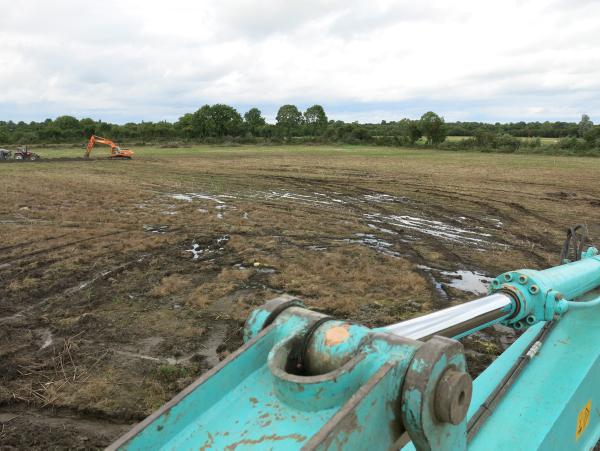
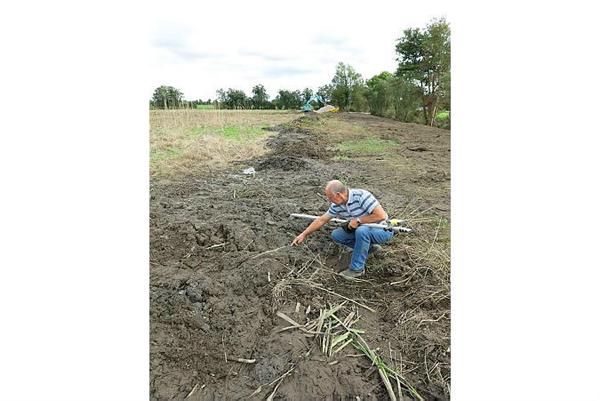
This field has been waterlogged all year, despite the dry weather. The drainage job is being carried out by Dessie Taaffe, who operates as Eagle Plant Hire and specialises in this kind of work. He moved two excavators on site, plus a stoning cart and tractor, and began the job on Friday morning. This was the scene when I called that afternoon.
Picture two
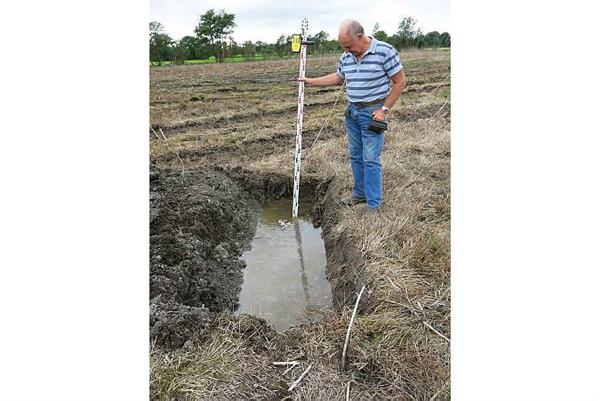
Prior to moving on site, Dessie examined the field, the open ditches and the surrounding land. The ditches were clogged. No existing drainage pipes were visible. Once on site, he dug a number of test holes in dry areas.
We can see that this one filled up quickly with water, showing the water table to be within a foot of the surface. The sandy soil under the top soil also appeared immediately.
Picture three
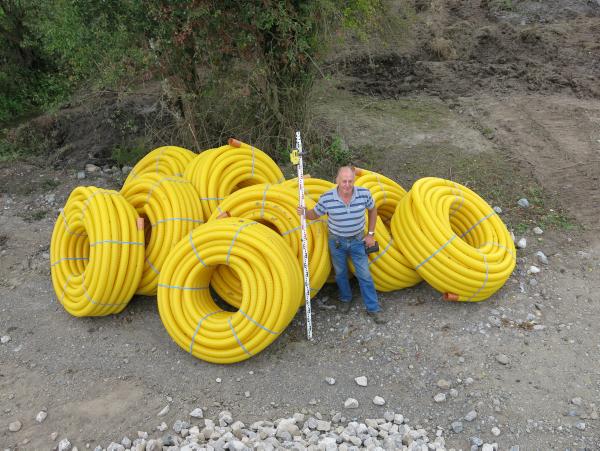
Dessie decided that a good approach here would be to clean the open drains and place a number of 80mm corrugated pipes at three feet depth, with stone on top, at intervals of about 25m.
Picture four
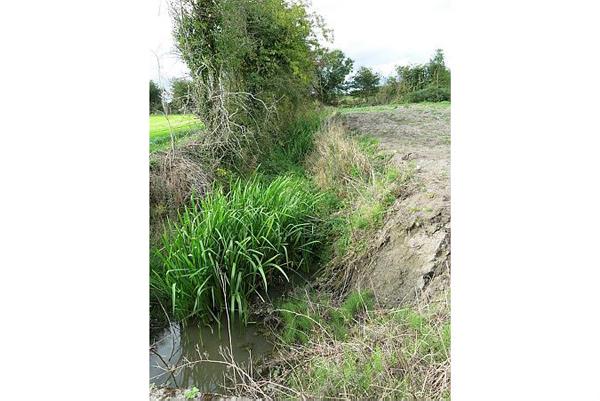
This section of ditch has not yet been cleaned out and it gives an idea of what all the open ditches here were like. They had not been cleaned out in years and were choked with weed and silted up with leaves falling from the high hedges.
Picture five
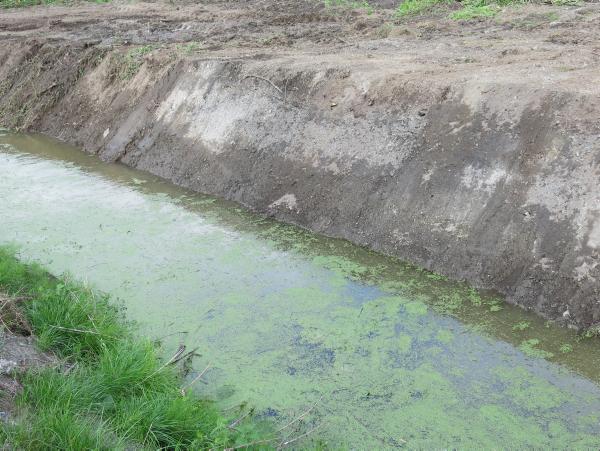
This silt was cleaned out a few hours earlier and is drying out. Dessie will spread it.
Picture six
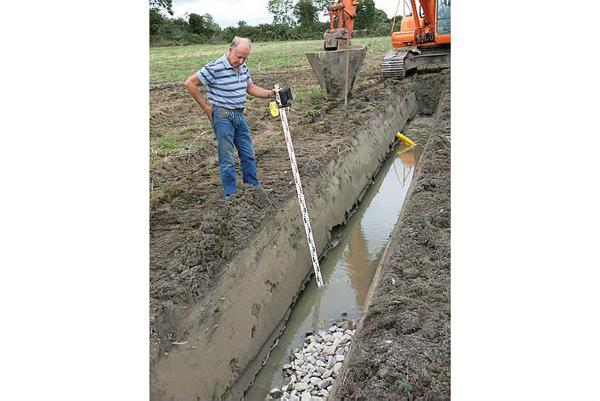
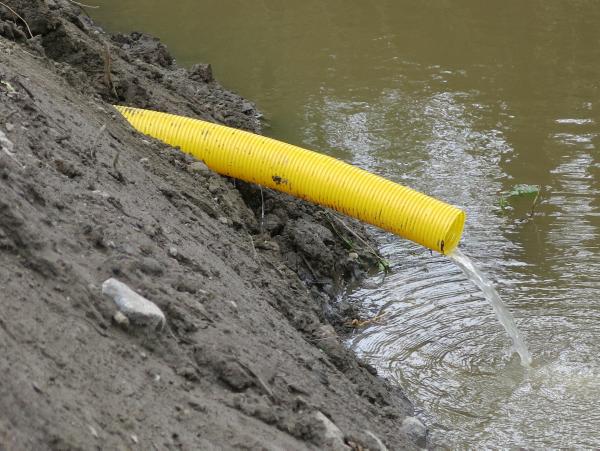
Here, we see a section of ditch cleaned out, weeds removed and the floor lowered. Water is flowing, but slowly, because there are blockages downstream. Hopefully, these can be sorted out. Meanwhile, we can see the layer of free draining sand and gravel showing through on the far bank.
Picture seven
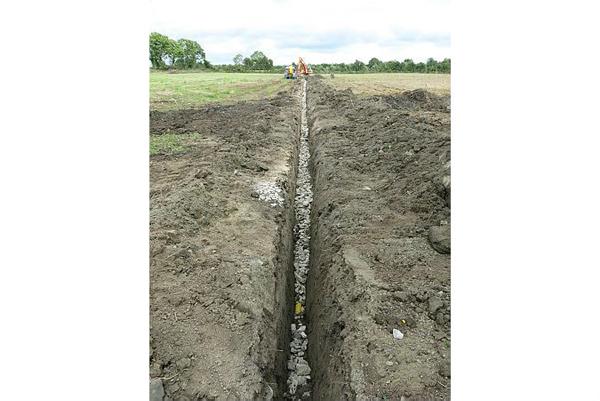
Dessie then began laying the first 165m length of pipe. Here, near the open ditch, it is laid at four foot, six inches, while this will rise to 36 inches at the other end. Depth is set by the laser and alarm unit on the excavator arm. Initially, Dessie used his normal piping bucket which makes a channel six inches wide at the bottom.
Picture eight
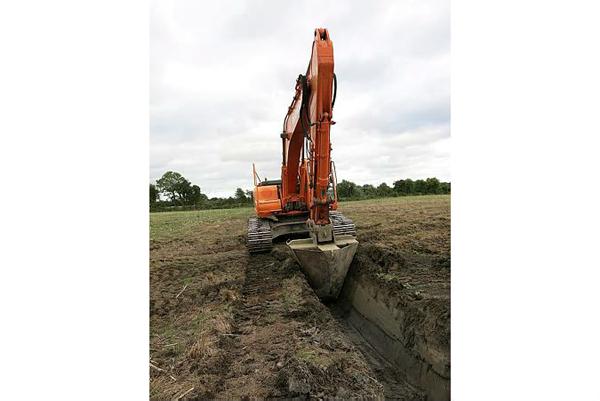
However, after about 60m, the soil became wetter, more sandy and more unstable. The sides of the channel were caving in quickly and Dessie had to move quickly to lay the pipe and place stone over it with the stoning cart.
Because of this instability, Dessie switched to digging out with this trapezoidal bucket. When he opens the channel, the bottom is dry.
Picture nine
However, within minutes, the bottom of the channel fills up with water. The pipe and cover of stone has to be placed quickly.
Picture 10
With the pipe in place an hour, water is already flowing strongly. But such is the length of this pipe, and the amount of water appearing in the bottom of the channel, that Dessie changed his mind on how to drain this field. An 80mm pipe would not be high enough in capacity, he decided. Having to dig out with the wide bucket would also be costly in stone.
Dessie decided instead to place one large, nine-inch pipe in the centre of the field, running 165m out from the ditch. The nine-
Where is all this water coming from? The general area is flat — there is no higher ground feeding down water to this field. So, what we are looking at is a high water table with rainwater unable to either soak down or flow across to a working outlet.
The first suspect is impermeable layers in the subsoil trapping the water. In fact, below a 12-inch layer of top soil, there is a deep layer of very free draining sand — and it is full of water.
As has been written in these pages before, the recommended approach for draining a field with free draining layers of soil is to place deep drainage pipes in a bed of pebble.
ADVERTISEMENT
The water will be able to flow sidewards through the free draining layers into the stone and pipes and through them away to the outlet. The more free draining the soil layers, the wider-spaced the drains can be, keeping down cost. Conversely, soils that are less free draining require the drains to be kept closer together and this drives up overall cost. And, where the soil is impermeable and allows little movement of water, deep, widely-spaced drains won’t be effective — not enough water will get into them.
A different approach is required — a dense network of shallow drains and this may be achieved most cost effectively by using mole drains or pebble mole drains instead of plastic pipes.
Register for free to read this story and our free stories.
This content is available to digital subscribers and loyalty code users only. Sign in to your account, use the code or subscribe to get unlimited access.
The reader loyalty code gives you full access to the site from when you enter it until the following Wednesday at 9pm. Find your unique code on the back page of Irish Country Living every week.
CODE ACCEPTED
You have full access to the site until next Wednesday at 9pm.
CODE NOT VALID
Please try again or contact support.
Where is all this water coming from? The general area is flat — there is no higher ground feeding down water to this field. So, what we are looking at is a high water table with rainwater unable to either soak down or flow across to a working outlet.
The first suspect is impermeable layers in the subsoil trapping the water. In fact, below a 12-inch layer of top soil, there is a deep layer of very free draining sand — and it is full of water.
As has been written in these pages before, the recommended approach for draining a field with free draining layers of soil is to place deep drainage pipes in a bed of pebble.
The water will be able to flow sidewards through the free draining layers into the stone and pipes and through them away to the outlet. The more free draining the soil layers, the wider-spaced the drains can be, keeping down cost. Conversely, soils that are less free draining require the drains to be kept closer together and this drives up overall cost. And, where the soil is impermeable and allows little movement of water, deep, widely-spaced drains won’t be effective — not enough water will get into them.
A different approach is required — a dense network of shallow drains and this may be achieved most cost effectively by using mole drains or pebble mole drains instead of plastic pipes.
If you would like to speak to a member of our team, please call us on 01-4199525.
Link sent to your email address
We have sent an email to your address. Please click on the link in this email to reset your password. If you can't find it in your inbox, please check your spam folder. If you can't find the email, please call us on 01-4199525.
ENTER YOUR LOYALTY CODE:
The reader loyalty code gives you full access to the site from when you enter it until the following Wednesday at 9pm. Find your unique code on the back page of Irish Country Living every week.





SHARING OPTIONS