



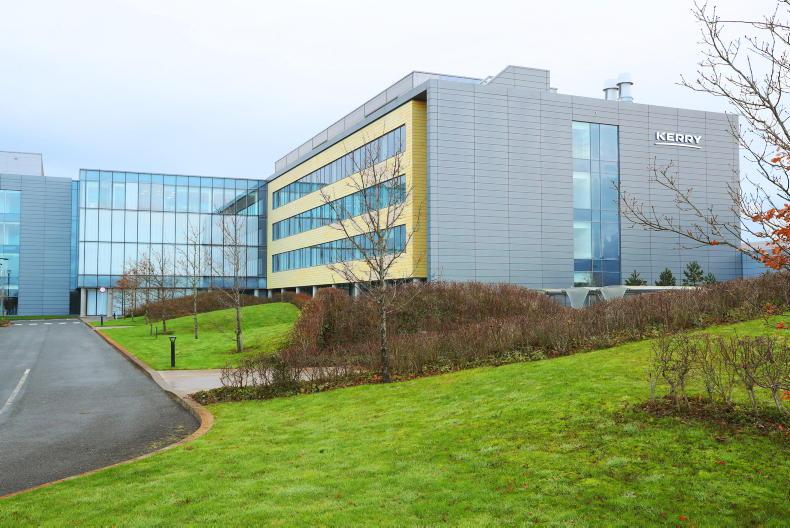
This week’s publication of annual results from Kerry Group for 2025 does not seem to have impressed investors. By the close of trading on Tuesday evening, the shares had dropped almost 6.5% below the previous day’s close, taking the share price to €73.45, close to the lowest level of the year, and 25% below the stock price at the same time a year earlier.
On the face of it, the numbers reported by Kerry Group were not bad at all. Revenue and profit after tax were €6.76 billion and €659 million respectively, only slightly behind the figures for 2024 – once the disposal of Kerry Dairy Ireland is taken into account.
Importantly, both revenue and earnings per share were in line with what analysts had expected ahead of the release this week.
Kerry’s earnings before interest, taxation, depreciation and amortisation (EBITDA) margin for the year at 17.9% was an improvement on 2024, again in line with analyst expectations.
The final dividend of 98 cents per share brought total dividends for the year to €1.40, a 10.1% increase from the previous year.
Kerry said its aim is to have double-digit dividend growth each year, adding that it has grown dividends by a compound rate of 16% since it first listed. The company also announced a fresh €300 million share buyback programme.
Sales volume overall was 3% higher in 2025, but there was a sting in the tale from the weaker US dollar and the strength of the euro during the year. Sales volume in the key US market was 3.8% higher, but there was a 5.2% headwind from currency translation, which meant that reported revenue performance slipped 2.4%.
Bottom line
The company’s bottom line was also hit with €74.4m in non-trading items, the majority of which consisted of costs relating to its operational transformation programme aimed at streamlining operations.
Kerry Group commenced the next phase of that programme during 2025, called Accelerate 2.0, aimed at driving “footprint optimisation and digital excellence across the organisation”.
Kerry said that the Accelerate 2.0 programme will run until 2028 and will support the reduction of its manufacturing footprint across all regions, while remaining aligned to the company’s business development and growth ambitions.
Interestingly, in his remarks published with the statement of results for 2025, CEO Edmond Scanlon cited the expansion of Kerry’s manufacturing footprint in emerging markets during 2025.
He also said that Kerry remains “well positioned for strong market outperformance,” and that the company expects to deliver “constant currency adjusted earnings per share growth of 6% to 10%.”
Kerry did forecast, however, that foreign currency translation is expected to be a headwind of around 4% in 2026, similar to what was seen for 2025.
Net debt at the end of the year was €2.244bn, up from €1.926bn in 2024 and €1.604bn in 2023. The company’s net debt to EBIDTA ratio has risen from 1.5 times in 2023 to 1.9 times at the end of 2025.
Tom Moran will retire as chair of Kerry Group at the company’s annual general meeting of shareholders in April. His role with be taken by Fiona Dawson, who joined the board of Kerry in 2022 following a 33-year career at Mars. Dawson is also currently a non-executive director of Lego Group, Marks and Spencer Group and Reckitt Benckiser Group.
Moran joined the board of Kerry in 2015 and has served as the company’s chair since 2022. The annual report of the company for 2024 shows that he earned director’s fees of €419,000 during that year.
Moran’s retirement from Kerry Group does not mean the former secretary general at the Department of Agriculture will be at a loose end; he was appointed as chair of the board of New Zealand meat processor Alliance Group Ltd in December following the strategic investment in the company by Dawn Meats.
Kerry announced yet another €300m share buyback programme which commenced on 17 February. This is the company’s fifth €300m programme, with daily share purchases running almost non-stop since early November 2023.
With share buybacks, there are often questions asked about whether they are the best use of capital, and even whether they are in the best interest of shareholders.
There are plenty of shareholders who would rather see increased dividend payments rather than buybacks. The argument against increasing dividends is that buybacks are usually a once-off event when the company has excess capital, whereas increasing dividends would lead to increased expectations for future payouts.
In Kerry’s case, this argument looks weaker with every additional buyback programme announcement. The €1.5bn spent on buybacks is the equivalent of €8.50 per share in dividends (based on the number of shares outstanding before buyback commenced), a far cry from the €1.40 per share paid out in the last 12 months.
Even from a capital allocation perspective, the buybacks don’t make a huge amount of sense, as the company’s net debt has increased by €640m over the past two years, from €1.604bn at the end of 2023 to €2.244bn at the end of 2025.
In fact, if the buyback money had instead been held onto, or used to pay down debt, then net debt at Kerry would be sitting around €1bn, with a net debt to EBITDA ratio of less than one.
When Kerry Group started its first share buyback programme in November 2023, the company’s shares were trading at around €73 each. After spending €1.2bn on buybacks, and announcing another €300m programme, this week Kerry’s shares are trading at around €73 each.
The financial results announced by Kerry Group this week are not that different than those published a year ago. It would be very hard to tell that just from looking at the company’s share price, which rose to over €100 in the wake of last year’s earnings announcement and have fallen towards €70 following this year’s.
Some of the drop in investor interest is due to factors beyond Kerry’s control – the trade policies of President Trump and their effect on the value of the US dollar, as well as global consumer demand levels are not something Kerry’s executive team can do anything about.
However, looking beyond the earnings report, the share price a year ago was also getting a lift from the successful offloading of Kerry Dairy Ireland to Kerry Co-op. At the time of that announcement Kerry CEO Edmond Scanlon said: “Kerry will become a pure play global business to business taste & nutrition company, with sustainable nutrition at its core, while also supporting our financial objectives of continued market outperformance, strong margin progression, and delivering greater returns for our shareholders.”
Scanlon might argue that Kerry has been successful in progressing its margin and increasing dividends, but it’s hard to look past the loss in shareholder value over the last year.
Perhaps Kerry’s biggest problem is that the company, to put it bluntly, has become quite boring. The business sector it is in is under pressure from weak consumer sentiment and changing consumer habits. Scanlon points to the need for further efficiencies in the company to drive margin improvement, meaning the company is relying on belt-tightening rather than expansion for increases in earnings.
This is a long way from Kerry’s history of growth through acquisition and innovation. The company’s capital allocation strategy seems to be focused on buying back its own shares and cost cutting, rather than investing more in research or mergers and acquisitions. That might help with quarter-to-quarter improvements in earnings per share and margin progression, but it creates no excitement about the company and certainly doesn’t point to where future growth will come from.
Kerry needs to have a story to tell investors about where its next phase of growth will come from in order to turn its share price performance around. Right now, it does not seem to have that.




SHARING OPTIONS