


Feeding cattle throughout the winter period can be expensive, especially in the areas of the country where land type is naturally heavy.
Having dry land can reduce the winter feeding period as cattle are normally housed late in the year and can be returned to grass early in the spring.
On heavier farms, there are still some opportunities to reduce the cost of winter feeding, albeit limited to smaller numbers of cattle and usually light weanlings or calves.
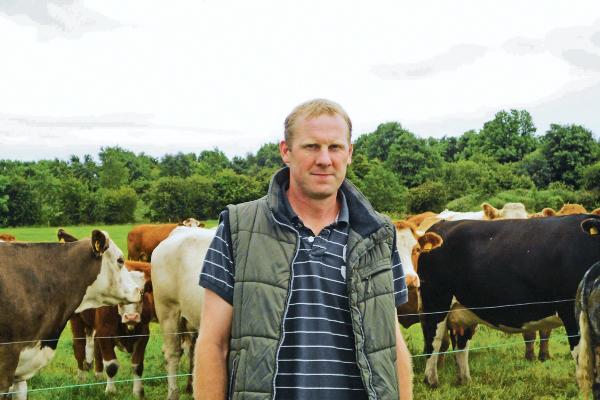
Growing forage brassicas such as kale and rape are usually associated with outwintering on drier, free-draining soils, but Adrian Kelly has been growing forage rape in peat soils on his Co Offaly farm over the past six years.
For Adrian, it has been a trial-and-error approach on how to grow and graze forage rape without causing permanent damage to the soil structure, as well as managing his cattle so that there is no negative impact on performance or health, as they remain outdoors throughout the entire winter period.
But he has met all of the challenges presented and has managed to persevere, despite working on a more challenging land base.
Farm background
The farm consists of 103 acres which is broken into five land blocks but they are located in a one mile radius of the farmyard.
The land is stocked with 30 late January to April spring-calving cows and a smaller September/October-calving herd of 12 cows.
Cows are mainly a mix of Limousin and Simmental which are served through a combination of AI and a Limousin stock bull.
As part of the farm plan developed by Adrian and his former programme adviser Adam Woods, the autumn herd is being gradually moved back in calving date and joining the spring herd.
With guidance from his new adviser, Alan Dillon, the farm is planning to calve all cows in a 12-week window from late January 2015.
As Adrian has a full-time job working off-farm in a partnership in a steel fabrication business, autumn is a period when he has limited spare time to attend to cows that are calving or to monitor cows coming back into heat.
Finishing enterprise
All progeny produced are normally taken through to slaughter, with only a few heifers selected as replacements.
Replacements are predominantly bought in annually as yearlings. Depending on purchase price and housing space, additional store cattle are purchased for finishing.
Male cattle were traditionally finished as bulls at 20 to 22 months of age in Kepak, Kilbeggan, but in recent years the bulls have been slaughtered at 17 to 18 months of age.
Carcase weights usually range from 410kg to 450kg for bulls. Heifers on the farm are killed off grass in the second season or housed and finished at carcase weights of 320kg to 340kg.
With the depressed market for bulls resulting in low prices, Adrian is rightfully concerned on how economically viable his bull enterprise will remain.
Cattle are weighed regularly on-farm and bulls currently weigh from 560kg to 690kg. Liveweight gain has averaged 2kg/day since early December. Heifers weigh 350kg to 480kg.
One option being considered by Adrian is to purchase a Charolais stock bull and move towards producing stores if the processors continue to penalise bull beef finishers.
Outwintering
Adrian has been growing forage rape for five of the last six years on his farm, with 2012 being the exception as land was just too wet to even plant the crop.
He decided to initially try rape in a field where he had been spreading peat used for cattle bedding. As the land had to be ploughed after spreading, he decided upon a trial crop of rape.
The decision to sow rape meant that the field could be used in late autumn rather than being out of commission until the following spring if it had have been reseeded with grass.
After some degree of success, the exercise was repeated. Once the rape was grazed, the field was reseeded by growing a crop of arable silage.
Grazing rape on peat requires good management and Adrian is certainly capable of meeting the crop and cattle requirements while operating inside of all cross-compliance regulations.
The farm is relatively flat and very exposed to wind which works in Adrian’s favour as it helps to dry out soils, keeping them firmer.
Cattle are provided with a hardcore laneway and run-back area which greatly relieves ground pressure. Silage is provided on the hardcore area and bales are normally left in the field in autumn before cattle are allowed to graze.
This eliminates the need for driving in and out of the field during the wettest periods of winter to provide silage for cattle.
Sowing
Three acres of Stego forage rape were planted on 1 August 2013. The field was ploughed, harrowed three times and rolled.
Seed was broadcast at a rate of 4kg/acre and received three bags per acre of 18-6-12. Farmyard manure was applied with 50 tonnes spread in total. All work was carried out by Adrian and the costs are outlined in Table 1.
A nominal cost has been applied to the cultivation process which is comparable with typical contractor costs.
No cost has been included for the farmyard manure as it was a resource on the farm that had to be disposed of regardless of growing rape and would therefore have been a farm expense in 2013 at some point.
At an establishment cost of €181 per acre and an estimated yield of four tonnes/ acre of dry matter due to the excellent growing conditions in the autumn, the crop has a cost of around €45/t of dry matter.
Cost comparison
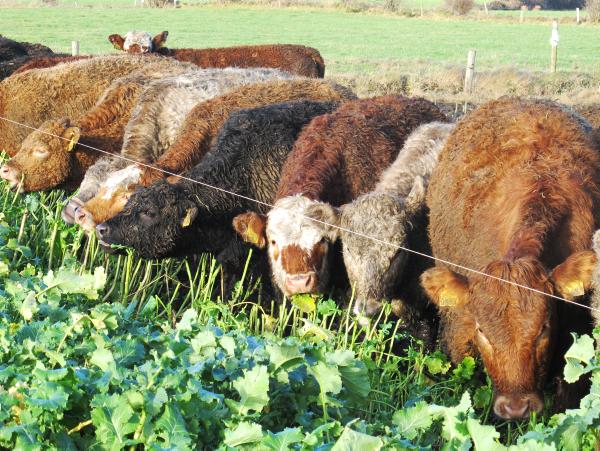
A group of 32 spring-born weanling heifers started grazing the crop on 23 November with an average liveweight of 350kg, with housed spring heifers at a similar weight. All the heifers were bolused to cover trace minerals. Mineral lick buckets were also provided.
On 4 December, 10 heifers were removed from the group to ease ground pressure, leaving 22 heifers. Adrian plans to have these heifers remain on the rape until mid-February, which will be approximately 90 days of grazing.
They will be weighed at this point and a comparison made between the outwintered heifers and those that were housed. Table 2 outlines the comparative feeding costs between the heifers on the forage rape and those that were housed over the winter.
The heifers on the rape are eating one round bale of silage every three days which Adrian values at €24 per bale (€30/t). Bales are 69 DMD and made on 30 May.
Assuming that a 350kg to 400kg heifer is consuming 5.6kg of dry matter and has a 50:50 intake of silage and rape, the daily feed cost for the outwintered heifers is 13c/day for rape and 34c/day for silage, or 47c/day in total.
The heifers indoors are eating 15kg of silage daily along with 2kg of concentrates, costing €275/tonne. The daily feed cost for these animals is €1/day, which is a margin of €0.53 between the two wintering systems, or a saving of €47 per animal on the forage rape.
Once the rape is finished, the 22 heifers will go straight to spring grazing. An added advantage of the outwintering is that the animals will respond quicker to spring grass as they do not require the same adjustment period compared with housed cattle.
Adrian hopes that this improved spring performance will help to get as many heifers killed off grass as possible next autumn.



SHARING OPTIONS