Ciarán Lenehan and Matthew Halpin look at three grass supply scenarios and discuss the management decisions involved in correcting grass surpluses and deficits.
To construct a grass wedge, you should graph your paddocks in order of decreasing grass cover, as shown below.
This can be done on a simple computer spreadsheet or even by using a pen and paper.
Decisions are made based on the demand line, which runs from your target pre-grazing height to your target residual. Target height equals: daily demand per hectare (stocking rate in LU/ha x 18) multiplied by rotation length (target 18 to 21 at this point) and target post-grazing cover (100kg to 150kg DM/ha).
ADVERTISEMENT
Draw a straight line between your target pre- and post-grazing covers from your heaviest to lightest paddock.
Theoretical farm
Eight paddocks.
Grazing stocking rate: 3LU/ha.
Daily demand: 55kg DM/ha.
Rotation length: 21 days.
The target residual: 150kg DM/ha (4.5cm).
The target pre-grazing yield: 1,300kg DM/ha (9.2cm).
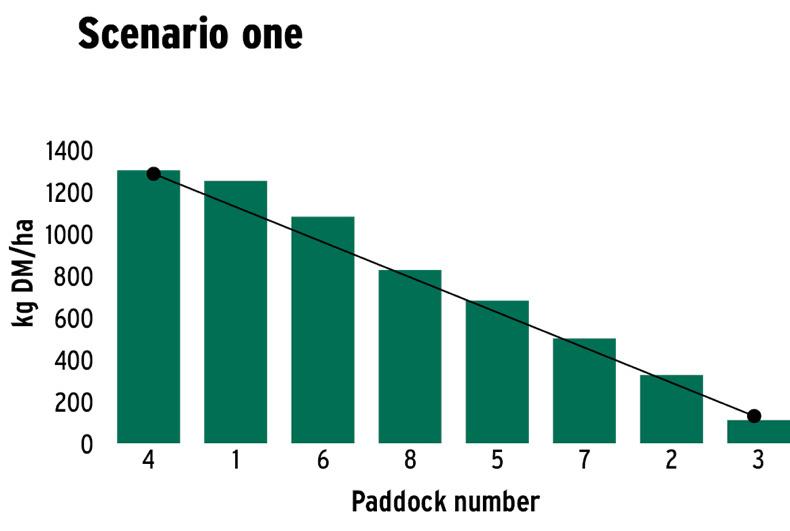
Optimum
Thirteen days ahead;
702kg DM/ha farm cover.
This is the perfect scenario for grassland management, but don’t rest on your laurels.
The farm should be walked once a week to continue monitoring grass growth.
If grass growth exceeds 70kg DM/ha/day, the farm should be walked twice per week.
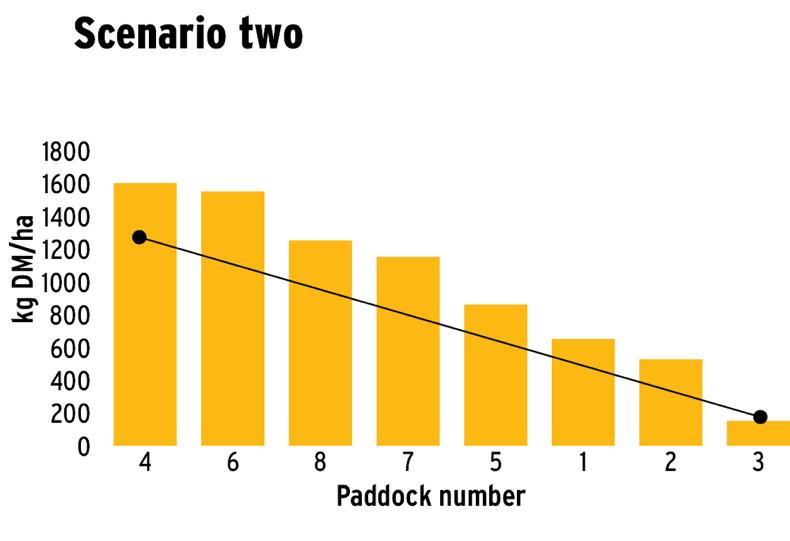
Surplus
Sixteen days ahead;
864kg DM/ha farm cover.
Pre-grazing yields are too high and decisions need to be made to rectify the problem in order to maintain quality.
Firstly ensure the target residual is being achieved.
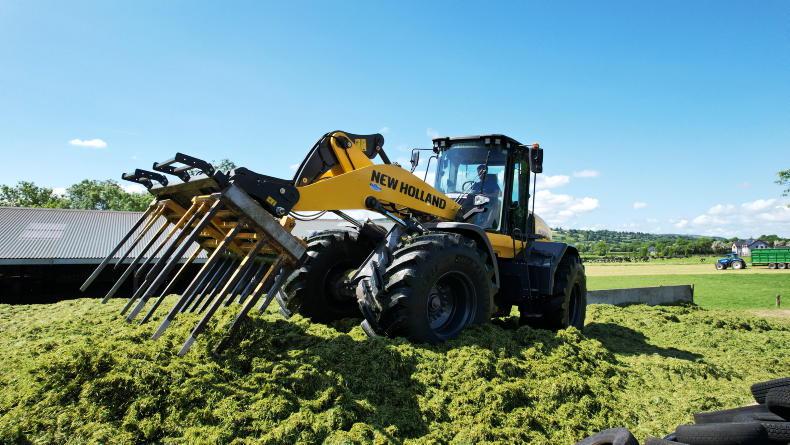
Remove surplus paddocks as silage – this should be completed as soon as possible so the paddock is back in rotation quickly.
Caution should be exercised so that excessive grass is not removed resulting in a deficit – look at the weather forecast. Will growth rates stay high?
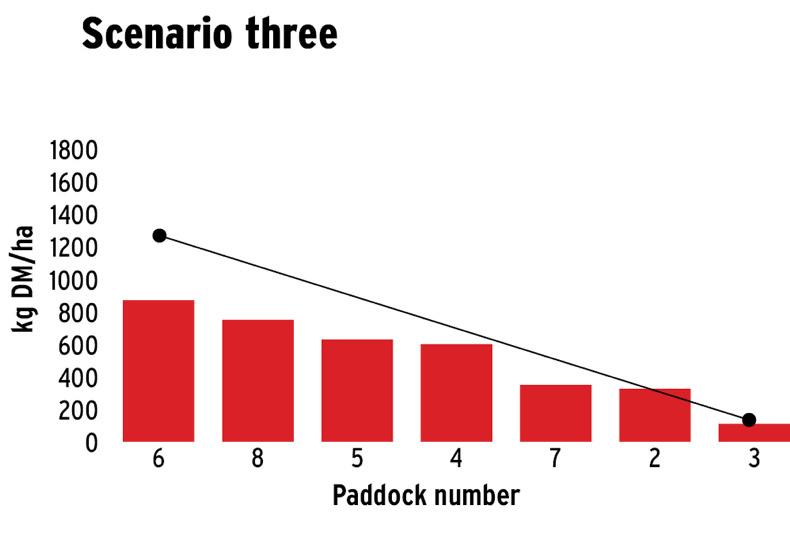
Deficit
Ten days ahead;
540kg DM/ha farm cover.
Do not speed up the rotation prior to magic day.
Increase the grazing area if possible or alternatively, lower stocking rate.
Supplement with concentrates or grass silage.
Re-graze area closed for silage if the pre grazing yield is not excessive.
This content is available to digital subscribers and loyalty code users only. Sign in to your account, use the code or subscribe to get unlimited access.
The reader loyalty code gives you full access to the site from when you enter it until the following Wednesday at 9pm. Find your unique code on the back page of Irish Country Living every week.
CODE ACCEPTED
You have full access to the site until next Wednesday at 9pm.
CODE NOT VALID
Please try again or contact support.
To construct a grass wedge, you should graph your paddocks in order of decreasing grass cover, as shown below.
This can be done on a simple computer spreadsheet or even by using a pen and paper.
Decisions are made based on the demand line, which runs from your target pre-grazing height to your target residual. Target height equals: daily demand per hectare (stocking rate in LU/ha x 18) multiplied by rotation length (target 18 to 21 at this point) and target post-grazing cover (100kg to 150kg DM/ha).
Draw a straight line between your target pre- and post-grazing covers from your heaviest to lightest paddock.
Theoretical farm
Eight paddocks.
Grazing stocking rate: 3LU/ha.
Daily demand: 55kg DM/ha.
Rotation length: 21 days.
The target residual: 150kg DM/ha (4.5cm).
The target pre-grazing yield: 1,300kg DM/ha (9.2cm).
Optimum
Thirteen days ahead;
702kg DM/ha farm cover.
This is the perfect scenario for grassland management, but don’t rest on your laurels.
The farm should be walked once a week to continue monitoring grass growth.
If grass growth exceeds 70kg DM/ha/day, the farm should be walked twice per week.
Surplus
Sixteen days ahead;
864kg DM/ha farm cover.
Pre-grazing yields are too high and decisions need to be made to rectify the problem in order to maintain quality.
Firstly ensure the target residual is being achieved.
Remove surplus paddocks as silage – this should be completed as soon as possible so the paddock is back in rotation quickly.
Caution should be exercised so that excessive grass is not removed resulting in a deficit – look at the weather forecast. Will growth rates stay high?
Deficit
Ten days ahead;
540kg DM/ha farm cover.
Do not speed up the rotation prior to magic day.
Increase the grazing area if possible or alternatively, lower stocking rate.
Supplement with concentrates or grass silage.
Re-graze area closed for silage if the pre grazing yield is not excessive.
If you would like to speak to a member of our team, please call us on 01-4199525.
Link sent to your email address
We have sent an email to your address. Please click on the link in this email to reset your password. If you can't find it in your inbox, please check your spam folder. If you can't find the email, please call us on 01-4199525.
ENTER YOUR LOYALTY CODE:
The reader loyalty code gives you full access to the site from when you enter it until the following Wednesday at 9pm. Find your unique code on the back page of Irish Country Living every week.







SHARING OPTIONS