


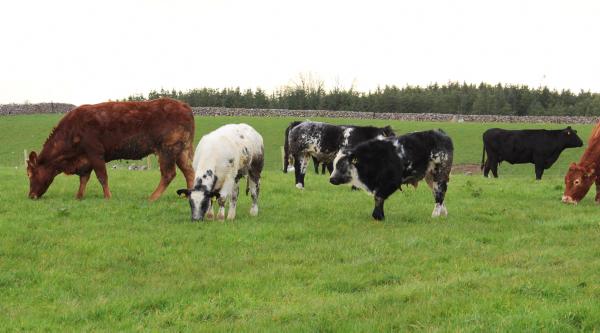
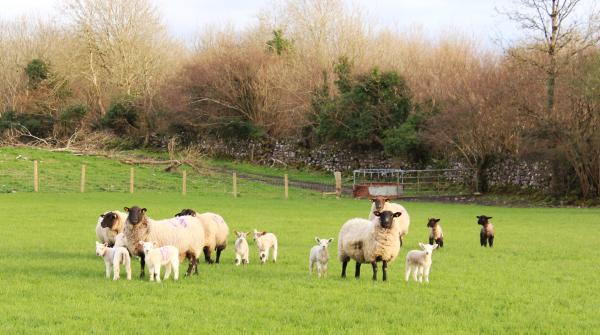
Getting cattle back to grass becomes more challenging where land type is naturally heavy. Having a mixed cattle and sheep farm also makes early grazing more difficult, where ewes are outwintered until the final few weeks before lambing starts.
A sheep flock offers many benefits in a mixed grazing situation. For instance, sward quality is usually improved where sheep and cattle graze side by side as grass utilisation is generally increased. Tighter grazing from sheep helps grass plants to tiller out, making the sward thicker and less prone to weed grasses becoming established.
Just as feed demand increases after calving, ewes have a greater nutritional requirement after lambing which can be mostly be supported by good quality spring grass. Allowing sheep to graze over the whole farm all winter will leave a shortage of spring grass, therefore delaying turnout of cattle and sheep and increasing the reliance on concentrates.
Richard Jennings is one of a limited number of BETTER Farm participants who runs a suckler and sheep farm. The farm carries 57 calving cows and 66 March lambing ewes on 36ha of grassland.
Stock details
Calving started on 1 November and finished on 15 February with 54 live calves on the ground. Cows are mainly Limousin cross Friesian and served to Blue sires through artificial insemination. Calving has been tightening year on year by two to three weeks.
The breeding season is now underway with the first cow inseminated on 5 February and Richard plans to finish by 5 May, which should have calving finished by mid-February. Calves are sold for export at 10 to 11 months of age at 400kg to 500kg liveweight.
Lambing started on 12 March and finished on 1 April with 117 live lambs on the ground, which is a live lambing percentage of 1.77 lambs per ewe.
Spring turnout
Planning for spring grazing started last October on Richard’s farm. The farm has been completely reseeded and is productive early and late in the year. Soil fertility is good on the farm with a lot of 10-10-20 used on grassland.
Paddocks are closed from mid-October with drier, reseeded blocks being closed first. As weanling calves and lambs are sold off farm from August to September, leaving only dry cows and dry ewes to graze, it is easier to start closing ground and building grass supplies for winter grazing.
Cows were housed in late October. Ewes continued to graze out the wetter parts of the farm into mid-winter. Ewes were housed in mid-January and offered haylage. Concentrates were introduced from mid-February onwards based on scanning results.
Calves have access to grazing paddocks through on-off grazing throughout winter. Cows are only let out to graze once settled in-calf and when ground conditions allow. Ewes go out to grass within days of lambing and this year were grazing two weeks before cows returned to grass.
Grazing management
Stocking rate is approximately 1350kg liveweight per hectare in early April, which is the equivalent of four ewes and lambs and a cow and calf per hectare. Grazing demand in spring was approximately 27kg DM/ha in early April and has now increased to 34kg DM/ha as more cows go back to grass.
Assuming a daily grass growth of 5kg/day DM from November to 1 March and 10kg DM/day from 1 March until 20 March, approximately 800kg DM would have been grown over the winter. At the grazing demand of 27kg DM/ha/day in early April, there was 29 grazing days ahead which has now reduced to 21 days as stocking rate has increased.
Ewes grazed the heavier blocks of land this spring until ground conditions improved enough to carry cattle. The sheep are normally grazed in two groups, the same as the cattle from May onwards. Richard is currently re-fencing the farm under TAMS. Once finished, he will have the opportunity to forward creep graze calves and lambs improving performance.
Silage
Silage is harvested in a two-cut silage system. Silage ground was grazed in April before closing but the later turnout of cattle meant that Richard was behind target on getting silage ground grazed off before cutting. With autumn and winter-calving cows, he is reliant on making high quality silage to reduce the level of concentrates fed to cows in milk.
As cows are also bred indoors, making silage with 70 DMD is essential so that cows are able to meet their dry matter energy demand. Silage fed in winter 2013/14 was 72 DMD and cows were offered 2kg of concentrates until settled in calf.
Making silage of this quality requires harvesting in late May to early June. Applying 100 units of nitrogen will mean there is a 50-day closed period for grass to utilise all fertilizer applied. With a target cutting date of 1 June, silage ground had to be grazed and closed by 10 April which was just about manageable this year.
Heavy covers of grass built up over winter delayed slurry spreading this year until after grazing. Richard is considering the benefits of grazing the silage ground in January before housing ewes.
The reason behind this is that it would allow early slurry to be applied on silage ground in early March. Ground could be closed earlier for harvesting first cut silage of even higher quality reducing concentrate requirement fed to cows after calving.
Silage requirement
There is a two-cut silage system yielding 10 tonnes per acre of first cut (fresh weight) and six tonnes per acre in the second cut. Assuming that cows are housed from 20 October until 1 April, the winter feeding period lasts for 162 days.
The silage intake for dry cows is based on an average 25kg as cows are housed in body condition score of 3.0 and eating an average 45kg of silage once calved.
In addition, ewes are housed for 80 days. Table 1 outlines the silage demand for next winter.
With 35 acres of silage ground, the first cut will produce approximately 350 tonnes of silage and second cut will produce 180 tonnes which will meet stock demand at the outlined levels.




SHARING OPTIONS