


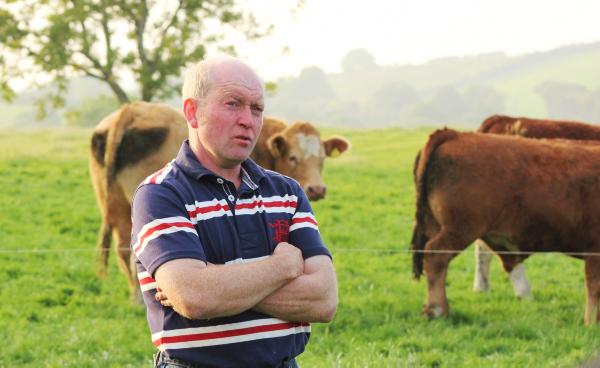
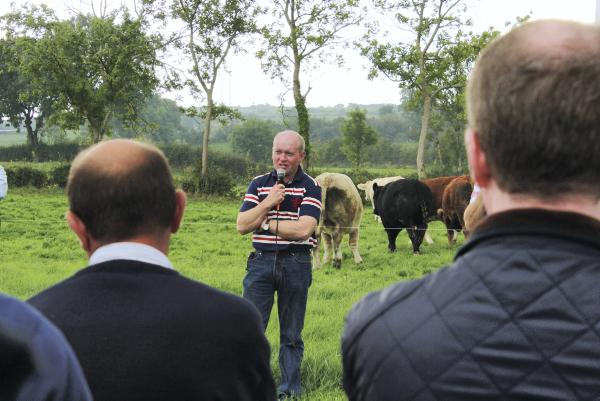
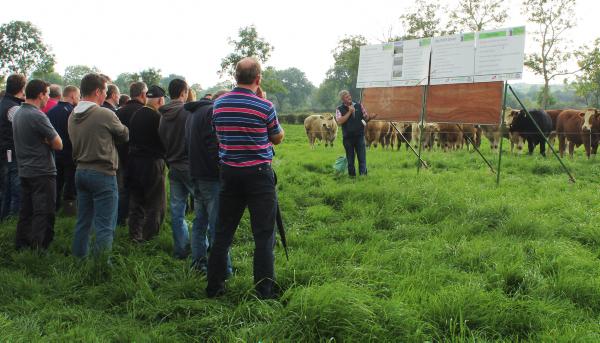

At the final autumn farm walk organised by the BETTER Farm programme, host farmer David Mitchell outlined how his 40-cow suckler to beef enterprise has been changing over the past two years. He works closely with programme manager Adam Woods and local B and T adviser, Conal Murnaghan to get advice on all aspects of herd management.
Greater emphasis has been placed on getting spring-born store cattle back to grass early, despite the challenge of farming on heavier land. In addition, David’s 48ha grassland farm carries a flock of 75 ewes lambing in March, which increases demand for grass in early spring.
Cow type
“I used to select cows based on breed type, size and conformation as I wanted to breed the real flashy looking calf. But the breed of the cow is not important. Selecting cows based on their growth and shape meant I wasn’t selecting the cows that had milk,” said David.
“Now I just want a cow that has milk, reasonable shape and is docile. The farm is a one-man operation, so I need to be able to handle cows on my own,” he added.
Cow breeds are a mix of Hereford, Limousin and some Simmental and split 60:40 between spring and autumn calving. As the herd is purely focused on producing slaughter cattle, moving to breeding more maternal-type cows could reduce carcase weight and quality without the careful selection of herd sires.
Cows are served with a Charolais bull while AI is used on heifers. Heifers are calving to APZ and OZS and there are daughters of these bulls calved down this year.
Replacements have been bred from within the herd. With a small number of suitable replacements to breed each year, it has been a slow process to increase cow numbers to the target of 50 breeding females.
The herd has remained static in numbers as culling rates of 10% to 15% mean that the heifers joining the herd are merely maintaining cow numbers. Trying to increase cow numbers and output by breeding from within does take longer to achieve.
This spring, David purchased five Angus cows with calves at foot in an effort to have more cows calving down next year. Table 1 outlines calving performance over the past three years.
Replacements
David’s selection criteria for choosing herd replacements are outlined as follows:
1 Good fertility: David operates a split calving system, so keeping calving tight to a 12-week period is very important to avoid calving all year round. In order to breed replacements with good fertility, David focuses on using maternal AI sires on his early calving cows with proven milk traits.
2 Good milking ability: David weighs his cattle regularly and now sees the importance of having a cow with good milk production from grass to drive on calf growth from birth to weaning. Heavier weaning weights increase cow output and heavier store cattle to put back to grass.
3 Easily calved and docile: David is the sole labour unit on the farm, so cattle have to be easily handled. Reducing calving difficulties is one area he concentrates on sires that can be calved with little trouble. Replacements selected are not heavily muscled and have a very good width of pelvis. Any cows that are repeatedly hard to calve are culled and their heifers finished.
4 Easily fed: As some grazing ground is heavy, it is important that cow size does not get too big. A medium-sized 650kg Limousin or Simmental cross cow is desired that will put on flesh at grass that is utilized during the winter to save on silage. Every additional 100kg liveweight in cow size increases silage demand by 0.5 tonnes per head per month. Over a six-month winter, this increases silage demand by 100-120t for David’s herd.
Finishing system
Male progeny are finished as steers at 25 to 26 months and slaughter data for steers finished in 2014 are outlined on these pages.
All cattle are marketed through a local supply group with ABP Clones.
Store cattle were gradually turned out to grass from late March after gaining 0.49kg/day on the winter diet. Steers went to grass and weighed 400kg on 4 April. This year has seen a good grazing season on the farm. Heavier land will hold moisture which helps to push grass growth during the summer.
Steers averaged 1.1kg/day from a grass-only diet since early summer, which is an excellent level of performance in 14- to 18-month-old cattle. They weighed 554kg on 4 September and will be housed in early October at a target of 580kg liveweight.
They will be built up to 7kg of meal and offered 70+DMD silage during the intensive feeding period. At a cost of €25/tonne of silage and €240/tonne of meal, the finishing diet for steers will cost around €2.05/day, assuming that the animal is eating 15kg of silage along with the 7kg of meal.
At a beef price of €3.80/kg and 55% kill-out, the steers need to average 1kg/day of liveweight gain to cover their feeding costs when housed.
Heifers will be housed for finishing first around 1 October at 500kg to 520kg having gained a similar level of performance as the steers. Meal will be introduced around two weeks pre-housing with both groups getting 3kg/day of a purchased nut. This will get them acclimatised to the finishing diet.
Heifers will be built up to 5kg within a fortnight of housing and slaughtered in early January, although with such good performance this year, heifers will kill before Christmas. Heifers will have consumed less than 500kg/head during the finishing period.
Gross Margin
Gross margin for the farm was €164/ha in 2013. Low fodder reserves meant the farm was buying in large quantities of meal to supplement all stock last spring, which greatly added to the cost of production. Killing steers at 28 months prolonged the winter feed period and this is one cost that will be eliminated this year when steers are slaughtered at 24 months. Gross margin should recover in 2014 due to increased weight gain from grass, with David commenting that both steers and heifers are on average 50kg heavier at housing compared to last year.



SHARING OPTIONS