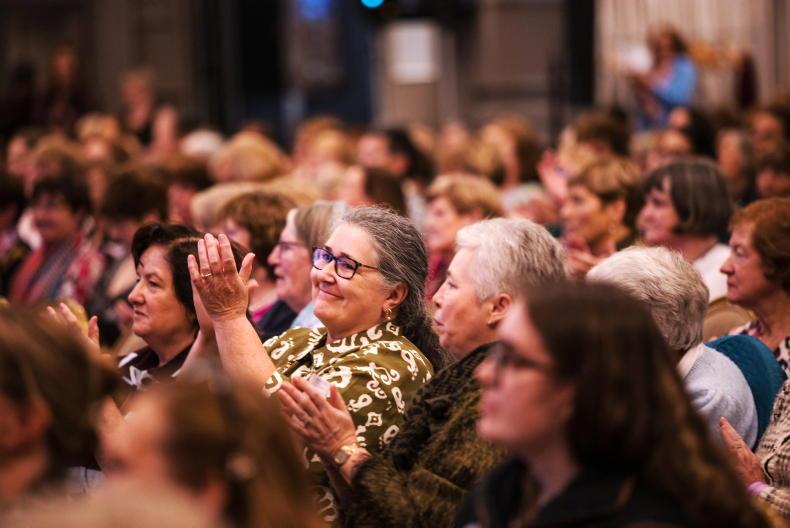
That’s a wrap on another Women & Agriculture conference. Our 17th conference, supported by FBD Insurance, was another great day, with plenty of laughs and chats. Looking around the room and seeing everyone belly laughing at John Creedon reminiscing about his Corkonian childhood was definitely a highlight. And a big thank you to the 80 women of Sound Waves choir who lifted everyone’s spirits and had us all singing our hearts out to Jackie Wilson’s Higher and Higher.
The strength of this conference has always, and continues to be, the mix of entertainment and information, the power of learning and supporting one another. Our panel on rural crime, chaired by rural affairs journalist Jacqueline Hogge, certainly touched a chord. The statistic that one in three women in Ireland will be a victim of some kind of psychological, physical or sexual abuse from an intimate partner really resonated.
Tara Farrell, CEO of Longford Women’s Link, outlined that when it comes to domestic violence, a lot of people think of the physical, but the power of coercive control cannot be underestimated. “Coercive control is an ongoing pattern of psychological and emotional abuse,” she said. “It could be things like consistently checking the mileage on the car, checking who you’ve met, who you were talking to, who was ringing you... It is designed to humiliate, to control, to instil fear... and it can be very gradual, but the important thing is it is a crime.”
Women in rural communities and on farms have “a different set of circumstances and barriers to overcome,” explained Tara. This is not just about the logistics of accessing services. “Things like having a licensed, legally-held shotgun, having a lot of fuel, a lot of machinery, they are normal parts of an everyday working farm. [But] in the hands of a perpetrator, they are very, very different.
“We’ve had women tell us that they have been told, ‘If something happens, I will set fire to the house, I will block the laneway with machinery, and nobody will be able to come down.’ Women are being threatened in that way.”
Coercive control is an ongoing pattern of psychological and emotional abuse. It could be things like consistently checking the mileage on the car, checking who you’ve met, who you were talking to, who was ringing you... It is designed to humiliate, to control, to instil fear... and it can be very gradual, but the important thing is it is a crime
Detective Garda Inspector Patricia Gill from the Garda National Protective Services Bureau outlined that 55,000 incidents of domestic abuse were reported to An Garda Síochána in 2025, and that number continues to rise. That doesn’t necessarily mean there were more cases of domestic violence but rather that reporting has increased. “For the first time in society, we’re saying this is no longer acceptable, we’re not going to tolerate this anymore,” she said.
This is not about one incident; Detective Inspector Gill outlined that research shows this could happen 30 times. “This is a pattern of behaviour by a perpetrator,” she said. She also encouraged those affected to report these incidents to the Gardaí, while also pointing out there are support services in every county in Ireland.
In a room full of women last week, we know there was at least one, probably many more, directly impacted. Someone reading this column is a victim of coercive control. This is a situation that thrives in silence and so it is something we will continue to talk about, with a follow-up in next week’s paper.
Thank you to every woman who attended the conference. It was so lovely to see new and familiar faces. There is real power in that room and we will continue to deliver talks and information that support women.