


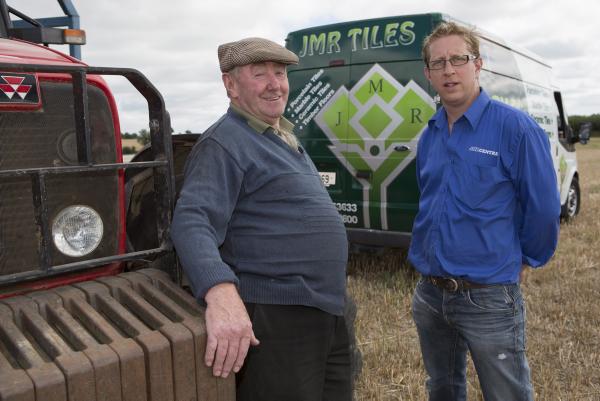
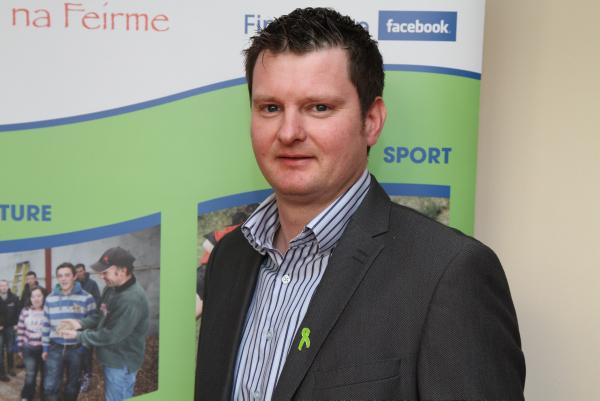
In recent weeks, we have heard from the older generation about long-term leasing land and how they put in place succession plans to hand over the farm. This week, we look at two young farmers who have taken over in recent years. In both cases, they were working off farm when their father asked them would they like to come back farming. It is clear that communication between generations and also within them is vital for one generation to hand over seamlessly to the other for a better future for all.
Richard Lucey Mallow, Co Cork
I took over the farm in December 2011, just after the budget. I was 36 and had missed out on the young trained farmer stamp duty relief. Thankfully, the budget reduced stamp duty relief to 2% or 1% for relatives reducing the cost of taking over.
When I was 19, I did the green cert and worked at home on the farm for the next eight years. I looked at staying on the farm but my father was too young to retire.
Grain was making €80 a tonne and there was definitely not an income for two families from the 300-acre tillage and beef farm.
I opened up a tile business, JMR Tiles Ltd, in Mallow, with my father-in-law and brother-in law-instead. We import tiles from factories in Spain and Italy and retail them, as well as a supply and fitting service.
We had two tile shops and employed 18 people at one stage. Now, like many in the sector, we have scaled back. Jan, my wife, also works in the business.
During that time, I had very little to do with farming. Then, a few years ago, as things started to slow down, I was telling my father. He said he was getting too old for the workload and wondered if I wanted to come back farming. Farming is always something I wanted and the offer came at the right time.
||PIC2||
After accepting dad’s offer, I sat down with my two sisters, both of whom work in their own family businesses, and a brother, who is working as a quantity surveyor in New Zealand.
We discussed a plan which we felt would be fair for all involved which resulted in me taking over 160 acres and the remaining, which dad kept, would be divided between the other three at my parents’ Paddy and Noreen discretion.
We all felt this conversation was essential to eliminate any fall-out over land in the future. Our parents’ biggest concern was that we would all be happy.
The transfer took about eight to 10 months. It was a lot of red tape and bureaucracy, meeting solicitors and tax advisers, and can all be quite costly. Dad had to get his own independent solicitor also. It would help if this procedure was simplified and made more cost-effective.
Initially, I made very little changes in the first year. My father kept cattle on his land so he did not step back completely. He always helps during the busy harvest and anywhere else that is needed.
Having just tillage, I check the crops once a week and plan what work needs to be done. I can plan a lot of the work around weekends but Sundays are for family.
At the busy time, I normally work in the tile shop in the morning and farm in the afternoon. The partners are very understanding and I always try to make up the hours. I have winter and spring crops to spread the workload.
The experience of the tile business has changed the way I think about farming. I set up a limited company from the start.
I felt if I ever wanted to buy land, it would be easier to save money at a tax band of 12.5%. Working the farm must be profitable. I have to be able to make more working the land than I would get from renting it. As well as the 200 acres, we have 70 acres of con-acre and do around 70 acres of hire work.
Tilling and sowing 300 to 350 acres of land is enough to justify the existing machinery, but the big question will be if it will pay to replace old machinery or will it be more cost-effective to use a contractor.
Ronan Feighery Belmont, Offaly
I was in the US when my father asked me was I interested in coming back home to farm. I had gone to college and had been working in the US for five years. I was 25 and getting to the stage that I would stay permanently but part of me always wanted to come home. So I did.
My father Joe was milking 28 cows on the farm at Belmount, Co Offaly, at the time. We had a limited land block so we had to really look at what we were going to do so I could make a living.
I did a five year plan to invest in buildings and infrastructure, increase cow numbers and reduce the beef enterprise. I was always more interested in dairy than beef and the plan was to cut beef out altogether.
Of course, I wanted the farm signed over straight away. My mother, Ann, would have done it, but my father was a typical 70-year-old farmer who didn’t want to. His mindset then was that it was better to wait until he had passed away.
Despite disagreeing with him, I never put him under pressure. We agreed that I would lease the land for five years. There was no payment but it allowed me to borrow in my own name, draw grants down and expand.
When he saw that I was serious and not going to go mad, he was the one that started pushing to sign the land over. Before the end of the five year lease, he started the process.
As national chairman of Macra, I have talked at succession meetings with IFAC and solicitors. I meet a lot of young farmers who are frustrated that they have nothing in their own name. Very often, it leads to conflict and, in many cases, a falling out.
The fact is that their parents have been the boss for many years and do have concerns about passing over straight away for a number of reasons.
My father passed away three years ago. At this stage, I can see the situation from my father’s point of view at the time when I came home. I see that a gradual changeover is not a bad idea.
Land can be transferred quickly but we forget that our parents have skills as well and these are not as quickly exchanged. Transfer of knowledge is a lifelong thing.
I have started to treat some areas of the farm the way my father did to get the most from them. He probably learned the skills from his father.
The biggest thing is that there has to be communication and an interim plan put in place.
If your father said he is not going to transfer, then you have to respect that.
However, you also should be able to ask him how he sees your farming future playing out.
In my case, where my father saw where I was going, he was quite happy. The transfer itself took a while. I was getting married and my father was hitting 80 and so the timing was right.
I definitely think that farmers should be planning succession in their mid-50s not waiting until their 60s, 70s or even 80s in some cases.
In Macra, we are very concerned about the mobility of land, especially for farmers who have not identified a successor. We have a list of young farmers who want an opportunity.
We have recently employed a land mobility manager who I see as the link between older farmers and young farmers to get the most out of our most valuable resource – land.
I think there should also be a land audit done that will identify where there is potential to produce more from what we have.
There should also be more than the 25% top-up for young farmers. I got €10,000 insulation aid which was a major boost. It paid for a lot of the expansion and I was able to borrow on the strength of it as well.
A lot of young farmers want to take over and jump to 150 or 200 cows. They should look to prove that they can build the business steadily first. I have certainly made mistakes myself, especially when borrowed money was so readily available when I was expanding.
I have increased to 70 cows and will go to 90 cows when quotas go. I have been lucky to get land closer to home to lease.
My wife Donna works fulltime and we have children. As you get older with kids, having a good work balance is important and I am even starting to think about, when the next generation will take over, what concerns I will have then.
READER FEEDBACK
James, 22
I have encountered similar difficulties in trying to access rented land. I have been looking for a few years as well and find that most rented land is either tied up by other farmers, or the rental values are artificially high because of farmers with high Single Farm Payments needing the land to claim payments. I think that more needs to be done to incentivise land rental and encourage young farmers into the business. Young farmers who will not inherit land and have to go out and rent land to start their business are currently at a big disadvantage.
David 48
Nigel Smithwick’s succession story struck a chord with me. In our own case, we had a plan for all the land and assets. All the assets were in my father’s name. After my father died, my mother had not made a will. She started suffering from Alzheimer’s. To cut a long story short, one of my sisters moved to make her a ward of court where the situation meant that my father’s wishes could not be carried out as my mother was not in a position to legally sign off her rights. The reason I contact you is that, like the family featured, we felt we had covered every angle but did not see this coming. By highlighting it, I hope to help others as well.
Jerome, 61
It was a great to read about an ambitious young farmer last week determined to make a business for himself from farming. Hearing about all the young people in agricultural colleges is also uplifting and I think it’s crucial that they are educated to a high standard in both the theory and practice of farming. I am in the twilight of my farming career, have no successor and would be open to forming some kind of partnership but for me to take that risk, the partner would have to be a skilled person with a lot of drive and initiative. Young farmers need to demonstrate themselves to be such.
Darren, 35
I took over the family farm four years ago after losing my job. The farm had been rented out for years and needed a lot of investment. I found that managing cashflow was extremely difficult. I had savings which I put into the farm to buy the stock, but the initial two years where there was very little financial output put me under serious pressure. The farm was not able to generate much income and I am still struggling to increase stock numbers. I think people often underestimate the level of planning that is needed in terms of cashflow and overestimate the returns.




SHARING OPTIONS