



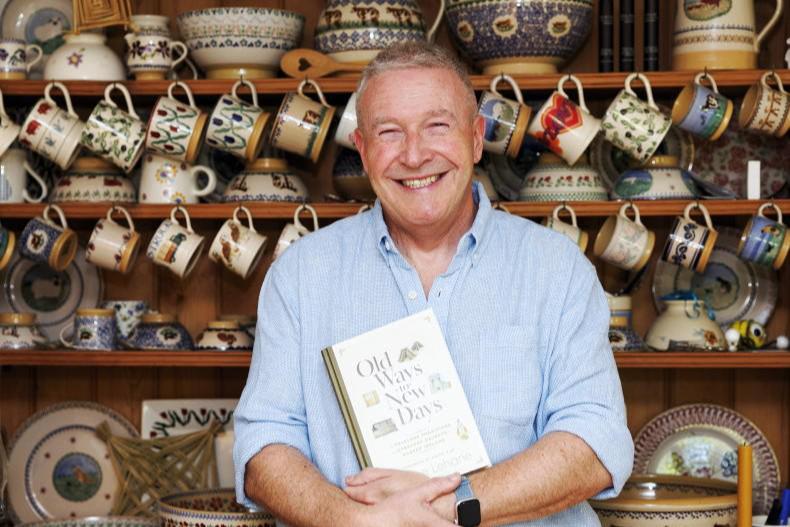
We’re often told to just keep moving and fix our eyes on the future, but folklorist and academic Shane Lehane has built his career on reflecting on the past.
“I think nostalgia has gotten some bad press,” Shane remarks. “People say we must always think of the future. Why are we looking back? Why are we being emotionally attached to our past?”
A firm believer that “our past informs the present”, Shane holds that: “without having an emotional attachment to the past, I think the past can become meaningless. It can almost be discarded in a kind of modern, almost capitalist way of thinking.”
All this forms the basis behind Shane’s new book, Old Ways to New Days: The Folklore, Traditions and Everyday Objects that Shaped Ireland. This is a collection and celebration of the rich and eccentric traditions that have gripped the island for centuries. Shane is a folklorist who lectures in UCC, and writes a monthly folklore column in Irish Country Living. He reflects on how we have ordered and ritualised points of transition in Irish life, with chapters dedicated to birth and death and the way these ‘circle of life’ moments are observed by an old Ireland.
“Everything had a symbol,” Shane says. “And we’ve lost the ability to read those signals. What I hope is that this book is going to start conversations.
“It’s not written for an academic audience. This is a book that is written for somebody who’s going to enjoy hearing and reviving all those aspects of Irish life.”
When reading the book, what is interesting to observe is why some customs have survived, and others not. Some traditions are lost to an ancient past (we no longer stop the clock when someone dies) but others are indeed universal.
One clear example of how folklore finds its imprint today is St Brigid, with crosses made and cloth cut around her bank holiday in February. The female saint is revered in Irish life, and is also “very important” to the author personally. “All my students, who would not see themselves as devout Christians are going to Brigid’s Holy Well, and they’re all continuing and maybe reimagining Brigid.
“To me, it’s always been the same [story], and it’s just that people re-emphasise and reimagine those really essential cosmological concerns that we all have.”
The same is true for the Irish language, which Shane describes as the “very heart and soul of our cultural identity” in Old Ways in New Days. The language is intricately linked to the living traditions across the island, he explains, providing “a different prism through which we explore our sense of place or sense of the world.”
“Whether it has to do with things like weather or place names or the way in which we greet each other, there’s a different way of being through the language,” Shane continues.
In a chapter detailing the part that the weather occupies in the Irish psyche (we are, as Shane puts it, “a nation emphatically obsessed and communally consumed” with weather), he unpacks the multitude of expressions as Ghaeilge for rain.
These include braon báistighe (a little shower of rain); braoille fearthana (a heavy shower of rain); and spéachán (a spit or kick of rain). They serve as cultural signifiers of our excellent understanding of the wet.
“All those words for the way we describe rain are a part of us, and we’re all celebrating it now,” says Shane. “Before we never even knew that we were doing it.”
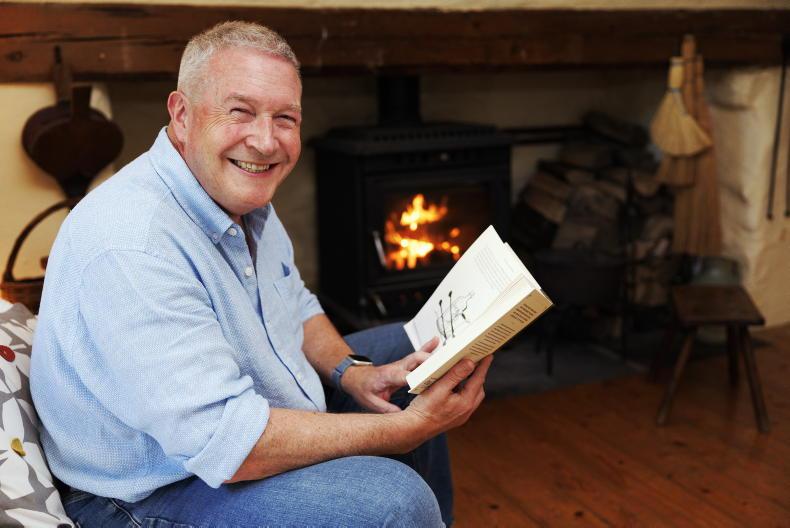
Influences like TG4 and the Gaeltacht have renewed an enthusiasm for our native language, Shane adds, but it was not always this way. “When I went to school, it was tough,” he says. “The language was being pushed upon us, and as soon as you finished school, you went away from it because there was no place to use it.
“Now people are proud of saying ‘slán’. There’s a sort of a contentedness to doing that, whereas before you were judged – you either had to be fully fluent or you didn’t speak at all. And I think people celebrating the language is giving them confidence to use their few words.”
Talking to Irish Country Living in his home in Cork, Shane explains that ironically, it was outside Ireland and in France where he wrote much of Old Ways to New Days.
“I have a mobile home in Fouras, a seaside town just south of La Rochelle and each morning I got up at half past six, and I wrote most of the book over the summer months.” The geographic distance gave Shane “a clarity” to think about Irishness and the way that it has manifested itself over time.
Peppered throughout are also quirky and humorous illustrations hand-drawn by Sara Baker, a Northern Irish artist. The book would not be the same without them, according to Shane.
“Sara’s magnificent, beautiful illustrations gives the book an incredible energy, it brings the text off the page,” he enthuses.
Evolution of media
Old Ways in New Days takes the reader right up to the present day. Shane’s reflects on the evolution of newspapers, radio and television, pointing to the rapid pace of change that defined the late 20th century. Now social media and AI are part of the conversation.
“It’s the same argument, isn’t it?” Shane responds. “We’re talking an awful lot about AI [these days]. Before we were talking about satellite television and radio.”
The cultural anthropologist is remarkably unfazed by AI. “I believe in humanity,” Shane resolves.
“I think there is an equal wave at the other side. There are other aspects of human endeavour, friendship, conversation, human contact, singing. AI is not going to get rid of it.”
Having worked in folklore for over 35 years, one could assume that Shane has uncovered everything there is to know about Ireland’s cultural and material heritage. But he insists that he is “always learning”.
“I have people writing to me, meeting me, telling me things, giving me information. That’s increasing rather than decreasing.”
A self-described “sponge”, he soaks it all up. That ‘other Ireland’ will always hold fascination and intrigue for Shane, and in his book, he beckons us in.
Old Ways to New Days: The Folklore, Traditions and Everyday Objects that Shaped Ireland by Shane Lehane is published by Hachette Books Ireland, Hardback, €18.99.



SHARING OPTIONS