



I had reason recently to be invited to a place called Tubbereenmire. There is an enjoyment in articulating this oft-unspoken placename. The slow pronunciation of its component parts: ‘tubb – ereen – mire’ roll around in one’s mouth. Regardless of such lyrical pleasure, it does little to define its location.
Tubbereenmire is neither a village nor a townland, but a simple crossroads, somewhere in the ‘Bermuda Triangle’ of interlacing roads and boreens tangling their way between the villages of Carrignavar, Watergrasshill and Glenville, a few miles north of Cork city.
The name in English comes from the Irish Tobairín Maighir, ‘the little well of Maighir’. A gentle local man, Donal Scanlon, has upheld the many previous generations’ dedication of caring for this tidy, holy well that nestles in one corner of the crossroads. Its low surrounding walls and pillars are painted bright white and topped with Holy Mary blue. There is a pathway of quartz stone lining a short avenue to the small covered well. The clear source of water is surrounded by a few holy statues and a flush of white lilies bursting from their clustered green leaves.

The inscriptions on the entrance pillars demarcate the holy well as ‘Tobairín Muire’ and ‘The Virgin’s Little Well’. An alternative name origin is given in a local legend that tells of a Catholic priest, Father Mires, whose church was at the nearby Killeagh crossroads. He used to come to the holy well for water to perform baptisms. This was during the time of the Whiteboy insurrections of the late 18th century, and as a priest he was hunted down and killed and the well bears his name.
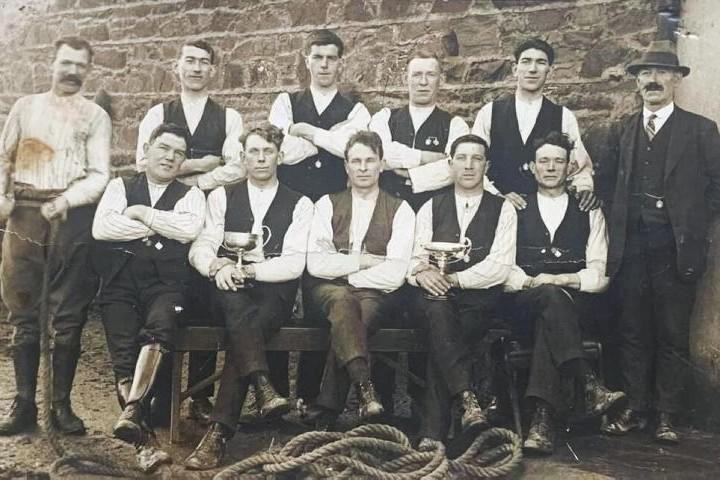
In the 1920s, Tubbereenmire Cross was well-known for those attending the point-to-point races of the United Hunt and the coursing meetings of the Barrymore club. Its familiarity was defined primarily as the location of Hickey’s forge, the then indispensable facility for all Irish farming life. Jimmy Hickey, like all blacksmiths ‘bellowsed’ the forge fire and with the sweat of heat and manic exertion, he pounded his heavy sledgehammers, shaping the red-hot irons on the anvil to make the tool for every trade and every chore. He put the teeth in harrows, banded cartwheels, shoed draught horses and donkeys and patched the holes in old kettles and bastible pots. The blacksmith was invariably the strongest man in the district and in the 1920s, Jimmy Hickey was the anchorman for the Tubbereenmire tug-of-war team. This extraordinarily powerful team was made up of the strong local farmers who congregated at the forge.
Tug-of-war
Tug-of-war as a competitive sport became very popular from the late 19th century onwards and was specifically associated with army regiments, police constabularies and fire brigades. In turn, teams were formed from organisations and professions where marked physical strength was demanded, including brewers and millers, along with a famous team made up of the staff of the Cork Mental Hospital.

Throughout the countryside, local districts formed their own teams and tug-of-war pulls were a highlighted feature of sports days and fairs. The best tug-of-war teams were on the road through the summer months and well-regarded teams such as Ring in Co Waterford and Croom in Co Limerick would travel to contest against the best. In those days a gold medal was made of solid gold and while these were an added bonus on the big occasions, the real reward was in the pride of victory. Such was the strength and prowess of the Tubbereenmire men, they would regularly field two teams, A and B, and their A team won all around them.
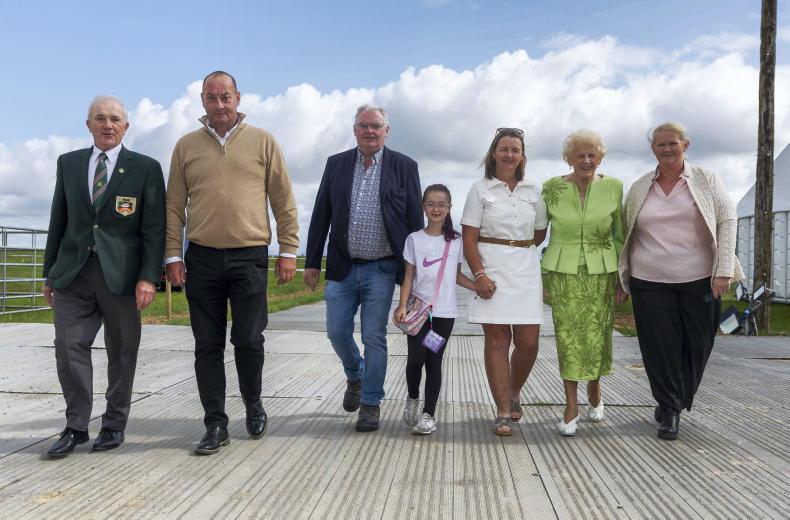
Recently, I was afforded the great honour of being asked to unveil a commemorative plaque beside Hickey’s forge in Tubbereenmire celebrating the tug-of-war team of 100 years ago. I was delighted and humbled to do so as a substantial crowd of more than 200 others made their way there.

On the night, the crossroads of Tubbereenmire was no longer a forgotten nowhere but the focal point of memory and the living, beating heart of a proud community.


SHARING OPTIONS