



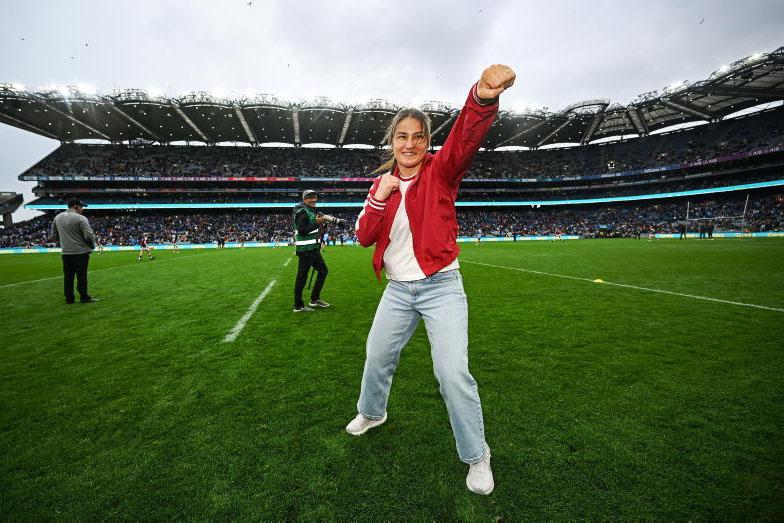
Last week, we noted how the absence of Gaelic games action from Croke Park in August and September had allowed for novelties like the friendly meeting of the Manchester United and Leeds United.
That brought a full house and this Saturday night a former Republic of Ireland women’s soccer international will play before a capacity crowd on Jones’s Road – though boxing rather than association football will be the sport on show.
It has taken a while to happen, but Katie Taylor, in her professional swansong, will finally have the opportunity to fight in front of a home crowd as she takes on French boxer Flora Pili for the various world super-lightweight titles.
In the past, when the possibility of Katie performing on a Croke Park card was raised, fears were expressed about the ability to fill the stadium – but, when tickets went on sale, they were accounted for at the rate of a global music superstar. You know that the promoters are earning enough from the event when they can allow it to be shown on free-to-air television – RTÉ providing coverage for those unable to attend – rather than hiding it on a subscription platform.
Local hero
Katie turned 40 in July, while Pili is 28 and, more pertinently, undefeated. This won’t be a Harlem Globetrotters-v-Washington Generals set-piece where the local hero is sure of the win. That should of course make for a better contest but it also underlines just what a success the Wicklow native’s professional career has been.
It’s a decade since the disappointing Olympic quarter-final defeat which proved to be her last amateur outing. Turning pro shortly after her 30th birthday was a move that came with more than a few risks, or could have been seen as a brief stunt to maximise earning potential.
Instead, 26 fights have yielded 25 victories and, as Boxing Ireland chief executive Gary Stewart points out, with the chance to sign off in a perfect fashion.
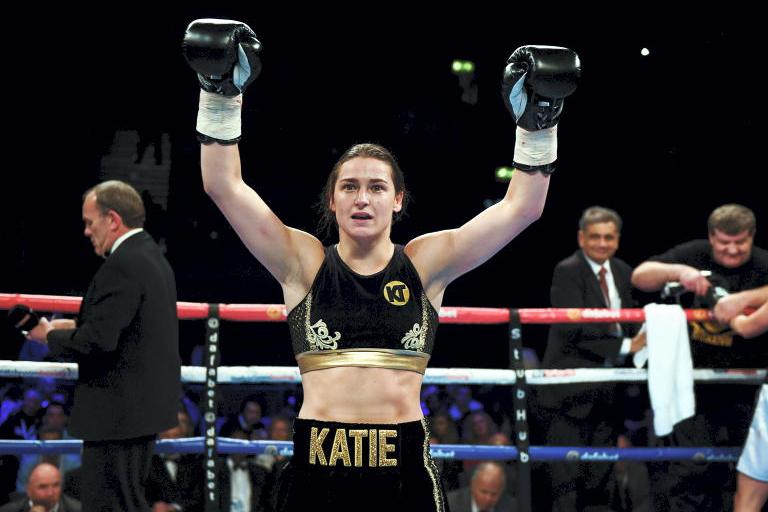
“I think this being the farewell is very romantic and poetic in many ways,” he says.
“Katie Taylor is a great Irish brand and good things come to those who wait.
“I think maybe they tried to do this four, five, six years ago, but in that time, her stock has only risen and what she’s done for professional boxing globally has been incredible.
“You have male boxers now wanting to fight on her undercard, which would have been unheard of 10 or 12 years ago, or even five years ago.
“There’s always a gamble when somebody goes from amateur Olympic-style boxing, as we call it, into the professional game where there’s a lot of unknowns and a lot of uncertainties.
“I think her drive and determination meant that she grabbed all of that with two hands and really drove it forward. And it’s more than just for herself, it’s what she’s done for other female professional fighters and it’s a great part of her legacy, really.”

The relatively late switch has stood to her in other ways too, Stewart believes – not least in how the way she carries herself outside the ring contrasts with the bombast that surrounds the professional code.
“In amateur boxing, which is our business, we have great role models across the sport and they’re steeped in humility, respect and character,” he remarks.
“I think when you go into professional boxing, it’s more about selling tickets and creating the grudge match.
“You get this, what they call trash-talking, and I think Katie has been the antidote to that in many ways.
“I think she’s probably the role model and the ambassador that professional boxing actually needed to show that there’s another way of doing this, to sell 80,000 tickets while being humble and then full of humility and respect.
“That shows there’s another way for professional boxing to behave.
“We’re very lucky in amateur boxing that that’s pretty much all of our boxers. Katie’s come from our community and understands that.”
Roll-call
The roll-call of those who have come in Katie’s wake is a strong one. The hope for Stewart and domestic boxing as a whole is that the trickle-down effect can continue as Irish female boxing’s footprint continues to grow.
“We’re very lucky that we have such great female role models,” he says.
“Obviously there’s Katie, we have Kellie Harrington, who’s a double Olympic champion, Aoife O’Rourke who’s a world champion, you’ve got Michaela Walsh, Gráinne Walsh, Daina Moorehouse – all top-class athletes.
I think her drive and determination meant that she grabbed all of that with two hands and really drove it forward. And it’s more than just for herself, it’s what she’s done for other female professional fighters and it’s a great part of her legacy, really
“In terms of participation, boxing is growing; our stats are increasing around 15% from a participation point of view, year on year.
“I think, since Katie’s success, there has been a spike in the number of women and girls wanting to join boxing clubs, and the same with Kellie.
“After theTokyo and Paris Olympics, we would have got another spike of people wanting to be next Kellie Harrington – and that’s an increase in boys too, not just girls.
“Any time there is media attention on boxing in a positive way, and there’s success in the ring, then naturally, there is a positive knock-on effect on participation.
“That’s why it’s really important that we keep supporting our elite athletes to perform at the highest level.
“Once Katie has retired from being a high-performance athlete, hopefully we’ll see more of her and she can continue to inspire generations as much as she has in the last 10, 15, 20 years.”


SHARING OPTIONS