


Circumstance had me in Glasgow City Airport on Sunday afternoon with a couple of lads from east Clare. They’re hurling men and parish men, so as we waited for the plane home we listened live to the final of the All-Ireland junior camogie club championship.
The match was in Birr and the east Clare side Scariff-Ogonnelloe went down bravely by a single point to the reigning champions, Johnstownbridge. We followed it on local community radio, on a mobile phone, from Scotland. Isn’t technology wonderful?
So is the GAA. This Sunday there will be a Cuala man or woman tuning in from further away than Glasgow. There’s a Leinster club final to be played, O’Loughlin Gaels await the Dublin champions in Portlaoise and you can be sure too that there’ll be folk in some corner of the world accessing the internet come 2pm on Sunday.
This internet yoke has been some boon to the GAA. To all you young ones out there, it wasn’t always this way. You are spoiled. Once upon a time in the 80s, living in America, I would await the voice of a man named Eddie Holt at 2pm (7pm Irish time) on Fordham Radio in New York. Eddie would broadcast the results from home on Sundays and very often that was how we found out who won the big games of the day.
Living in London for a while in the same decade, on some Sunday afternoons I would get a transistor radio and take a train to Hamstead Heath. From there I would walk to the highest point of the park and search for a signal from home. Before you conclude that I was mad, I would meet various Irish people there, walking around holding radios above their heads. We’d all end up in a group, gathered around whoever had the best reception.
Later in the year when the All-Ireland semi-finals and finals would be broadcast at home, we’d (willingly) pay $20 for the privilege of watching the games live early in the morning in the States. In London, long before mobile phones and texts were around, rumours would sweep the city of the potential venues showing The Sunday Game on a Monday night.
While the club championship wasn’t as popular back then, as ever it mattered if your club were involved. To many exiles, it might have taken until The Kerryman, Anglo-Celt or Nenagh Guardian were out on a Thursday or Friday before they knew how their club got on.
Today, you can follow a game, blow by blow, on Twitter and chances are you will be up to date on the score before a man in the stand at the actual match can look up at the scoreboard. It is that instant.
Rough with the smooth
With this explosion in technology and such rapid access to information comes pitfalls, of course. The internet doesn’t really come with a filter. The GAA, like any organisation of its reach and size, has shown vulnerabilities on this front, with various websites libelling and personally attacking players and officials alike.
There is very little the GAA can do about this, as employing the necessary army of technical experts and solicitors to quell the keyboard warriors isn’t feasible. And I suppose this is the price we must pay for being able to sit on a beach in Indonesia and listen to the Leinster club final in December.
Maybe with all this technology someone could figure out, by the way, why the Leinster club hurling final is being played in December. Hopefully the dry weather being forecast will make the Portlaoise surface hurling-friendly because this has the makings of a right good contest. Cuala come in search of their first Leinster crown, although losing last year’s provincial final to Oulart should be fresh enough in the memory.
I fancy the Dublin champions to make a form of history on Sunday and win a very elusive Leinster club championship. How elusive are they for Dublin sides? Well, incredibly, Dublin only have one Leinster club crown to their credit, won way back in 1979-80 by Crumlin. That’s a staggering statistic when you consider the playing population of Dublin, allied to the growth of the game in the capital in recent years.
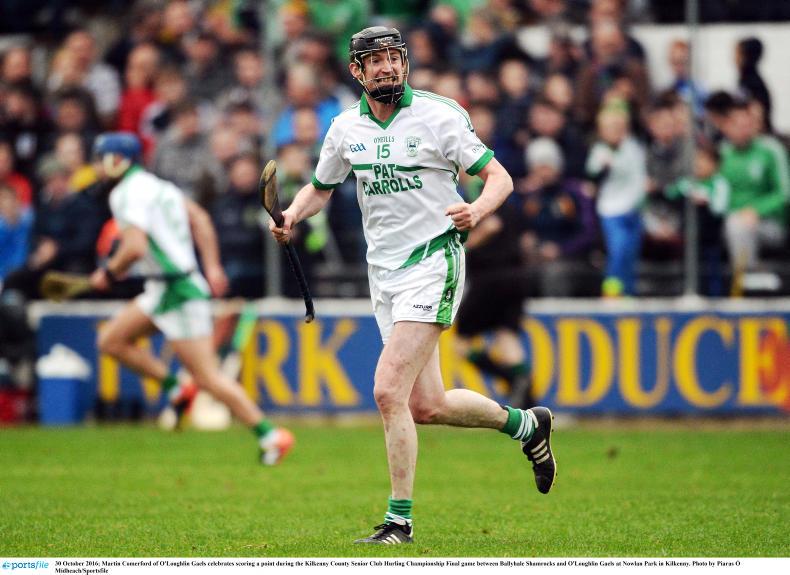
Kilkenny also struggle at provincial level, having only won 19 titles. O’Loughlin Gaels have won two of those, back in 2003 and 2010. A staple on their side is Martin Comerford and this warrior turned 38 years young a fortnight ago, yet he is still their inspiration – every point he scores appears to be worth double.
This is the magic of the club competition: players like Comerford have a second, third, fourth or fifth coming. That inter-county cuteness/touch of class can last a lot longer than the legs; ‘Gorta’, as he is fondly known, has proven that. It is six summers since he graced the black and amber; he still looks the part in the O’Loughlin Gaels’ white and green.
Mark Kelly and Mark Bergin are in Cody’s mix in recent times, even if neither have really nailed down a county place. They are key to the Gaels though, and both shone in the comprehensive win over Oulart, who it must be remembered were defending Leinster champions.
The Dubs have a few stars they can call on too: forward Con O’Callaghan has hit 5-6 in his last two championship starts while David Treacy and Mark Schutte are well known and capable players.
Of course, games in December can often be won by the unlikeliest and unheralded of club players. That’s the beauty of the AIB club championship. It is where local legends are made.
Dublin hurling needs the boost a Leinster championship going to the south of the city would bring. That’s what can happen here.
You could do a lot worse this Sunday than tune in. There’s internet, Twitter, Facebook, Instagram, etc, or if you’re a bit old school like myself, the wireless or the television. CL


SHARING OPTIONS