


Growing up, I sometimes felt that other children had far more exciting lives than mine – so much more seemed to happen to them compared to my mundane quotidian existence.
As I grew up, I understood that I simply didn’t have the ‘exaggerate everything’ gene: as a journalist charged with dealing in facts, I now see that as a strength. I’d like to think that most of our readers would also favour straight talk over embellishment.
Apropos of nothing, the northern hemisphere leg of rugby’s Nations Championship commences this weekend. For those who haven’t spent the week celebrating, let’s revisit the quotes from Ronan Dunne, chair of Six Nations Rugby and co-chair of the Nations Championship, from the summer, prior to the opening set of games.
“The launch of the Nations Championship is arguably the most significant evolution in the sport since rugby turned professional,” he said.
“More than just a new tournament, it is a demonstration of the power of collaboration, and a shared vision to redefine the future of the sport.
“Created by the game, for the game, its players and the fans, the Nations Championship stands to be a major catalyst for growth, and its inaugural edition this year marks a landmark moment for a sport that is ready to go truly global.”
Bums on seats
We get it – every professional sport is in the business of selling the product, attracting more bums on seats and television viewing figures. Against that, something as amazing as what is described above shouldn’t need any marketing bumpf to promote it.
Which is not to say that the tournament is without its merits. In the top tier, the Six Nations countries form one conference, with the other section featuring teams from The Rugby Championship – Argentina, Australia, South Africa, New Zealand – as well as Fiji and Japan.
Running in alternate seasons, avoiding World Cup and Lions years, the format is that each team plays the six countries in the opposite conference once – three in the southern hemisphere during the summer and then the other three in traditional November internationals slots in the north.
Then, the finals weekend pits each northern hemisphere side against its equivalent in the southern table – first v first, second v second and so on. Thankfully, given Ireland’s historic World Cup travails, there are no quarter-finals.
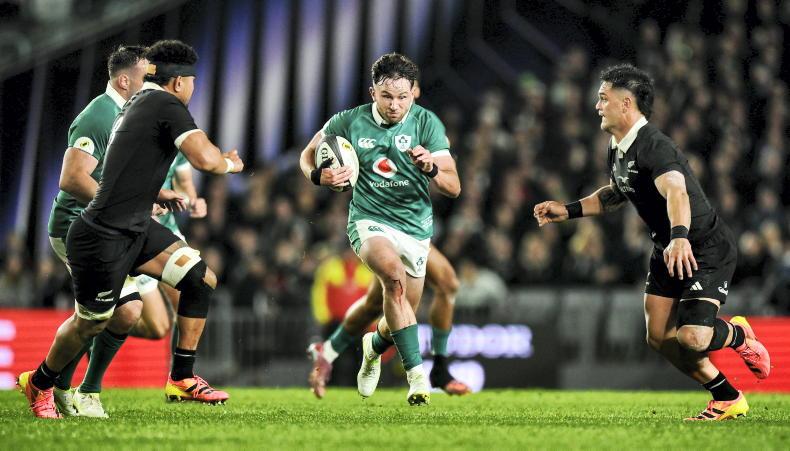
Having beaten Australia and Japan in July before losing to New Zealand, Ireland complete their schedule over the next three weekends, with Argentina and Fiji visiting Aviva Stadium before the world champions South Africa are in town on 21 November.
The schedule means just one ‘marquee’ home fixture, rather than the two big hitters Irish supporters have become accustomed to welcoming, although a high finish would guarantee another tie.
At the midway point, Ireland lie in fourth in the northern table on 10 points, albeit just two behind leaders France – there is a possibility that the game against the Springboks could be the first of a double-header, depending on the countries’ placings.
The inaugural finals will take place at Twickenham on the last weekend in November, with double-headers on the Friday, Saturday and Sunday.
It will be interesting to see attendance figures for those games: it is asking a lot of supporters to travel with less than a week’s notice of time and date of their country’s game, though one would expect that a few package deals have been sold. In any case, such is the nature of modern sport, it’s likely that the broadcasting deal will feather the organisers’ nests more than those through the turnstiles.
The increased competition means an extra consideration for management teams looking to build towards the 2027 Rugby World Cup. Whereas the games against the sides outside of the southern hemisphere ‘big three’ used to afford greater opportunity for squad rotation as fringe players were given a chance to shine, now the chase for points casts more of a shadow.
Counter-argument
The counter-argument is that the heightened intensity should act as a better test of those being auditioned. In any case, a sizeable injury list, featuring captain Caelan Doris, out-half Jack Crowley, Jack Conan and Iain Henderson among others, demands that Andy Farrell has to go down the depth chart.
Even with so many unavailable, the make-up of the initial 36-man squad starkly illustrated the current balance of power – 17 Leinster players, nine from Ulster, eight from Connacht and just two from Munster.
The perceived snub might have been fuel for the southern province’s fire in opening their Champions Cup campaign with a win against Racing 92 and added a subplot, as if it were needed, to the URC clash with Leinster a week later, with the hosts winning 24-18 at the Aviva.
For the next month, tribal loyalties are cast aside and everyone pulls together under the green banner.
The world rankings currently place Ireland third. By the end of November, we’ll have a much clearer idea of how well that reflects their standing in “a sport that is ready to go truly global”.

