



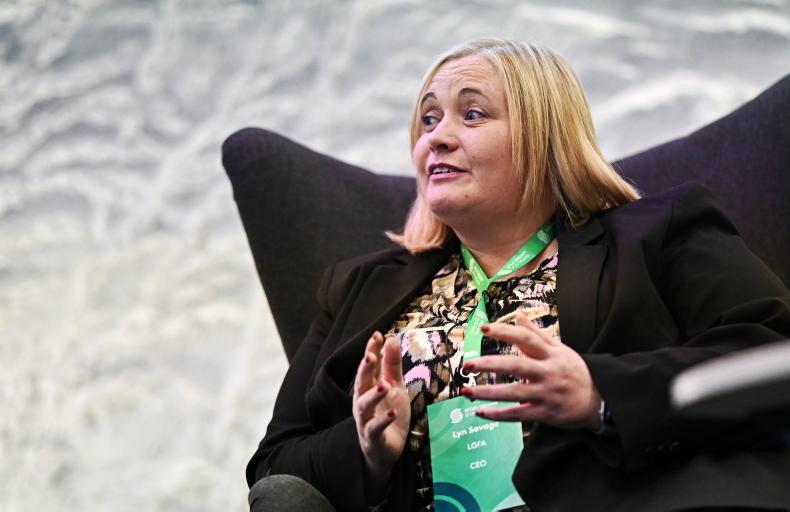
In one sense, Lyn Savage’s progression to the role of CEO of the Ladies’ Gaelic Football Association is a small step; in another, it’s giant leap.
The Louth native took office in early March, succeeding Helen O’Rourke. In addition to a stellar playing career with Cooley Kickhams and the Louth inter-county side, Lyn’s professional life has revolved around Gaelic games – work as a coach with Dublin County Board was followed by regional and then national development postings with the LGFA.
It was as the association’s national development manager that she last spoke to Irish Country Living just over a year ago – an ideal grounding for ascending to the top job but, equally, there is a sense of going into the unknown for Lyn.
“I’m 18 years working in ladies’ football,” Lyn says, “and you kind of think you knew what it was but it’s very different when you’re in a different role and trying to get your head around everything that’s in it.
“It was great, the fact that I did work that length of time here, because I had the background in so much that was happening. It’s been a whirlwind, don’t get me wrong, but enjoyable to get your feet stuck in.
“The development job covered a very broad spectrum from volunteer, coach, player, match official and then obviously participation, all the development of those areas.
“It meant I had a really deep understanding of everything from grassroots, which I think is extremely important for this role, you understand what is happening and what support is needed.”
With her predecessor having served for the best part of three decades, any change was going to be a significant one for the LGFA. In as much as Lyn is a natural fit as a successor, she still had to properly consider the matter.
“It was a very big step to actually put my name forward for it,” she says.
“I mean, Helen O’Rourke had been amazing and the shoes you were going to have to wear, weren’t exactly easy shoes to be filling.
“So I did put a lot of thought into it in relation to, was I going to be the right person to bring it to the next level?
“After much consideration, I was like, ‘You know what, put your name in the hat, and see where it goes.’
“I’m just passionate about the sport and where we go next and I wanted to be part of that.
“My biggest thing starting off is just bringing stability to everything, that was the key word I wanted.
“Building from that is just trying to bring the sport to another level in relation to participation and then it’s just ensuring that we continue to operate at the highest standards that we can, to make sure we continue to grow into the future.”
There are no better role models than people you can meet in your local community and there’s an onus on us to make sure we get that visibility out there
That growth will of course encompass the integration of the GAA, LGFA and Camogie Assocation, with all three organisations set to vote on the matter in the autumn.
There may be some adjustment, but Lyn feels that there is a lot of potential wrapped up in that change.
“There will be changes needed for all of the associations involved,” she says, “otherwise it’s not an integration.
“It’s a hugely significant and positive step for Gaelic games and we’re trying to create a more aligned, efficient and inclusive structure for everyone.
“It will be really important now that we listen to the stakeholders because that will be critical, to ensure that everybody feels their voices are part of the process.
“That transition then will have to be very carefully managed and be transparent. I think there has to be changes for each code to make this work, but I think the biggest thing for us is it gives us massive potential to drive real progress in Gaelic games.
“At the same time, we need to make sure we maintain the momentum of ladies’ Gaelic football.”
And it is a development which brings its own opportunities and challenges all wrapped up as one.
Real Growth
“With Gaelic4Mothers and Others and Gaelic4Girls, there’s real growth potential for ladies’ football,” Lyn says.
You’d wonder where those women would be now, would they be lost to Gaelic games if that initiative wasn’t there? So there’s a huge potential there.
“The other big growth potential is the visibility. We have a lot of new audiences that want to see us and we announced a renewal of our broadcast deal with TG4 recently.
“I think what we really want is to make sure when our players are walking down the streets, that they’re being recognised as key role models, which they are.
“There are no better role models than people you can meet in your local community and there’s an onus on us to make sure we get that visibility out there.
“The growth is a challenge in itself, because you don’t want it to outgrow itself.
“But also, we need more coaches, we need more referees, we need more administrators. So there has to be potential to make sure we bring all of those to sustain the growth that has happened player-wise, because they need all of those support structures.
“It’s a positive, but it can also be a challenge. But with that, sometimes seeing all these new members coming in, we don’t want it to overshadow if we are losing players, particularly around those teenage years.
“We’ve put a huge amount of time into Gaelic4Teens and Spreag Í and different programmes. The biggest thing we need to be conscious of in all of this is the demand that’s putting on volunteers.
“The demand that’s there, we need to be very conscious of, and balancing our amateur ethos versus the expectations of what the performance of everyone should be.”


SHARING OPTIONS