



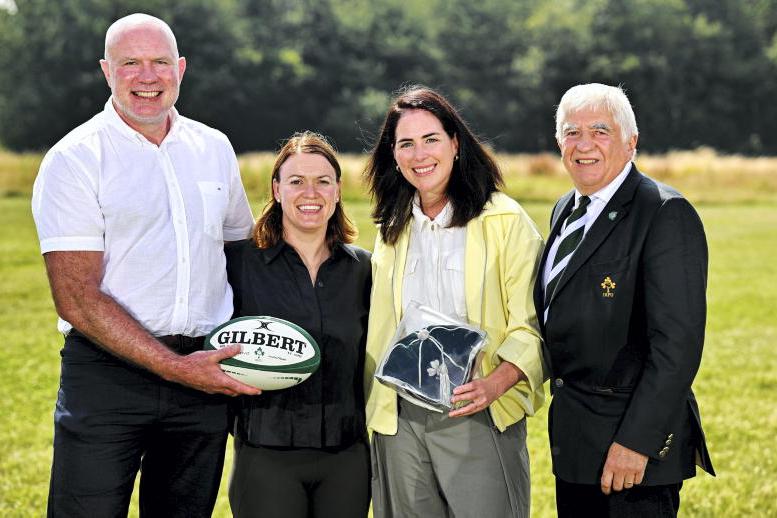
Last month, the Minister for Culture, Communications and Sport, Patrick O’Donovan, and Minister of State, with responsibility for Sport and Postal Policy, Charlie McConalogue, announced a €4m investment under the Women in Sport (WIS) Programme for 2026.
It marked the third straight year that such a figure has been committed and represents a doubling of the 2022 amount. Rather than simply being a stipend for governing bodies, however, the monies are targeted towards areas such as active participation, coaching and officiating, visibility and leadership.
In terms of overseeing the implementation of the programme, Nora Stapleton – Sport Ireland director of strategic national governing body programmes and Women in Sport lead – is very well-placed, having been a high-achieving woman in sport – or, rather, woman in sports. As well as winning the Six Nations twice with the Ireland women’s rugby team, she represented her native Donegal in ladies’ football and played soccer for UCD, giving her a keen insight into the progress made in the area.
“It’s about fairness in sport now,” she says.“I guess I don’t really compare too much anymore to when I used to play, because it was a different time.
“Society’s attitudes to women were different, attitudes to sport were different. Those who were making decisions for sport would have clearly identified the male side of that sport as the important side.
“When I was younger, it was whatever you did in school and that was based on the teacher – a lot of the time, it was ball-sports but not everybody would be into them.
“We probably didn’t have any opportunities in any of the water sports or, say, martial arts or things like that or orienteering and athletics might have been once a year when it came around to that being in place in school.
“Those opportunities are there now and that’s really important, so that kids get to try out different things and get to really work on their physical literacy, because that stays with you then through adulthood.
“Then, if you are interested in certain sports, there tends to be more of a pathway now through a club, before you might be lucky if there was a team at every age-group, whereas now I think you do have that.
“Obviously, it’s different in different parts of the country, but I definitely think the opportunity to play is increased and there are more options of different types of sports for you to do as well.”
Female side
In order to provide for those wishing to participate – especially on the female side – national governing bodies need assistance to allow them to target particular areas.
“Things have progressed but I’m not going to say it’s 100% there because it’s definitely not,” Nora says.
“There is still a sense in some quarters that ‘the girls, they don’t really get as many spectators, so they don’t need as much of the budget.’
“The €4m has been there for the last two funding cycles and this is now our third funding cycle and it makes such a difference.
“It allows the national governing bodies to innovate, to be creative and to try to be brave to do new things within their sports rather than just business as usual, because we need to be doing things slightly different from the female perspective if we’re to get more female coaches progressing through to high-performance coaching.
Society’s attitudes to women were different, attitudes to sport were different. Those who were making decisions for sport would have clearly identified the male side of that sport as the important side
“If we’re to look at leadership and governance within organisations, if you’re to look at participation and increasing that.
“The structures that are there have been there for years and some of them are fantastic at engaging women and girls, but others need to be slightly different.
“This funding and how we encourage the use of this funding is, ‘Where are the gaps, what have you identified, where do you need to be?’ kind of over-emphasised from a female or girls or women point of view in order to close that gap, and so therefore we allocate money based on those projects or programmes.”
Monitoring
However, just as important is the continued financial input, rather than a one-off injection with no monitoring of progress. Nora outlines how important the commitment from the various stakeholders is.
“From our side, we use data and research, so all the work that we do is evidence-informed,” she says.
“If we’re encouraging programmes or initiatives in certain topics, it’s based on the research that we have and we encourage the sports to do the same.
“If you don’t have an action plan or a strategy, it makes it hard for that national governing body to see any impact with that funding.
“Without the commitment from the minister and the Department of Sport, this funding wouldn’t exist. Ireland has rated quite highly across the world for the work that we’re doing under women in sport and that’s because we have strong commitment from senior leadership in government and the Department of Sport and we’ve good leadership here in Sport Ireland as well.
“Any of the progress that we are having, we’re certainly seeing it because of that leadership and commitment shown to women in sport. But we definitely know as well, from working with other countries internationally, that all of us still have a long path to travel, because things can be quite fragile.
“As soon as you take the foot off, you start to see participation gaps widen, you start to see numbers drift off in terms of who’s coming through coaching courses, you start to see a change in attitude on the boards and committees and in organisations.
“It’s great to have that leadership and commitment and it’s needed, so that we can keep driving this momentum forward.”


SHARING OPTIONS