


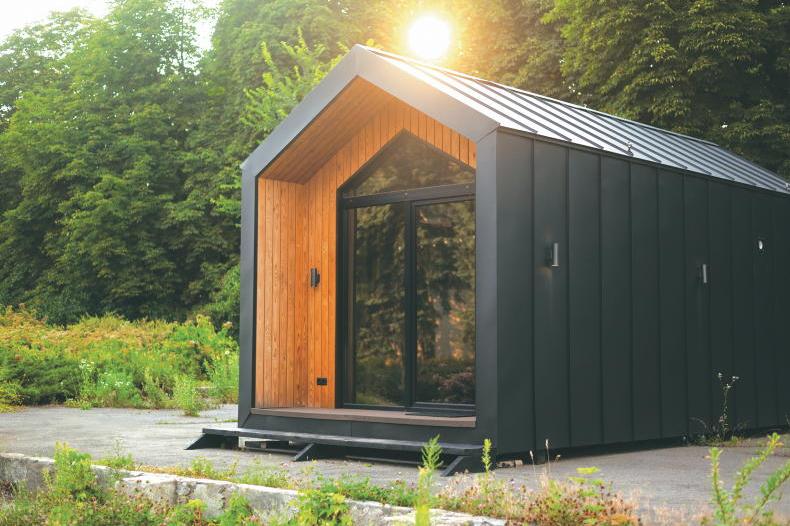
Question: My daughter is farming at home with us. She was trying to buy a house but there are none coming up for sale within her price range. She is now contemplating building a modular house behind the farmhouse to give her some independence. Is there anything we should be aware of before giving her the go-ahead, like planning permission, etc? I know there are conditions, but I’m not sure what they are. Can you advise?
Answer: Since 27 July 2026, the Planning and Development (Exempted Development) Regulations 2026 allow a detached ‘auxiliary dwelling’ to be built to the rear of an existing house without planning permission. This new Class 3A exemption covers units of between 32 and 45 sq m, and applies to works carried out up to the end of 2030.
The conditions are strict, and you should check each one:
1. The unit must be in the rear garden of the farmhouse, within its curtilage. A unit ‘beside’ the house, or out in a field, will not qualify.
2. It must stay part of the main property. It cannot be sold or let separately, or used for short-term letting.
3. It cannot have its own connection to water, electricity or waste water; services must run through the farmhouse.
4. It must be set back at least 0.6m from walls and boundaries.
5. You must notify the county council at least 14 days before work begins.
6. Any conditions attached to the original permission for the farmhouse still apply.
If your daughter wants a larger home, a separate site, or the ability to own and mortgage the house herself, this is not a viable option for her.
Regulations and services
An exemption from planning is not an exemption from the building regulations. The unit must meet the same standards as any home for fire safety, insulation, ventilation and structure.
Buy from a reputable supplier whose product is certified for Irish use, and have an engineer or architect oversee the foundations and installation. Because the unit must share the farmhouse services, check that your septic tank or treatment system can cope with the extra load. Be sure to tell your home and farm insurers about the new building before it is occupied.
Who owns the house?
This is the issue families most often overlook. Anything built on your land becomes part of your land. Even if your daughter pays for it, the house legally belongs to you unless and until the property is transferred to her. It also means that most lenders will not give her a mortgage on it.
If she funds the build, she may later have an equitable claim against the farm, and these disputes can be bitter and expensive. Put a written agreement in place, drawn up by a solicitor, setting out who paid for what and what happens if circumstances change such as she moves away, or the farm passes to someone else. Your own wills should also reflect the arrangement.
Transferring a site instead
If the long-term aim is for your daughter to own her home, transferring a site to her may be the better route. Generous reliefs apply.
A parent can transfer a site of up to 1ac, worth up to €500,000, to a child free of Capital Gains Tax (CGT), provided the child builds a house and lives in it as their main home for at least three years.
The child can also claim a refund of Stamp Duty of 11/15ths on a site transferred from parent to child for a principal private residence. From a Capital Acquisitions Tax (CAT) perspective, the value of the site is normally sheltered under the Group A Threshold, currently €420,000.
Tax implications for succession
Where the modular unit comprises a fully independent and distinct self-contained unit used or suitable for use as a residential dwelling, it may be regarded as a separate dwelling house for the purposes of the Dwelling House Exemption from CAT.
This could also impact on whether the modular home is regarded as a separate asset from the farmhouse for the purposes of Agricultural Relief from CAT.
Talk it through as a family
If you have other children, be open with them about the plan. A house on the home farm can raise questions about fairness that are far easier to settle now than after you are gone.
Before giving the go-ahead, sit down with your solicitor and accountant to address the issues as set out above and put the relevant safeguards in place.
Disclaimer: The information in this article is intended as a general guide only. While every care is taken to ensure accuracy of information contained in this article, Aisling Meehan, Agricultural Solicitors & Tax Consultants does not accept responsibility for errors or omissions howsoever arising. Email ameehan@farmersjournal.ie

