


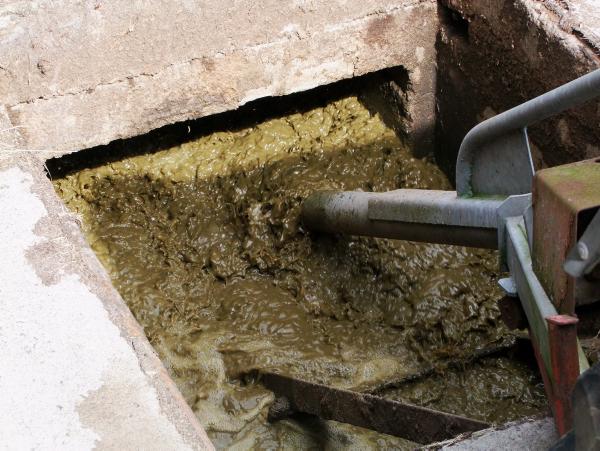
Grassland Agro recently introduced a product called Actiglene with claims of maximising N available in slurry and in turn maximising growth from applied slurry.
Recent trials in France have shown that cattle slurry treated with Actiglene can potentially increase available N in slurry from nine units to 16 units per 1,000 gallons through its ability to maximise N availability and reduce ammonia emissions.
The claim for the product is that by using Actiglene to treat slurry, N supplied to the plant from slurry is increased. Grassland Agro also claims that trials have shown that grass growth over three cut silage system was increased by one tonne DM/ha.
Other claimed advantages of Actiglene include that it has improved the breakdown of manure and improved the cleanliness of slats by increasing the liquidity of the manure.
Research also conducted on behalf of the Grassland Agro in France by Rennes Chemistry Institute in France has shown that, following agitation of treated cattle slurry, harmful and odour-causing gases were reduced by 83% and 53%, respectively.
This product has the potential to be very useful as slurry is a valuable resource that each farmer must use to its maximum potential. It is a cheap source of nitrogen (N), phosphorus (P) and potassium (K) is applied at the correct time. The utilisation of slurry to match crop demands can help to maintain soil fertility and maximise outputs from the land.
Each 1,000 gallons of cattle slurry has a nutrient equivalent to a bag of nine units of N, six units of P and 38 units of K. In terms of nitrogen, early spring is the best time to achieve best utilisation of applied nitrogen in slurry.
Research from Teagasc has shown that applying slurry in spring has a higher efficiency of N compared to applying slurry in June following first cut silage. The utilisation of cattle slurry N applied in spring is nine units/1,000 gallons, while the utilisation of cattle slurry N applied in June is equivalent to three units/1,000 gallons.
Better agitation
Jeremiah Browne, Castlewrixon, Ballyhea, Charleville, is an Actiglene user for this season. He is hoping to get the results of improved nitrogen availability and easier agitation from using the product.
He has a slatted shed that was converted from an older building with shallow 1.4 metre (5ft) tanks running the length of three columns.
He is feeding 65 weanlings and 35 year-and-a-half cattle in the shed and using Actiglene in the hope of getting better value from his slurry.
His slatted tanks run along each side of a central passage with an additional section crossing under the passage. The slurry can be difficult to move at times in the shed, so any product that can make it more liquid is useful to Jeremiah.
He is using one and a half of the 25kg bags of the Actiglene product per day in his slatted shed but as yet cannot confirm its effectiveness.
“The cattle seem drier and there is less of an odour from the slurry since I started using the Actiglene,” said Jeremiah.
“I’ve been using the product since the middle of October, so hopefully I will see the first results when we start to agitate and spread in a few weeks’ time.
“At this stage, I can’t tell whether the Actiglene is working 100% or not, but looking down through the slats, the slurry seems more liquid,” said Jeremiah.
“We’ll know when we agitate and then we will have to see how the grass performs in terms of the nitrogen uptake,” he added.
Nitrogen value important
Dairy farmer Declan Murphy, Effin, Charleville, Co Cork, is also a first time Actiglene user.
He is using the product on the slurry in his slatted shed in the hope that he will get the claimed benefits of better nitrogen utilisation and easier slurry agitation.
Declan has 95 cows and in-calf heifers in his shed that is almost 100ft square and has two tanks separated by a central feed passage. The cows have cubicles on the outer walls and the slatted passage, over 2.4 metre (8ft) deep, is cleaned by an automatic scraper.
Declan is using two 25kg bags of Actiglene per week.
“It is easy to apply, just let it down through the slats and it mixes itself,” said Declan. “While I’m willing to give the product a trial, I can’t give an opinion on it yet,” he added, “but we will know as soon as we start to spread the slurry before the end of the month.”
The main reason for using Actiglene is that he was impressed with the claims of improved nitrogen utilisation.
“Since we started to use slurry properly, we have started to appreciate its value, and maybe this will make it even more valuable, but it’s early days yet,” he added.
Declan is currently using the Actiglene in both tanks of the cattle shed. When he empties the tanks later this month, he aims to carry out his own trial by leaving one side without Actiglene while using the other with the product. This will give him a first-hand valuation of the slurry enhancing product.
Emptying the shed will also tell a tale about the effectiveness of Actiglene. Normally, Declan adds up to four tanker loads of dairy washings into the slurry tanks in order to help with agitation. This year, he will also be able to assess the difference, if any, from for his pump type agitator, following the use of Actiglene.


SHARING OPTIONS