


Replacing a set of tyres for a four-wheel drive tractor can run into thousands of euros. This highlights the need to prolong the life of your tractor’s tyres, and that starts with tyre pressure.
Regular checks of the tyre pressure are crucial. We know that over-inflated tyres do not flex as designed; they do not absorb shocks and reduce the amount of tread contact with ground. Over-inflated tyres are more vulnerable to cuts, snags, impact breaks and rapid tread wear in the centre of the tyre. On the other hand, under-inflated tyres flex too much on the sidewall. This results in excessive flexing of tyres and casing break-up, radial cracks, tread or ply separation, tyre slip on rim, excessive heat generation, excessive bead rocking in the flange area, rapid shoulder wear or uneven wear. Under-inflation will lead to premature tyre failure.
Tyre pressures also affect fuel economy. For tillage operations, lowering tractor tyre pressure and forward speed can deliver fuel savings of up to 25%.
That’s why investing in an accurate tyre gauge is a useful place to start.
Ploughing pressure
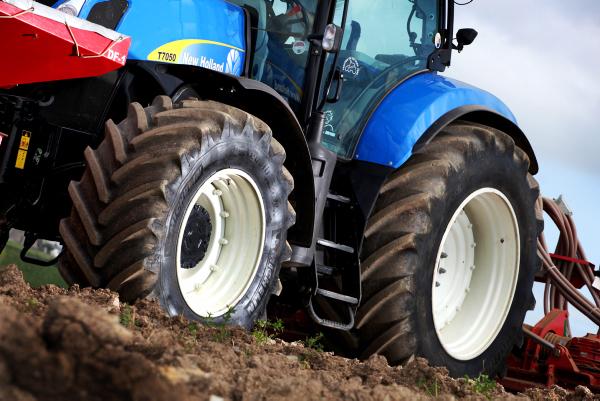
Ploughing is one of the most fuel-hungry activities in agriculture, but tyre strategies can make it more efficient. A study carried out by Efficient20 in Europe examined how adjusting tractor tyre pressure according to the type and condition of the ground could improve efficiency.
The results showed that the highest reduction of fuel consumption of up to 25% could be achieved by lowering the tyre pressure and lowering the engine speed of the tractor. Reducing only the engine speed of tractor from 1800 to 1600 rpm was found to reduce fuel consumption by 8-12%, depending on the defined tyre pressure.
Tyre pressure reduction led to 15-18% fuel savings, depending on the defined engine speed of tractor. Fuel consumption also depends on different working conditions, such as soil type and moisture, soil compaction, different speed or working depth, etc.
For a slurry tanker drawing from the farmyard to local fields operating at a maximum speed of 10km/h, air pressure of 25psi may be acceptable. However, for roadwork, you need to increase the air pressure according to the speed so as to avoid overheating the tyres while travelling on the road.
As a general rule, the difference between 10km/h operating speed in a field and 40-50km/h operating on a road will mean a variation of 10-12psi for tractor and tanker tyres.
There are now plenty of tyre pressure calculator apps available from almost all of the tyre manufacturers. These are accessible in the field and should be used to establish and then set the correct tyre pressure in the field
In many cases the user has to input the tyre dimensions and load index, both of which are shown on the side of the tyre, as well as the axle and implement weights, and these calculators will give the optimum inflation pressure for the application.
Reduce your soil compaction
1. Visually check tyres on a daily basis and make sure that there is a cap on each valve.
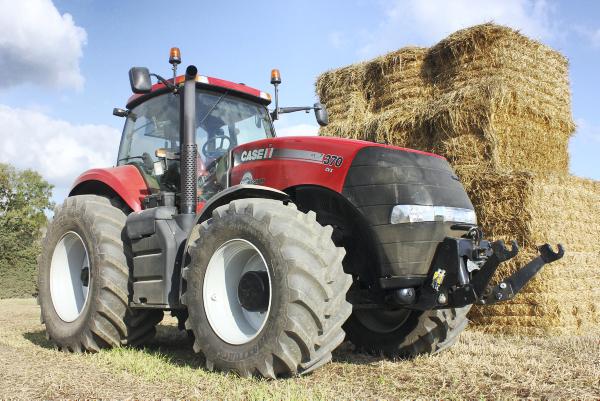
2. Use widest, largest tyre size possible (large profile/large volume) or use duals/triples to increase contact patch on ground and minimize air pressure.
3. Use proper pressure in tyres.
4. Check tyre pressure routinely and also when changing application/equipment.
5. Use wide radial tyres on implements.
JB Tyres offers more options
J B Tyres, the all-Ireland distributor of Goodyear agricultural tyres, carries the full range from the original tyres fitted to small Fergies right up to large volume tyres to suit high horsepower tractors and harvesters. Based at 27 Desertmartin Rd, Tobermore, Magherafelt, Derry, the company has topped the Goodyear sales across Europe since early 2013.
Goodyear has introduced its handler/shovel tyres for hard surface work on concrete. This tyre is available in 400/70R20, 460/70R24 and 500/70R24.
As a Michelin Exel-Agri agent for the North of Ireland, JB Tyres carries a full range of Michelin and Kleber tyres. Kleber tyres have made a resurgence again with Michelin’s technology.
J B Tyres (028/048-79644128) has installed new tractor wheel alignment technology. James Barfoot said the company has been very busy as tractor owners strive to get the best out of their front tyres and ensure greater fuel economy. It also offers a useful vulcanising service for tyres of all sizes, carried out to Michelin specification.
Agrimax adds IF Technology
The new Agrimax Force is a range radial tyres from BKT and available from Agrigear in Bailieborough, Co Cavan, that has been developed for tractors over 200HP. The range was designed incorporating IF Technology to give a higher load capacity at lower pressures than a standard tyre of the same size.
The even pressure distribution on the land as well as the large footprint area ensures excellent traction on any kind of agricultural land.
Agrigear claims the Agrimax Force tyres are comfortable for both field operations and road transfers. It claims that it allows movement from the field to the road without the need for increasing the inflation pressure. Agrigear (042-9666444) says it is also important to use the recommended rim size when fitting with IF Technology tyres to support the bead and sidewalls and to get up the volume of air. You need to consider load, speed and torque when deciding on the tyre pressure setting.
World’s largest tractor tyre
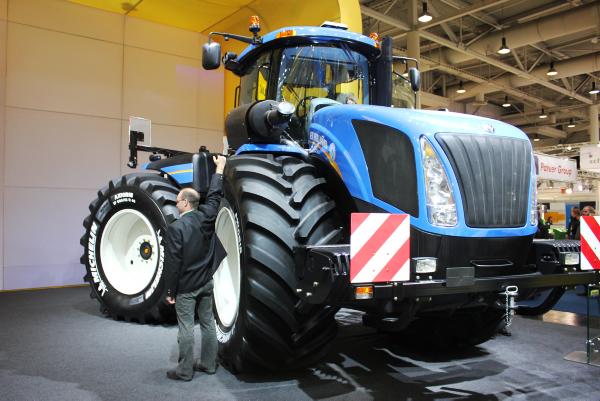
Michelin unveiled what it claims is the world’s largest tractor tyre at last year’s Agritechnica Show. The tyre, which is 900mm wide and 2.32m high and has a per-tyre load capacity of 10,600kg and a maximum speed of 65km/hr.
This new Michelin AxioBib IF900/65R46 tyre uses all of the benefits of Michelin Ultraflex technology. It is capable of being used at pressures as low as 0.8 bar, so as to minimise soil compaction.
Higher profile for Trelleborg
Tom Geraghty Tyres of Newrath, Dublin Road, Waterford, is one of the leading agricultural tyre suppliers in Ireland. Tom supplies tyres for tractors, combines and a host of farm machinery including trailers.
While he stocks all leading brands from Continental, Dunlop, Michelin, Trelleborg, Goodyear to Firestone, tyre selection will be determined by a combination of the tractor work and age and the cost. Tom is also the Irish agents for Stocks wheel equipment.
“Tyre selection is very individual between farmers so we stock a wide range to suit all of these varied needs,” says Tom Geraghty. “The acceptance of the Trelleborg range has improved in recent years and more tractors are coming to farms fitted with Trelleborg tyres as original equipment,” says Tom.
“The Trelleborg range is showing good wearing qualities, delivering good traction in the field and are reasonably priced to suit our market.”


SHARING OPTIONS