


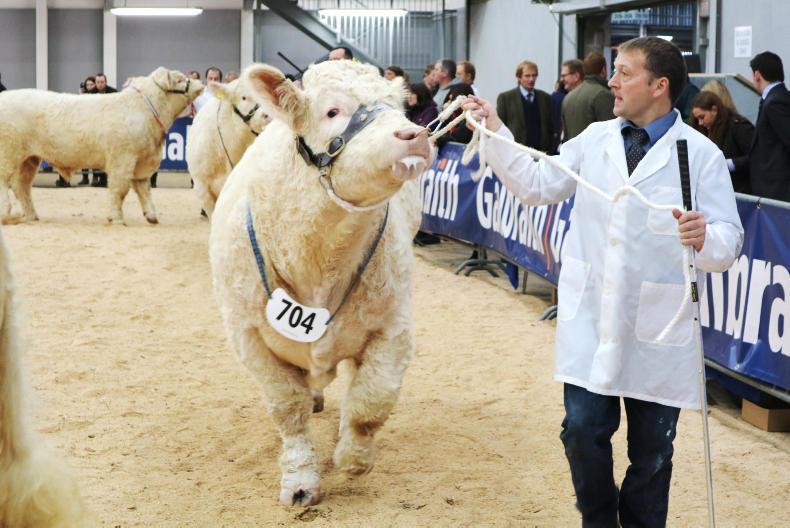
Fast growth rates in Charolais cattle will keep the breed relevant amid uncertainty in the industry, according to leaders from its breed society.
“Obviously, as we go into a big period of uncertainty in terms of Brexit, anyone rearing beef needs something that will grow quickly and adapt to all sorts of systems,” chair of the British Charolais Society (BCCS), Chris Curry, told Farmers Journal Scotland at the Stirling bull sales this week. “The one thing we have is growth rate – and surely in any system you want cattle to get to the target weight as quick as possible.”
With demand for straw high, an animal that needs more time to get to finishing can be more costly to winter. The new chief executive of the society, Peter Phythian, says that having a bull finished by the age of 15 months is what farmers need.
“There’s a momentum there for people to come back to Charolais,” he said, after factories introduced penalties for heavy carcases. “Modern Charolais are easier-calving, store cattle prices are good for Charolais,” Phytian said.
The breed itself is relatively new to the UK, with the first Charolais bull calf officially born here in 1967. From those beginnings to achieving a record price of 100,000 guineas for a bull in Stirling in 2012, the breed has come a long way. Its society boasts a membership of 2,000.
However, ahead of the Stirling bull sales, there was concern that uncertainty caused by Brexit would result in lower prices around the ring.
“People are wary of the future,” Curry said. “The difficult summer and harvest has put a lot of pressure on the industry. I don’t think people appreciate the impact weather can have. You would expect to see that around the ring. We’ve got to be honest, there is a shortage of money in the industry at the moment.”
Premium stock
And while some breeds have managed to carve out a premium price for their finished animals, the Charolais society says that targeting something like that increases supply too much.
“We believe our brand is a premium brand, but not everybody can hit that premium market.
“As soon as you target something like that, it gets more diluted,” said the Charolais chair.
Numbers
The relatively new chair, who also happens to be a funeral director, believes strongly in making data recording among breed societies work. However, that depends on uptake, rather than what may have been perceived as anomalies in figures input to date, he says.
“Figures come in for a lot of flack, but they are part of the bigger picture. All the breed societies are looking at making them more accurate, more credible. The challenge we have is encouraging members to use the figures.
“Part of the inaccuracy is [down to] the low percentage of uptake. The more cattle recorded, the higher the accuracy. These figures rely on comparisons in peer groups, so the less you record the less accurate. By just recording the good animals you are penalising yourself, really.”
As a breed society, BCCS is legally required to have some sort of recording system.
“The more information that can be shared from the minute that calf is conceived to when it goes to the factory, the better. Rather than criticising the figures, we need to make better use of them. As sires improve and develop, the figures improve.
Just because anomalies get thrown up doesn’t mean you throw it all away. We’re at a very embryonic stage at the moment, it can only get better.”


SHARING OPTIONS