Afamily steeped in equestrian history, the Hughes family from Kilkenny have shaped the face of the horse sport industry in Ireland. The extended Hughes family has been synonymous with breeding top-class horses, with breeding lines established as far back as the 1930s.
The desire to breed quality horses, saw them build up a stock of foundation mares that will allow them to breed future stars for generations to come.
Seamus Hughes had a great passion for breeding good horses and had the foresight to keep good mares. The Hughes stables have produced some outstanding horses such as, Vivaldi, winner of the Hickstead Derby, and Diamond Exchange, ridden by Jessica Kurten to win a World Cup qualifier in Millstreet in 1992 and two Grand Prix in Mechelen and Helsinki. The tradition and the passion for breeding top horses continues with Seamus’ daughter, Marion Hughes.
As an international showjumper, Marion Hughes needs little introduction. She established herself on the senior international stage with Flo Jo, winning the Queens Cup at Hickstead in 1995 and 1996. In 1999 she was victorious in the Belgian Queen’s Cup at the Mechelen Christmas Show, while riding Heritage Voar D’Isigni.
She had several successful outings that year and was a member of the Irish show jumping team who finished second in the Nations Cup at the Dublin Horse Show where she jumped a double clear with Heritage Charlton.
Also in 1999 she finished tenth with Heritage Charlton in the European Championships at Hickstead (UK). In 2004 Marion competed in the Athens Olympics riding the Stallion Heritage Fortunus. She was second the same year in the Saint Lo Grand Prix in France and came third in the Eindhoven Grand Prix.
She partnered Heritage Transmission to win the four-year-old championship in the Dublin Horse Show, they went on to win the six and seven-year-old Cavan Classic before hitting the international scene, where they performed the only double clear in the Nations Cup in Hickstead after being second in the Grand Prix in Falsterbo. Today along with competing herself, the young stock that she has bred has gone on to feature in the top national and international arenas.
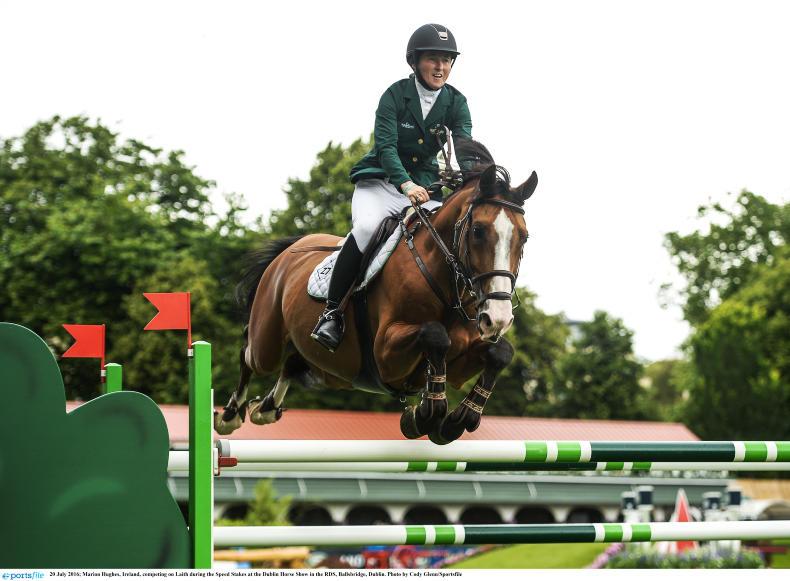
Marion Hughes competing on Laith during the Speed Stakes at the Dublin Horse Show in 2016. \ Cody Glenn/Sportsfile
Stud
At Hughes Horse Stud, Marion and her husband Miguel continue to fulfil the vision of the late Seamus Hughes. Brendan Doyle runs the breeding operation, he has a wealth of knowledge and a passion for breeding quality foals. Using mares which descend from quality bloodlines, they produce horses to compete them at the highest national and international level.
For Marion, the principles are the same as the ones that her father adopted when he started breeding. She explained: “You need to start off with a good quality mare and match it to a top-quality stallion. It’s so important to always breed out of good mares, because even if you get a top stallion the chances are that they can turn out quite normal.
“I have mares that go back to my father’s breeding lines, China Town for example. As well as having a top preforming mare, if you are looking to produce a top showjumping horse, I would also aim for a stallion that is jumping 1.60m to be in with a chance to get a good return for your investment.“There is a great market for top horses and the evidence is clear to see in the elite sales across Europe”.
On average Marion breeds 15 to 20 foals a year. “Not every foal that I breed is going to make a top show jumping horse, but I use a stallion with enough blood that there is a chance that they will be suited well to another discipline.”
Without a doubt, breeding technology has advanced and these come at a higher cost. Marion believes that we need to move forward with the times. “Yes, procedures such as embryo transfers can be a big investment, but it can pay off in the end. The farming community, in my opinion have embraced new technologies and to keep going forward with we need to upgrade and open our minds.”
“What worked in the past, may not work now. Demands in competition have changed and a horse that was considered top of the field, may not be able for the demands put on them today,” she added.
Choosing the right stallion is important, Marion invests a great deal of time into selecting stallions. “We look for a performance stallion with plenty of athletic ability. Temperament is also very important, and the stallion needs be have plenty of blood.”
Production
For us, we are fortunate that we produce the young stock ourselves. Our four-year olds are worked for six weeks and then given some time off. I find it gives them time to mature and the land in Ireland allows us to turn out our young stock.
Marion has recently found potential buyers are looking for seven and eight-year-olds with the work done.
“We are lucky that we have some very talented riders that get on very well with our horses. We help in their training, which is beneficial for us and for them. Our riders are Mikey Pender, Dominic Curly, Karl Webb, Luke Gallagher and now Leah Stack, who is in transition year in school. We try and bring the riders on and this year Mikey is hoping to jump in some Nation Cups on some of our horses that we produced”.
Marketing
“I think in Ireland we could do more to market our young horses, instead of depending on a few shows that run in the summer. I think if you had some type of league, where good quality young horses are being shown, it would do a lot for the market and for breeders.
“I am in the market for four-year-olds and I would welcome a league that would show these horses competing over a period of time. It would also offer breeders an incentive to showcase their animals.
“I think the time is right to run these competitions, as the buyers are there for quality horses, and I think sponsorship environment is looking for new ideas.
“I was at the KWPN stallion show this year and there were 1.50m stallions being shown. They were all perfectly presented and there was also a corporate hospitality. It was a great showcase for these stallions.
“We have a lot of breeding groups around the country and I feel that we could communicate better and share knowledge and generate good ideas. I am part of the breeding in Horse Sport Ireland and we are always keen to hear ideas from breeders.”
Afamily steeped in equestrian history, the Hughes family from Kilkenny have shaped the face of the horse sport industry in Ireland. The extended Hughes family has been synonymous with breeding top-class horses, with breeding lines established as far back as the 1930s.
The desire to breed quality horses, saw them build up a stock of foundation mares that will allow them to breed future stars for generations to come.
Seamus Hughes had a great passion for breeding good horses and had the foresight to keep good mares. The Hughes stables have produced some outstanding horses such as, Vivaldi, winner of the Hickstead Derby, and Diamond Exchange, ridden by Jessica Kurten to win a World Cup qualifier in Millstreet in 1992 and two Grand Prix in Mechelen and Helsinki. The tradition and the passion for breeding top horses continues with Seamus’ daughter, Marion Hughes.
As an international showjumper, Marion Hughes needs little introduction. She established herself on the senior international stage with Flo Jo, winning the Queens Cup at Hickstead in 1995 and 1996. In 1999 she was victorious in the Belgian Queen’s Cup at the Mechelen Christmas Show, while riding Heritage Voar D’Isigni.
She had several successful outings that year and was a member of the Irish show jumping team who finished second in the Nations Cup at the Dublin Horse Show where she jumped a double clear with Heritage Charlton.
Also in 1999 she finished tenth with Heritage Charlton in the European Championships at Hickstead (UK). In 2004 Marion competed in the Athens Olympics riding the Stallion Heritage Fortunus. She was second the same year in the Saint Lo Grand Prix in France and came third in the Eindhoven Grand Prix.
She partnered Heritage Transmission to win the four-year-old championship in the Dublin Horse Show, they went on to win the six and seven-year-old Cavan Classic before hitting the international scene, where they performed the only double clear in the Nations Cup in Hickstead after being second in the Grand Prix in Falsterbo. Today along with competing herself, the young stock that she has bred has gone on to feature in the top national and international arenas.
Marion Hughes competing on Laith during the Speed Stakes at the Dublin Horse Show in 2016. \ Cody Glenn/Sportsfile
Stud
At Hughes Horse Stud, Marion and her husband Miguel continue to fulfil the vision of the late Seamus Hughes. Brendan Doyle runs the breeding operation, he has a wealth of knowledge and a passion for breeding quality foals. Using mares which descend from quality bloodlines, they produce horses to compete them at the highest national and international level.
For Marion, the principles are the same as the ones that her father adopted when he started breeding. She explained: “You need to start off with a good quality mare and match it to a top-quality stallion. It’s so important to always breed out of good mares, because even if you get a top stallion the chances are that they can turn out quite normal.
“I have mares that go back to my father’s breeding lines, China Town for example. As well as having a top preforming mare, if you are looking to produce a top showjumping horse, I would also aim for a stallion that is jumping 1.60m to be in with a chance to get a good return for your investment.“There is a great market for top horses and the evidence is clear to see in the elite sales across Europe”.
On average Marion breeds 15 to 20 foals a year. “Not every foal that I breed is going to make a top show jumping horse, but I use a stallion with enough blood that there is a chance that they will be suited well to another discipline.”
Without a doubt, breeding technology has advanced and these come at a higher cost. Marion believes that we need to move forward with the times. “Yes, procedures such as embryo transfers can be a big investment, but it can pay off in the end. The farming community, in my opinion have embraced new technologies and to keep going forward with we need to upgrade and open our minds.”
“What worked in the past, may not work now. Demands in competition have changed and a horse that was considered top of the field, may not be able for the demands put on them today,” she added.
Choosing the right stallion is important, Marion invests a great deal of time into selecting stallions. “We look for a performance stallion with plenty of athletic ability. Temperament is also very important, and the stallion needs be have plenty of blood.”
Production
For us, we are fortunate that we produce the young stock ourselves. Our four-year olds are worked for six weeks and then given some time off. I find it gives them time to mature and the land in Ireland allows us to turn out our young stock.
Marion has recently found potential buyers are looking for seven and eight-year-olds with the work done.
“We are lucky that we have some very talented riders that get on very well with our horses. We help in their training, which is beneficial for us and for them. Our riders are Mikey Pender, Dominic Curly, Karl Webb, Luke Gallagher and now Leah Stack, who is in transition year in school. We try and bring the riders on and this year Mikey is hoping to jump in some Nation Cups on some of our horses that we produced”.
Marketing
“I think in Ireland we could do more to market our young horses, instead of depending on a few shows that run in the summer. I think if you had some type of league, where good quality young horses are being shown, it would do a lot for the market and for breeders.
“I am in the market for four-year-olds and I would welcome a league that would show these horses competing over a period of time. It would also offer breeders an incentive to showcase their animals.
“I think the time is right to run these competitions, as the buyers are there for quality horses, and I think sponsorship environment is looking for new ideas.
“I was at the KWPN stallion show this year and there were 1.50m stallions being shown. They were all perfectly presented and there was also a corporate hospitality. It was a great showcase for these stallions.
“We have a lot of breeding groups around the country and I feel that we could communicate better and share knowledge and generate good ideas. I am part of the breeding in Horse Sport Ireland and we are always keen to hear ideas from breeders.”





SHARING OPTIONS