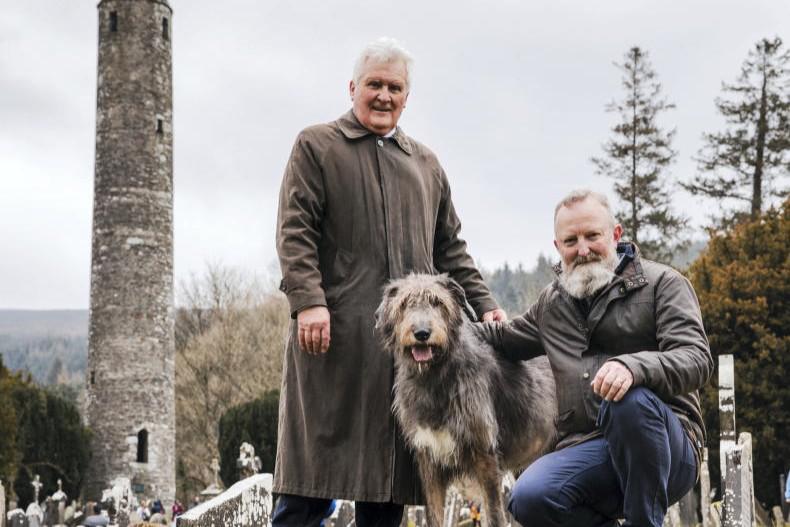
"Oh hi! You’re gorgeous! Can I stroke her?" Being stopped by adoring fans on a walk is part and parcel of owning a wolfhound, and it’s an everyday occurrence for Kevin O’Byrne when he leaves the house.
“This is Muireann and she’s an Irish Wolfhound”, he says, gently.
Kevin introduces Muireann to anyone who stops us, and tells them a bit about the breed while they contentedly stroke her wiry grey coat.
It’s a dull, drizzly day and we’re in Glendalough. Sheltered from a light rain by native Irish oak and natural woodland, facing just opposite the monastic site, it feels like the perfect spot to meet Anthony Dunne and Kevin O’Byrne from the Irish Wolfhound Club of Ireland. They’re here to talk about the oldest and most famous of Ireland’s native dog breeds.
We’re just five yards down the path before we’re stopped again. “There’s your Irish Wolfhound there, lads,” one tour guide shouts to her group of Spanish students. “Beautiful dog.”
Judging from the squeals of delight from the gaggles of American tourists upon seeing Muireann, we’ve made their day too. “I love wolfhounds. I’ve seen plenty of pictures. But we don’t have a lot of them in the States,” one of them drawls.
It’s easy to be struck by the commanding appearance of the Irish Wolfhound, with their muscular legs and long neck (not to mention their soft eyes). But one of the reasons why we’re so fascinated by these dogs, Anthony explains, is that they’ve been with us since the dawn of time.
“As a hound and a dog, they’ve been with us as we’ve evolved as people,” says Anthony, who is chairperson of the Irish Wolfhound Club of Ireland and has two other wolfhounds, Meabh and Aoife.
“If you went back 1,000 years to look at us [humans], we might appear slightly different and smaller than we are now. And I’m sure that would be a similar characteristic trait in these dogs. They’ve grown up along with us.”

Muireann the Irish Wolfhound explores the terrain. \ Claire Nash
Dog breeds were not registered and documented until the 1800s and in 1885 the Irish Wolfhound Club of Britain & Ireland was formed. The Irish Wolfhound Club of Ireland was later established in 1908.
“There were three or four men who started to document and develop the first breed standard, which is basically the template of what other Irish Wolfhound breeders should aim for,” Anthony explains.
He pays a special mention to Captain George Augustus Graham, a British army officer who made documenting the wolfhounds his life’s work. The military man went around Ireland and documented the best wolfhounds that he could come by, a pursuit that came at a critical time in Irish history.
“The last wolf was shot in the early 1800s on Mount Leinster, so there were no more wolves or a need for the wolfhound to protect livestock. And the famine also almost [nearly] put them into extinction.
“Normal everyday people in Ireland couldn’t afford to keep them. Those three men saw what was happening and thought, if we don’t do something, they’ll disappear. They took the best they could find, documented them, bred them and preserved the line.”
The club, which is affiliated to the Irish Kennel Club, continues to champion that breed standard, and protect the Irish Wolfhound – of which there are roughly 150 in Ireland.
“Every year, there’s between 100 and 110 pups born and registered with the club,” says Anthony. “But a lot of them would be exported to America, or they would go to the UK or mainland Europe.”
And what meets ‘breed’ standard, you ask? A dog that could do what it was meant to do: hunt.

Muireann makes a splash. \ Claire Nash
Irish Wolfhounds are classified as sight hounds, meaning that they hunt by sight. Their job is to chase and pull down their prey, allowing their owner to follow up and despatch it.
“You’re looking for a dog that is capable of pulling down a wolf, deer or a wild boar. Has she got the correct bone structure to be able to excel at that speed? When you look at the mouth, we check the teeth to see if is she is able to hold the prey and not let it go. All that stuff is particularly important.”
Using Muireann as an example, Anthony points out her “good top line” (a wolfhound’s back should be relatively level) and her “easy movement”. The desired height should also be somewhere between 32-34 inches.
Irish passport redesign
A vital role of the club is also helping people to understand that wolfhounds are part of our heritage. This is illustrated in the many roles that the breed enjoys in Irish life. They lead parades on St Patrick’s Day, are connected with ancient sites, and are one of the symbols of the State, alongside others like the St Patrick, the harp and the shamrock.
In 2019, the Irish Government also awarded the breed ‘heritage status’, which means that the Irish Wolfhound is protected and recognised as native flora and fauna. We can also soon expect to see the wolfhound on the new Irish passport as part of the redesign, which is “anticipated to launch in mid-2026”, according to a spokesperson from the Department of Foreign Affairs.
In 2023, the Department of Foreign Affairs asked the public what native animal they’d like to see on the passport. Options included a great elk, red squirrel and the basking shark but it was the Irish Wolfhound that came out on top. Boánn, a hound belonging to Mary Potter, a member of the Irish Wolfhound Club of Ireland, is the model for the new design, and the photographs and artist’s impressions have been completed.
Ambling around Glendalough with Muireann, it’s easy to see why the Irish Wolfhound makes an excellent family pets. The breed is good-natured and placid, despite their size. “Gentle giants”, Kevin says with a smile – he also has two other hounds at home, Oisín and Fiadh. “When you’re that size you don’t need to assert yourself.”
Giant is right. This is no ordinary dog, and they have certain requirements, explains Kevin, which is why the hound is not for everyone. This is something the club take very seriously when they rescue and rehome hounds – they vet candidates to ensure they can cope and have the space to home it safely. The process takes some time, it could be a one to two-year wait.
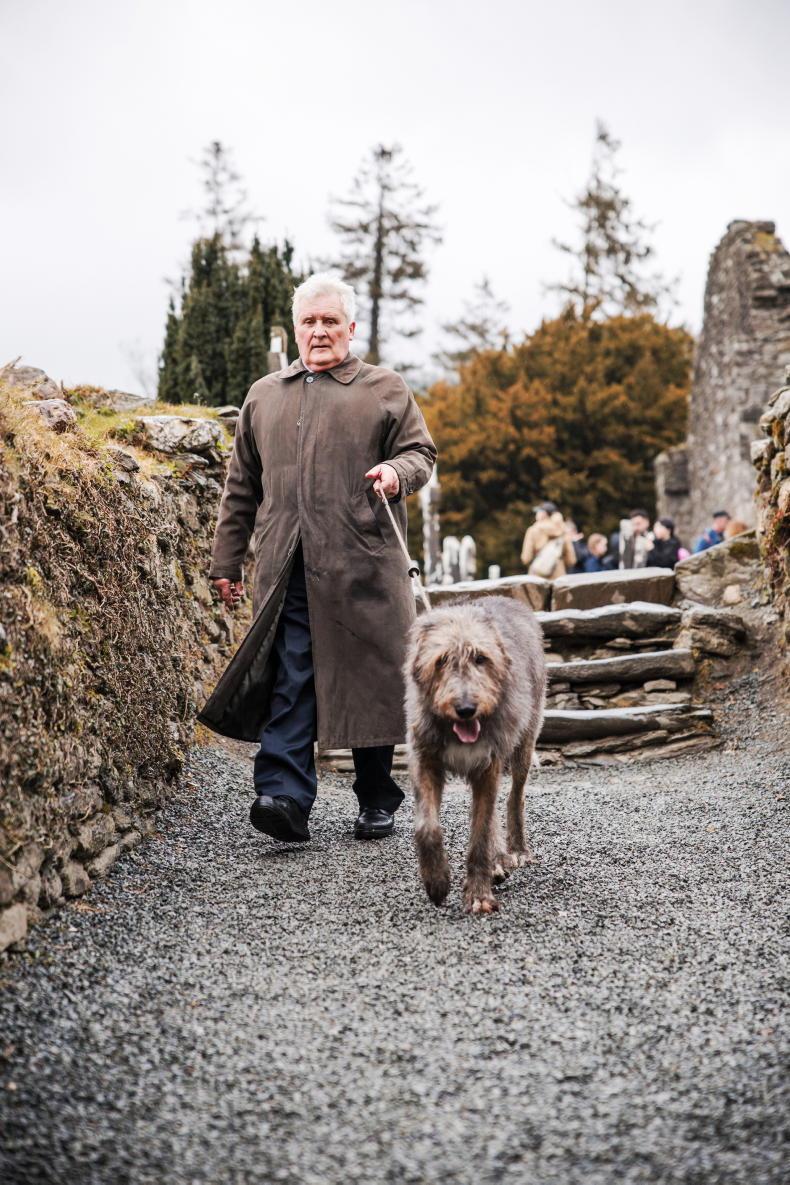
Kevin O'Byrne walking Muireann. \ Claire Nash
Another common problem facing every breed is trends, explains Anthony. “Currently the fashion trend is Chihuahuas and French Bulldogs. They’re bred to plague proportions by puppy farmers.
“So that’s the problem we have with Irish Wolfhounds. Not so much now, but at the time of the boom. They were the ‘must have’ fashion accessory, and we had puppy farmers breeding them everywhere in poor quality. And when the crash came, people couldn’t afford to keep them and they were abandoned left, right and centre. They were found in places like this, tied to trees and everything. We had a hell of a job with rescuing and rehoming for about three years.
“Thankfully, we’re at a situation now, where, for every one dog that we would rehome, we’ve got about 60 people we could give it to. And that’s the way it should be for any breed.”
After a meander around Glendalough, a splash in the water, and plenty of pats from passersby, Muireann flops into the car ready for home. She has, along with Oisín and Fiadh, taken over Kevin’s sunroom – or “what was a sunroom with two couches and a table”, he quips.
“It’s like a little hideaway for them and the chairs are like beds and I’m thinking to myself, I’m never going to get into that chair again.”
See iwcofireland.com
"Oh hi! You’re gorgeous! Can I stroke her?" Being stopped by adoring fans on a walk is part and parcel of owning a wolfhound, and it’s an everyday occurrence for Kevin O’Byrne when he leaves the house.
“This is Muireann and she’s an Irish Wolfhound”, he says, gently.
Kevin introduces Muireann to anyone who stops us, and tells them a bit about the breed while they contentedly stroke her wiry grey coat.
It’s a dull, drizzly day and we’re in Glendalough. Sheltered from a light rain by native Irish oak and natural woodland, facing just opposite the monastic site, it feels like the perfect spot to meet Anthony Dunne and Kevin O’Byrne from the Irish Wolfhound Club of Ireland. They’re here to talk about the oldest and most famous of Ireland’s native dog breeds.
We’re just five yards down the path before we’re stopped again. “There’s your Irish Wolfhound there, lads,” one tour guide shouts to her group of Spanish students. “Beautiful dog.”
Judging from the squeals of delight from the gaggles of American tourists upon seeing Muireann, we’ve made their day too. “I love wolfhounds. I’ve seen plenty of pictures. But we don’t have a lot of them in the States,” one of them drawls.
It’s easy to be struck by the commanding appearance of the Irish Wolfhound, with their muscular legs and long neck (not to mention their soft eyes). But one of the reasons why we’re so fascinated by these dogs, Anthony explains, is that they’ve been with us since the dawn of time.
“As a hound and a dog, they’ve been with us as we’ve evolved as people,” says Anthony, who is chairperson of the Irish Wolfhound Club of Ireland and has two other wolfhounds, Meabh and Aoife.
“If you went back 1,000 years to look at us [humans], we might appear slightly different and smaller than we are now. And I’m sure that would be a similar characteristic trait in these dogs. They’ve grown up along with us.”

Muireann the Irish Wolfhound explores the terrain. \ Claire Nash
Dog breeds were not registered and documented until the 1800s and in 1885 the Irish Wolfhound Club of Britain & Ireland was formed. The Irish Wolfhound Club of Ireland was later established in 1908.
“There were three or four men who started to document and develop the first breed standard, which is basically the template of what other Irish Wolfhound breeders should aim for,” Anthony explains.
He pays a special mention to Captain George Augustus Graham, a British army officer who made documenting the wolfhounds his life’s work. The military man went around Ireland and documented the best wolfhounds that he could come by, a pursuit that came at a critical time in Irish history.
“The last wolf was shot in the early 1800s on Mount Leinster, so there were no more wolves or a need for the wolfhound to protect livestock. And the famine also almost [nearly] put them into extinction.
“Normal everyday people in Ireland couldn’t afford to keep them. Those three men saw what was happening and thought, if we don’t do something, they’ll disappear. They took the best they could find, documented them, bred them and preserved the line.”
The club, which is affiliated to the Irish Kennel Club, continues to champion that breed standard, and protect the Irish Wolfhound – of which there are roughly 150 in Ireland.
“Every year, there’s between 100 and 110 pups born and registered with the club,” says Anthony. “But a lot of them would be exported to America, or they would go to the UK or mainland Europe.”
And what meets ‘breed’ standard, you ask? A dog that could do what it was meant to do: hunt.

Muireann makes a splash. \ Claire Nash
Irish Wolfhounds are classified as sight hounds, meaning that they hunt by sight. Their job is to chase and pull down their prey, allowing their owner to follow up and despatch it.
“You’re looking for a dog that is capable of pulling down a wolf, deer or a wild boar. Has she got the correct bone structure to be able to excel at that speed? When you look at the mouth, we check the teeth to see if is she is able to hold the prey and not let it go. All that stuff is particularly important.”
Using Muireann as an example, Anthony points out her “good top line” (a wolfhound’s back should be relatively level) and her “easy movement”. The desired height should also be somewhere between 32-34 inches.
Irish passport redesign
A vital role of the club is also helping people to understand that wolfhounds are part of our heritage. This is illustrated in the many roles that the breed enjoys in Irish life. They lead parades on St Patrick’s Day, are connected with ancient sites, and are one of the symbols of the State, alongside others like the St Patrick, the harp and the shamrock.
In 2019, the Irish Government also awarded the breed ‘heritage status’, which means that the Irish Wolfhound is protected and recognised as native flora and fauna. We can also soon expect to see the wolfhound on the new Irish passport as part of the redesign, which is “anticipated to launch in mid-2026”, according to a spokesperson from the Department of Foreign Affairs.
In 2023, the Department of Foreign Affairs asked the public what native animal they’d like to see on the passport. Options included a great elk, red squirrel and the basking shark but it was the Irish Wolfhound that came out on top. Boánn, a hound belonging to Mary Potter, a member of the Irish Wolfhound Club of Ireland, is the model for the new design, and the photographs and artist’s impressions have been completed.
Ambling around Glendalough with Muireann, it’s easy to see why the Irish Wolfhound makes an excellent family pets. The breed is good-natured and placid, despite their size. “Gentle giants”, Kevin says with a smile – he also has two other hounds at home, Oisín and Fiadh. “When you’re that size you don’t need to assert yourself.”
Giant is right. This is no ordinary dog, and they have certain requirements, explains Kevin, which is why the hound is not for everyone. This is something the club take very seriously when they rescue and rehome hounds – they vet candidates to ensure they can cope and have the space to home it safely. The process takes some time, it could be a one to two-year wait.

Kevin O'Byrne walking Muireann. \ Claire Nash
Another common problem facing every breed is trends, explains Anthony. “Currently the fashion trend is Chihuahuas and French Bulldogs. They’re bred to plague proportions by puppy farmers.
“So that’s the problem we have with Irish Wolfhounds. Not so much now, but at the time of the boom. They were the ‘must have’ fashion accessory, and we had puppy farmers breeding them everywhere in poor quality. And when the crash came, people couldn’t afford to keep them and they were abandoned left, right and centre. They were found in places like this, tied to trees and everything. We had a hell of a job with rescuing and rehoming for about three years.
“Thankfully, we’re at a situation now, where, for every one dog that we would rehome, we’ve got about 60 people we could give it to. And that’s the way it should be for any breed.”
After a meander around Glendalough, a splash in the water, and plenty of pats from passersby, Muireann flops into the car ready for home. She has, along with Oisín and Fiadh, taken over Kevin’s sunroom – or “what was a sunroom with two couches and a table”, he quips.
“It’s like a little hideaway for them and the chairs are like beds and I’m thinking to myself, I’m never going to get into that chair again.”
See iwcofireland.com
SHARING OPTIONS