



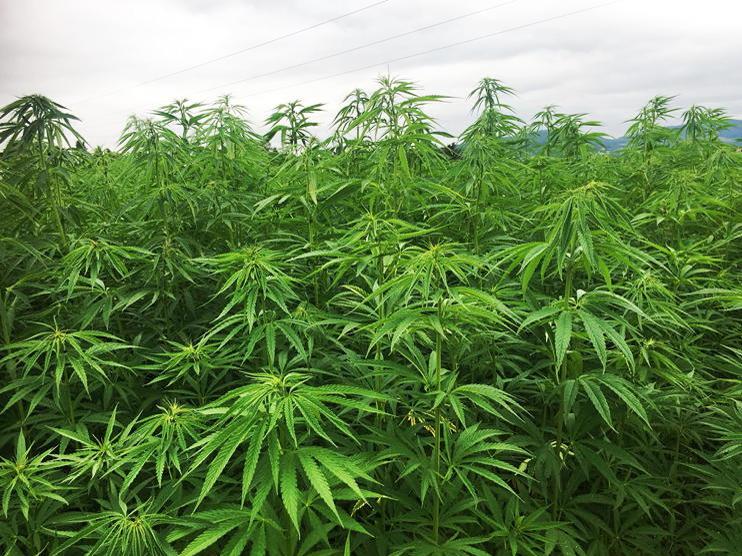
As a crop, hemp is tightly regulated by the Department of Health under the remit of the Health Products Regulatory Authority (HPRA). This is because hemp contains a small amount of tetrahydrocannabinol (THC), which is the main psychoactive compound found in cannabis. In Irish-grown hemp varieties, the amount of THC must be kept at or below 0.2% (compared to up to 20% THC found in marijuana).
Currently, Irish farmers who wish to grow hemp must apply for a license each year. Those who do grow hemp mainly grow for cannabidiol (CBD) production, which is used for a variety of health and wellness reasons.
It has been well established, at this stage, that hemp won’t get you high. Why, then, is it so tightly controlled?
No legal level
Barry Caslin is the energy and rural development specialist at Teagasc. He says current legislation doesn’t differentiate between amounts of THC within a product.

“CBD is not a controlled drug following separation and extraction from the plant, as it is not psychoactive,” he explains. “However, if CBD-containing products or preparations also contain THC, in any quantities, these are considered ‘controlled drugs’. There is currently no legal exemption in Ireland under the Misuse of Drugs legislative framework for any amount of THC, and this is causing a barrier for the processing of hemp in Ireland (as the main two cannabinoids in industrial hemp are CBD and THC).
“An amendment of national legislation to exempt finished products containing trace amounts of THC at levels not greater than 0.3% would remove the grey area concerning the production and sale of CBD products,” he adds.
Novel food?
In the late 1990s, the European Union (EU) introduced the idea of “novel foods”.
A novel food, by definition, is any type of food which had not been consumed “to a significant degree” within the European Union before 15 May 1997. Examples of novel foods include extracts, concentrates – and even chia seeds, which had no previous proof of consumption prior to 1997 within the EU. Many EU member states feel that CBD (in any form) is a novel food, while Ireland disagrees.
Dr Pat O’Mahony – who is chief specialist, food science and technology at the Food Safety Authority of Ireland (FSAI) – says since CBD is a natural component of the hemp plant and we can prove a history of consumption within the EU, giving it a novel food label is not so straightforward.

“There’s a negative attitude toward hemp and derived products in the food arena at European level – possibly both for ideological and political [reasons],” he says. “The main division between other EU member states and Ireland is we hold the view (based on discussions at EU level as far back as 2009) that novel food doesn’t apply to unrefined hemp food products. If you take an existing food and concentrate or purify certain components from it, those components are likely to become novel food. Simply separating the various types of hemp products mechanically for use in or as food does not make them novel food.”
Good reasoning
All of this being said, Pat also believes the reasoning behind novel food status (for consumer protection and health purposes) can be good. Until more research has been completed, we can’t legally say whether or not CBD, (or any of the other 100+ cannabinoids present in the cannabis plant) is a “safe” food.
“CBD appears to be innocuous compared to THC,” he says, “but it does have some kind of psychoactive element – we just don’t have the research [on it]. CBD products currently on the market can either have very high or very low [cannabinoid] dosages. We can’t say whether the high-dosage ones are safe or not safe – we don’t have that data. We’re hopeful there will [soon] be a [proven] safe upper level, but at the moment we have nothing to go on.”
Nutrition
The nutritional value of hemp as a food source is well-established. A 2021 Review of Hemp as Food and Nutritional Supplement, written by a team of Italian researchers, says: “Hemp has been a valuable source of food for mankind for millennia, as shown by the hempseeds found in tombs dating back to the third millennium before Christ in China, where roasted hempseed can still be bought on the street as snacks.”
Hempseed oil, derived from cold-pressed hemp seeds, is rich in essential fatty acids and contains almost as much protein as soybean. It is also a good source of iron, vitamin E, magnesium, B vitamins and zinc. The seeds (also called hemp “hearts”) can be consumed whole, roasted or cooked (like any grain). Hempseed oil can be used in similar ways to other cooking oils.
Barry says the plant offers a unique nutritional package in terms of dietary oil, protein, vitamins and minerals.
“Hempseed oil contains high levels of unsaturated fats and contains both essential fatty acids in a nutritionally balanced ratio,” he says. “The protein in hempseed is considered to contain all the essential amino acids in nutritionally significant amounts. The increased cultural and environmental shift towards eating less meat will be a [future] driver for hemp-based food.”
Environmental benefits
The environmental benefits of growing hemp are another reason increasing numbers of Irish farmers are interested in learning about it. It has long been noted that hemp is a strong-growing plant. Its roots can go up to a foot into the ground, bringing up nutrients to the top layer of soil for subsequent crops. These deeper roots also help with soil compaction.
Barry believes hemp production has a lot to offer both consumers and farmers – and not just in terms of CBD – but that we are a long way off from making it easy to cultivate and process.
“Facilities would be required to process hemp straw each year,” he explains. “An industrial hemp decortication plant would be needed to separate the crop into its two main components – ‘shivs’ or ‘hurds’ (60-70% of the plant) and fibre (20-25% of the plant). The remainder (10-15%) consists of fines and dust from the process – and is also marketable as a bio fuel. A decortication plant would also include facilities to remove dust from the hurds and to produce fuel briquettes from fines and hurds. The fibre could be sold for insulation and bio-composite reinforcement, bioplastics to replace fossil fuel derived equivalents and the fines as a by-product could be used as fuel.”
Hemp4Soil
Laura Foley, who was featured in last week’s article (alongside other members of Hemp Cooperative Ireland), is leading a year-long study on the environmental benefits of growing hemp, combined with other regenerative methods, can have on soil health.

She and others involved in the study believe if Irish farmers were to grow one rotated crop of hemp per year, it could have a positive environmental effect and generate income at the same time.
The study, called Hemp4Soil, is being funded through the European Innovation Partnerships Initiative (EIP) and locally led schemes (which are funded by the EU Recovery Instrument Funding under the Rural Development Programme 2014-2022). Key stakeholders in the study include Loop Head Together, Teagasc, Hemp Cooperative Ireland, An Taisce, Irish Wildlife Trust, University of Essex and Limerick Institute of Technology.
Working with 10 different farms on Loop Head, Co Clare, the study will combine regenerative growing methods with hemp cultivation to show a quantifiable improvement in soil biodiversity. They aim to prove an increase in soil health by using a combination of biochar and slurry as a natural fertiliser.
Laura hopes that once there is established data on the subject, others will be more open to growing and investing in hemp. The project will look at revenue streams for farmers in the bioeconomy producing biomass from hemp and in carbon credits. A recent report from Cambridge shows that Hemp can sequester 8t to 15t of CO2 per hectare.
“We really aim to remove some of the stigma [around hemp], because it has so many solutions from an environmental and rural development point of view.”




SHARING OPTIONS