



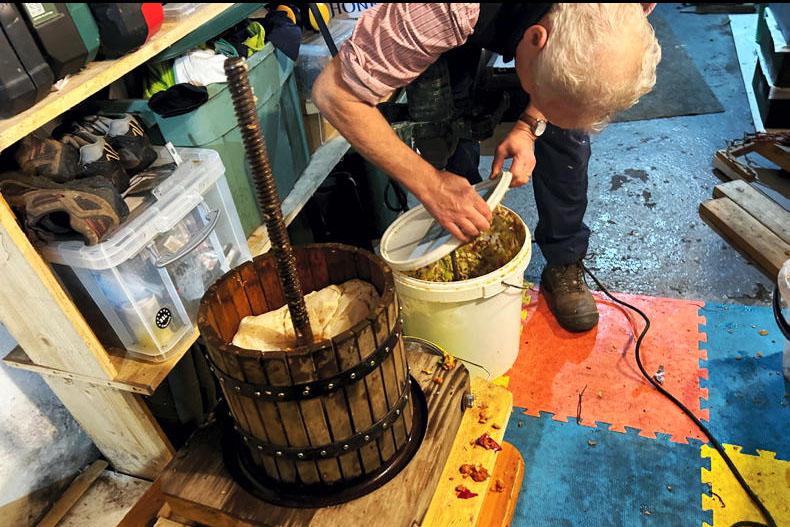
It was in September of last year that ‘The Tuesday Night Cider Club’ came into being. More chaotic than organised, the kindest description might be a flurry of friends manically active in a shed salivating at the prospect of making our own batch of inebriating cider. The catalyst for the interest was the bumper excess of apples that came on the trees last year.
What could be so hard? Let’s make some cider!
Like all folk traditions, vernacular cider-making is a characteristically simple undertaking yet one which is full of small, yet highly significant inherited details, the ignorance of which leads to consummate failure. What is necessary is to have someone who is the bearer of the living tradition. Their savoir-faire and long-lived hands-on experience will have met the different challenges and will know what, how and when to do what is necessary.
The experience of the cider club became an exercise in appreciating folklife and the body of unspoken knowledge that is slipping away from us.
The whole affair began some 30 years ago in a corner shop in the town of Villefranche de Rouergue in Aveyron in France. I came across a small apple/wine press in a classic quincallerie, ‘hardware’ or ‘ironmongers’. In a fit of enthusiasm, I bought it. It remained gathering dust in the corner of the shed until the accumulated guilt of three decades of neglect pushed me into action.
Main challenge
My house has a small orchard of 10 apple trees, a mixture of eaters and cookers and these were shaken, apples picked and wheel-barrowed to the shed. We washed off the mud and slugs with the hose and left the apples floating in a procession of plastic garden tubs and trugs.
Our main challenge was to find a way of crushing the apples into a pulp before putting them in the press. There was all manner of electric pulpers and macerators available online, but an ingenious, if somewhat dangerous solution, was found: Peter’s heavy-duty plaster mixer. Holding down the bucket to stop it from skirting off around the shed, we pulverised the apples to produce a sweet-smelling liquidy mash, much of it ending up on the ceiling and ourselves.
We lined the small cider press with some muslin and filled the circular space with the macerated apple pulp. A heavy wooden block of the press was fixed on a central threaded bar and this was pushed downward as we turned the turning bar on top. The pressure caused the juice to flow.
There is no describing the shared excitement as we watched the fragrant apple juice pouring from the wooden spout at the base of the press. We took a glass and sampled its full ripe body that exploded with flavour. Nothing commercially available can compare to the scintillatingly sensual experience of this fresh apple juice.
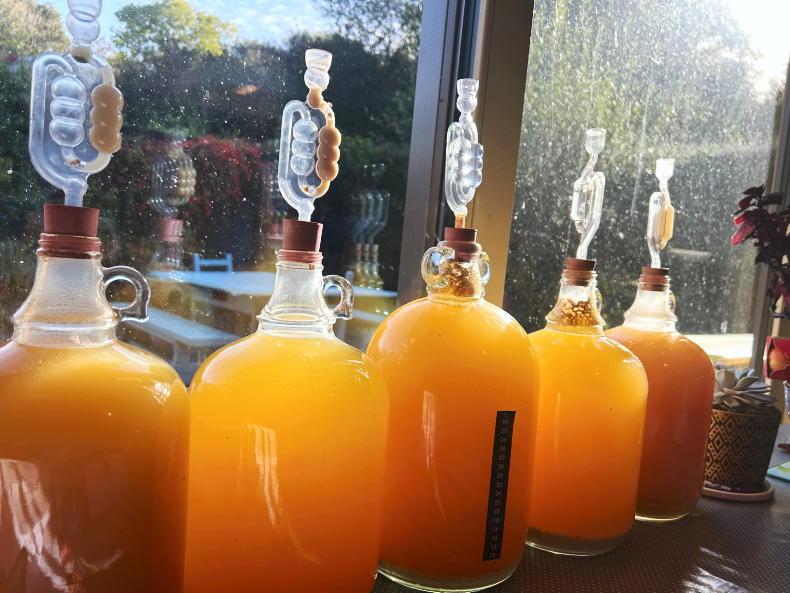
It was cloudy, an extraordinary mix of colour, with bits of grey, brown and green and as the night went on, we filled bucket after bucket.
We were now part of a sort of assembly line, one emptying the press of its spent apple pomace, another few ‘scratting’ with the Kango mixer while others decanted the juice into some lovely old demijohn glass containers that were then fitted with airlocks.
There was an intense pleasure in this wholesome cider-making process and each subsequent Tuesday night attracted more and more participants to share in the delight of making.
The natural yeast on the apples started the fermentation and over the next few weeks the bubbles slowed and ceased, and the cloudy mixture miraculously cleared, with the sediment falling to the bottom.
There is no describing the shared excitement as we watched the fragrant apple juice pouring from the wooden spout at the base of the press. We took a glass and sampled its full ripe body that exploded with flavour. Nothing commercially available can compare to the scintillatingly sensual experience of this fresh apple juice.
Here is where the story takes its turn because our hard-won cider, although potently alcoholic, turned out to be markedly sharp and acidic and barely palatable. It was so tart, it would dissolve the enamel off your teeth.
Despite this, we will go again this year and tweak our apple choices and consider blending some fresh sweet apple juice to our ‘paint-stripper’.
Our folklore is dotted with numerous accounts of the popularity of cider in areas where apple orchards were cultivated. In such areas, it was the drink of hospitality for visitors to the house and was a favourite for meitheals in the fields at harvest time.
Drunk geese
A story that had always stuck with me is of the woman who had a flock of geese and on a cold, frosty night her barrel of cider expanded, and the cider poured out in a little puddle. Her flock of geese busied themselves lapping up the contents and in the morning, they were all drunk and laid out across the yard.
She thought them dead and without delay set to plucking them until they were bald. However, it was not long before they began to awaken from their inebriation, and her flock of plucked geese had people far and wide calling to witness their naked parading around the yard.
Shane Lehane is a folklorist who works in UCC and Cork College of FET, Tramore Road Campus. Contact: slehane@ucc.ie




SHARING OPTIONS