The prevalence of mental illness in the farming community is becoming more of a talking point, as research is proving how susceptible farmers are to poor mental health.
John Wallace, a dairy farmer from Templederry, in north Tipperary has first-hand experience of how devastating mental illness can be. He lost his father William to suicide a decade ago, and it has taken him many years to process his grief and to realise how prevalent the problem is in rural Ireland.
A trip to visit his younger sister Avril in Perth, Australia last Christmas planted the seed of doing something to raise awareness of mental health in farmers, and last month, John completed a 550km walk, Miles for Minds, to highlight the issue.
Speaking to Irish Country Living at his farm near Borrisoleagh, John says the reception he received along the Beara Breifne Way, part of which goes through his farm, was incredible.
“I went over to visit Avril for three weeks last December and I’ve an aunt living over there too so talking it over with them both, we decided we would do something to coincide with the anniversary of Dad’s death which is next month,” he says.
“My older sister Susan lives in Limerick with her family and she wanted to be involved too so Avril took on the social media side of things once we decided to go ahead. She flew home during the walk and both my sisters joined me at different stages.”
‘Grief is a journey’
So far, the family has raised almost ten times their initial goal of €2,500, with a running total of almost €23,000 on the iDonate platform, to be split between three charities; Pieta, Jigsaw and Aware.
“The walk was tough going, harder than I expected, but it gave me time to think. It was also amazing to meet so many people and to have such open conversations on mental health,” he says.
“There is still a stigma around mental health because people, and farmers in particular, are reluctant to look for help.
“Looking back on my father’s death, I didn’t know he was struggling. We were two thick men with strong opinions – one young farmer thinking I knew it all, one older farmer – living under the one roof.
“It took me about five years to process his death and I used the services of Pieta which helped me. Grief is a journey and everyone has their own path.”
John says he received countless support from the public as he completed the walk which took him from Castetownbere in Co Cork to Blacklion in Co Cavan. Over 17 days, the walk brought him through counties; Cork, Kerry, Limerick, Tipperary, Galway, Offaly, Roscommon, Sligo, Leitrim and Cavan.
“I can’t thank everyone enough for all the help, and the donations from the public, it’s been incredible,” he explains.
“So many people shared their own stories with me when they learned the reason behind the walk and on the tougher days those stories kept me going. I also had huge support locally, with a crowd turning out in Borrisoleigh, which was roughly the halfway mark, to cheer me on the next leg of my journey.
A dose of cellulitis threatened to halt John’s progress, but a course of strong antibiotics and strapping got him back on the road.
“Avril arrived in for the final stretch of the walk and without her help pushing the event on Instagram in the weeks leading up to it, I don’t know if I’d have been half as successful in raising the phenomenal amount of money we have done,” he adds.
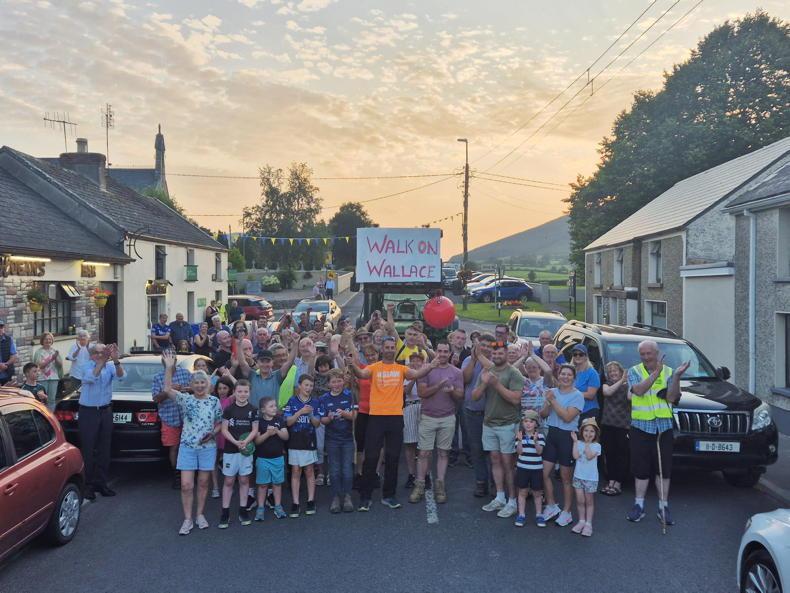
John Wallace, centre, receives a rousing reception from his home parish in Borrisoleigh as he nears the halfway mark of his Miles for Minds charity walk to raise awareness of mental health among farmers. \ Odhran Ducie
Kindness of strangers
“The time difference between here and Perth made things tricky but that didn’t stop her getting up in the middle of the night to post videos and update the appeal. For her to arrive over to physically walk it with me, that meant a lot. As did Susan’s support. It’s been a real family effort and I know Dad would recognise that and be proud of us.”
John says he appreciates the many challenges farmers face, but is hoping Miles for Minds has helped some people realise that there is help out there when you’re struggling.
“I know how hard it can be, but farmers can be very sentimental about the land. Yes, we are the gatekeepers for future generations but there is more to life than the land.
“And I’m not saying things like being locked down with TB isn’t a terrible situation to face, it’s horrendous. But there are bigger things in life.
“Anyone who is struggling needs to ask for help. That’s how I dealt with things when it all got on top of me [after my father’s death]. We all have bad days but there is help out there. And it might be as simple as talking to a stranger and sharing what’s bothering you.
“I was lucky in that the cows got me up in the morning, I had to get up to milk them, but there were some days when it was very, very hard.
“Some of the best advice I’ve ever got has been from strangers, although I do believe that those who have experienced loss through suicide tend to gravitate towards each other.
“One lady I met on the walk, she’s a retired teacher and when she heard my story, she spoke of the child she lost to suicide, and it was the first time she had ever spoken of it.”
When asked if he would contemplate making the trek again, John said he wouldn’t rule it out.
“There was a reason the walk happened this year. Farming is in a good place and the general mood is high. We couldn’t have done it last year, or even in 2023, when the weather was terrible and directives such as the derogation had everyone in bad form. The reception was so positive.
“I had people walking with me on some sections and one man even insisted on driving ahead to my destination to bring my bag for me, which had my tent and all my gear. I didn’t end up using the tent once. Everywhere I went I was offered a bed and I was fed and watered.
“I was tempted to keep going and complete the journey by taking in the Ulster Way which goes all the way to Ballycastle in Co Antrim but Avril talked me out of it. You’re talking another 200km to cross the border and continue on up, but I would consider doing it again, the whole journey.
“I’m also very thankful to my cousin, Anna Harding who did relief milking for me while I completed the walk. Without her I couldn’t have done it, She’s in her final year of her degree in South East Technological University in Waterford and having her here while I’m gone was a huge reassurance, the place was in safe hands.”
If you or someone you know has struggled with the themes in this story, support is available at:
Aware: information, support and peer groups for people experiencing anxiety, depression, bipolar disorder and mood-related conditions. Freephone 1800 804848, 10am to 10pm, aware.ie.
Pieta: free counselling, therapy and support for people who self-harm or are thinking about suicide and people who have been bereaved by suicide. Freephone 1800 247 247 any time, pieta.ie.
Jigsaw: free therapy and mental health supports in-person and online to children and young adults aged 12-25. jigsaw.ie.
Make the Moove: a mental health initiative supported by FBD to help combat and raise awareness around suicides in the farming community, makethemoove@macra.ie.
Research: findings of a new Irish study into psychological distress among farmers has led to calls for enhanced mental health support for farming families. ‘Between the Farm and Family: A cross-sectional survey on work–family conflict in farmers in Ireland’, was carried out by UCD and DCU researchers who spoke with 446 farmers in Ireland. It is the first research to examine work-family conflict specifically in Irish farmers and has found that male farmers, those with larger farms and dairy or mixed farmers experienced more significant strain.
To donate to Miles for Minds, go to idonate.ie/fundraiser/milesforminds2025
The prevalence of mental illness in the farming community is becoming more of a talking point, as research is proving how susceptible farmers are to poor mental health.
John Wallace, a dairy farmer from Templederry, in north Tipperary has first-hand experience of how devastating mental illness can be. He lost his father William to suicide a decade ago, and it has taken him many years to process his grief and to realise how prevalent the problem is in rural Ireland.
A trip to visit his younger sister Avril in Perth, Australia last Christmas planted the seed of doing something to raise awareness of mental health in farmers, and last month, John completed a 550km walk, Miles for Minds, to highlight the issue.
Speaking to Irish Country Living at his farm near Borrisoleagh, John says the reception he received along the Beara Breifne Way, part of which goes through his farm, was incredible.
“I went over to visit Avril for three weeks last December and I’ve an aunt living over there too so talking it over with them both, we decided we would do something to coincide with the anniversary of Dad’s death which is next month,” he says.
“My older sister Susan lives in Limerick with her family and she wanted to be involved too so Avril took on the social media side of things once we decided to go ahead. She flew home during the walk and both my sisters joined me at different stages.”
‘Grief is a journey’
So far, the family has raised almost ten times their initial goal of €2,500, with a running total of almost €23,000 on the iDonate platform, to be split between three charities; Pieta, Jigsaw and Aware.
“The walk was tough going, harder than I expected, but it gave me time to think. It was also amazing to meet so many people and to have such open conversations on mental health,” he says.
“There is still a stigma around mental health because people, and farmers in particular, are reluctant to look for help.
“Looking back on my father’s death, I didn’t know he was struggling. We were two thick men with strong opinions – one young farmer thinking I knew it all, one older farmer – living under the one roof.
“It took me about five years to process his death and I used the services of Pieta which helped me. Grief is a journey and everyone has their own path.”
John says he received countless support from the public as he completed the walk which took him from Castetownbere in Co Cork to Blacklion in Co Cavan. Over 17 days, the walk brought him through counties; Cork, Kerry, Limerick, Tipperary, Galway, Offaly, Roscommon, Sligo, Leitrim and Cavan.
“I can’t thank everyone enough for all the help, and the donations from the public, it’s been incredible,” he explains.
“So many people shared their own stories with me when they learned the reason behind the walk and on the tougher days those stories kept me going. I also had huge support locally, with a crowd turning out in Borrisoleigh, which was roughly the halfway mark, to cheer me on the next leg of my journey.
A dose of cellulitis threatened to halt John’s progress, but a course of strong antibiotics and strapping got him back on the road.
“Avril arrived in for the final stretch of the walk and without her help pushing the event on Instagram in the weeks leading up to it, I don’t know if I’d have been half as successful in raising the phenomenal amount of money we have done,” he adds.
John Wallace, centre, receives a rousing reception from his home parish in Borrisoleigh as he nears the halfway mark of his Miles for Minds charity walk to raise awareness of mental health among farmers. \ Odhran Ducie
Kindness of strangers
“The time difference between here and Perth made things tricky but that didn’t stop her getting up in the middle of the night to post videos and update the appeal. For her to arrive over to physically walk it with me, that meant a lot. As did Susan’s support. It’s been a real family effort and I know Dad would recognise that and be proud of us.”
John says he appreciates the many challenges farmers face, but is hoping Miles for Minds has helped some people realise that there is help out there when you’re struggling.
“I know how hard it can be, but farmers can be very sentimental about the land. Yes, we are the gatekeepers for future generations but there is more to life than the land.
“And I’m not saying things like being locked down with TB isn’t a terrible situation to face, it’s horrendous. But there are bigger things in life.
“Anyone who is struggling needs to ask for help. That’s how I dealt with things when it all got on top of me [after my father’s death]. We all have bad days but there is help out there. And it might be as simple as talking to a stranger and sharing what’s bothering you.
“I was lucky in that the cows got me up in the morning, I had to get up to milk them, but there were some days when it was very, very hard.
“Some of the best advice I’ve ever got has been from strangers, although I do believe that those who have experienced loss through suicide tend to gravitate towards each other.
“One lady I met on the walk, she’s a retired teacher and when she heard my story, she spoke of the child she lost to suicide, and it was the first time she had ever spoken of it.”
When asked if he would contemplate making the trek again, John said he wouldn’t rule it out.
“There was a reason the walk happened this year. Farming is in a good place and the general mood is high. We couldn’t have done it last year, or even in 2023, when the weather was terrible and directives such as the derogation had everyone in bad form. The reception was so positive.
“I had people walking with me on some sections and one man even insisted on driving ahead to my destination to bring my bag for me, which had my tent and all my gear. I didn’t end up using the tent once. Everywhere I went I was offered a bed and I was fed and watered.
“I was tempted to keep going and complete the journey by taking in the Ulster Way which goes all the way to Ballycastle in Co Antrim but Avril talked me out of it. You’re talking another 200km to cross the border and continue on up, but I would consider doing it again, the whole journey.
“I’m also very thankful to my cousin, Anna Harding who did relief milking for me while I completed the walk. Without her I couldn’t have done it, She’s in her final year of her degree in South East Technological University in Waterford and having her here while I’m gone was a huge reassurance, the place was in safe hands.”
If you or someone you know has struggled with the themes in this story, support is available at:
Aware: information, support and peer groups for people experiencing anxiety, depression, bipolar disorder and mood-related conditions. Freephone 1800 804848, 10am to 10pm, aware.ie.
Pieta: free counselling, therapy and support for people who self-harm or are thinking about suicide and people who have been bereaved by suicide. Freephone 1800 247 247 any time, pieta.ie.
Jigsaw: free therapy and mental health supports in-person and online to children and young adults aged 12-25. jigsaw.ie.
Make the Moove: a mental health initiative supported by FBD to help combat and raise awareness around suicides in the farming community, makethemoove@macra.ie.
Research: findings of a new Irish study into psychological distress among farmers has led to calls for enhanced mental health support for farming families. ‘Between the Farm and Family: A cross-sectional survey on work–family conflict in farmers in Ireland’, was carried out by UCD and DCU researchers who spoke with 446 farmers in Ireland. It is the first research to examine work-family conflict specifically in Irish farmers and has found that male farmers, those with larger farms and dairy or mixed farmers experienced more significant strain.
To donate to Miles for Minds, go to idonate.ie/fundraiser/milesforminds2025





SHARING OPTIONS