



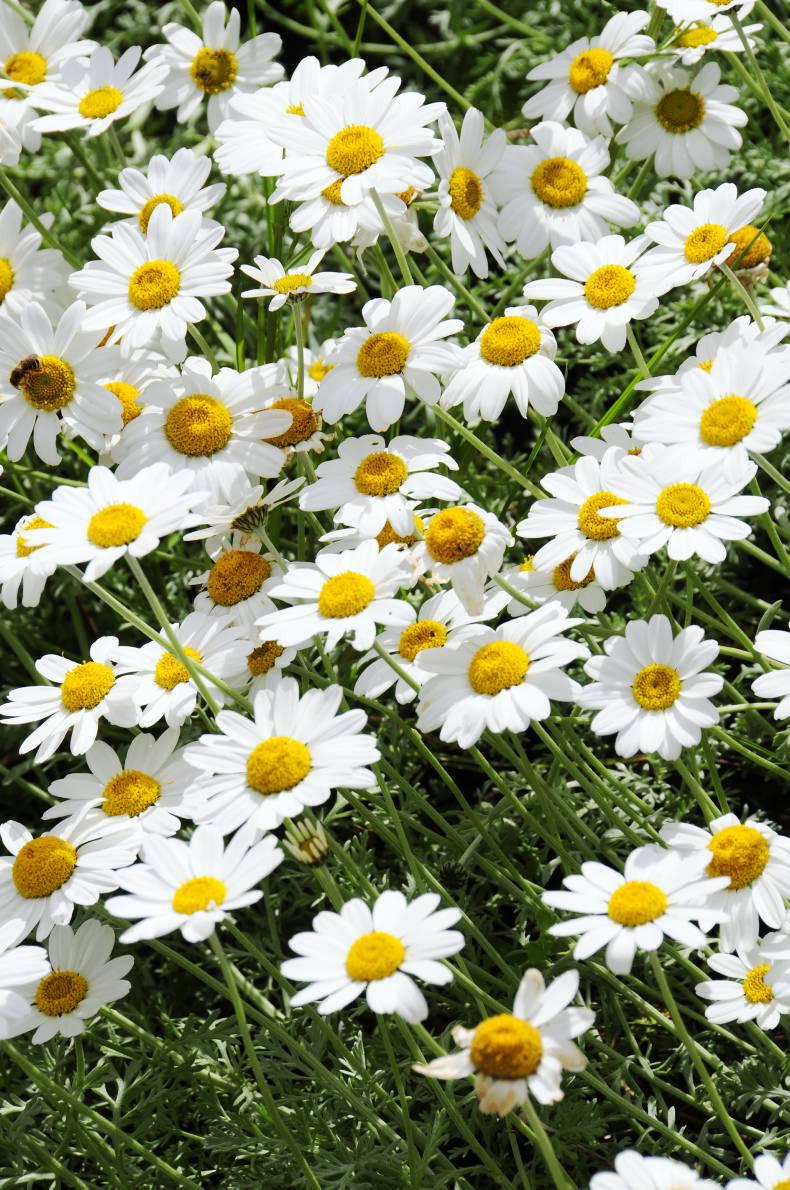
The Sicilian daisy has very bright white flowers with a contrasting golden-yellow centre, a typically lively daisy flower. The individual flowers are about 5cm in diameter, held on short, slender stems that make them seem to be hovering over the silvery-green leaves.
The low-growing foliage is evergreen and much divided to give a seaweed-like appearance and it is very pretty in winter. It forms a broad mat of foliage to over 1m wide after a few years. It grows very quickly, especially on new ground, where it has a clear run and no competition from other plants. It is an ideal filler for the front of a new bed or border, or the edge of a patio area.
The botanical name is Anthemis cupaniana and being native to Sicily gives good clues as to the conditions that it likes. It loves full sunshine and well-drained soil. The silvery grey leaves help it to reduce the impact of the strong sunlight of Sicily with a covering of fine hairs, while the much-divided leaves are more tolerant of the drying winds of that region.
These features help the plant to cope with dry or well-drained soil here too, though the challenge of drought is much less. Of course, a relatively plentiful supply of moisture and nutrients sees the plant revelling in the rich conditions and growing very fast.
Unlike many similar mat-forming plants, this anthemis does not form a perfect circle of foliage and flowers, but a more informal, slightly ragged outline that has a special natural charm. This can be enhanced by planting several plants in an uneven grouping, so that a snaking slew of white daisies is produced.
In winter, the foliage loses some of its silvery coating and appears more grey-green. It looks great in combination with the yellow flowers of Helianthemum, which forms a low, bushy plant covered with flowers, and some purple alliums, their rounded shapes picking up the round shape of the daisy flowers. It begins to flower before both of these but they catch up in time for the full show of daisies.
The Sicilian daisy is attractive to insects looking for an early source of pollen and nectar and its shape has evolved to encourage bees and other insects. When an insect lands on the daisy flower, it is warmed by sunlight reflected from the petals. The warmth encourages the bee to be as active as possible in spreading pollen about.
This anthemis is not completely hardy and can suffer in a hard winter in an inland area, but it survives well in most places in average winters, and it is much hardier than generally given credit for. Besides, it is easily raised from cuttings and a few insurance plants can be raised.
It is less likely to be frost-damaged when grown in dry, well-drained soil where the leaves will be less soft. When really well suited as to soil, ideally when grown in a gravel bed, it can produce self-sown seedlings.
These add to the number of plants and the irregularity of the planting but often appear in a very attractive natural pattern. They also can be used to replace older plants that might have become a little straggly. CL
Trees, shrubs and roses
Although the bare-root planting season is over, pot-grown trees and shrubs can still be planted. Watering is important in making sure these plants take root. Rose bushes are making very vigorous growth and should be sprayed to control blackspot disease if previously affected. Feed rose bushes with rose fertiliser or general fertiliser, and young trees and shrubs too.
Flowers
Many plants are attacked by slugs as new shoots come through the soil and sometimes this is difficult to spot. Bedding plants raised from seeds should be regularly watered and given liquid feed to get good size. Space plants well to give them room to grow. Tubers of begonias and dahlias can be potted up, and corms of gladiolus can be planted out.
Fruit, vegetables and herbs
Control weed seedlings by hoeing between the rows and hand-pulling in the rows. Thin vegetables that need it as they reach a suitable size. Thinning is best done early, and in two stages. Vegetable seed sowing can continue, especially of maincrop vegetables, such as carrots, broccoli and peas. Spray apple and pear trees for scab disease if previously affected.
Lawns
After a late spring and low soil temperatures, grass growth has finally picked up a bit. Lawns that are pale, with slow growth should be fed now with lawn fertiliser, or high-nitrogen fertiliser, but just enough to green the grass not so much as to cause vigorous growth and extra work mowing. Thirty grams per square metre should be adequate.
Greenhouse and house plants
Over-grown house plants can be cut back, well-watered and fed until they show signs of new growth. Houseplants can be re-potted if they are pot-bound and inclined to topple over. All greenhouse plants should be fed and watered well to get a good start. Spray a grapevine for mildew if it had the disease last year, before flowers open.
Pear leaf blister mite
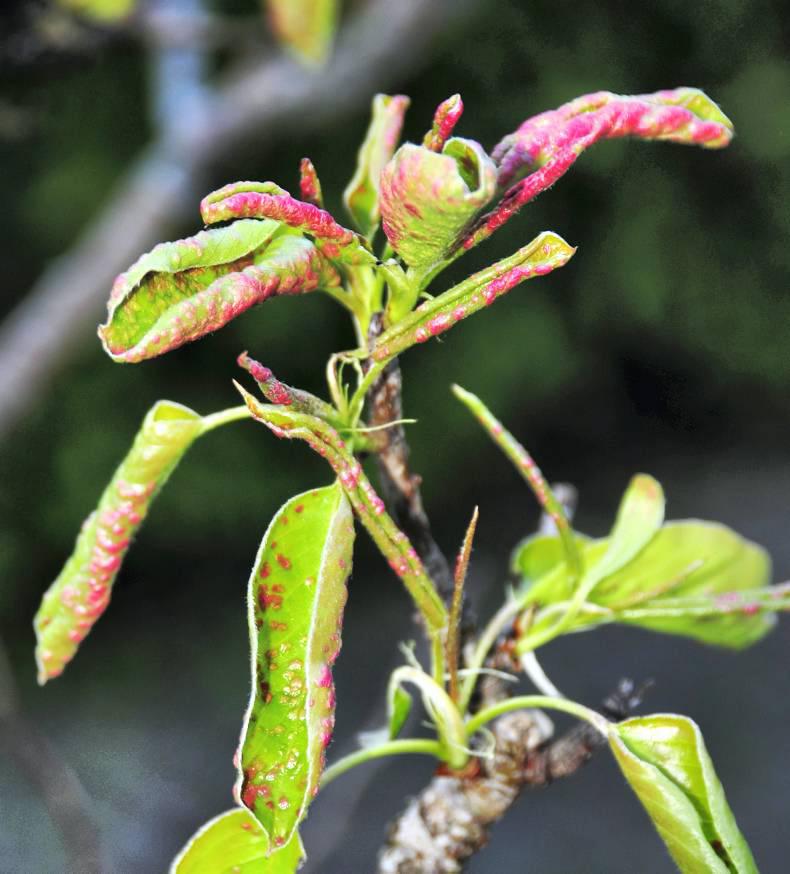
In recent years, there has been an increased occurrence of pear leaf blister mite. The mites are tiny and can only be seen with a powerful hand lens or microscope, but the symptoms they cause are only too visible. The mites move into the buds during bud break and feed inside the buds, drawing sap from the folded leaves. When the buds open, the damage can be seen as distortion and reddening of the leaves. Later the red tinge turns yellow and eventually the leaves turn green with dead patches where the damage was greatest.
The leaves are not completely destroyed, but they can be badly damaged and deformed into curled shapes, and their capacity to photosynthesise and grow is greatly reduced. Cropping can be significantly reduced or completely stopped. After flowering, so as not to damage pollinators, the foliage can be sprayed with a suspension of 50ml vegetable oil per litre of water and a few drops of washing-up liquid, if the symptoms are extensive or have occurred in recent years.


SHARING OPTIONS