


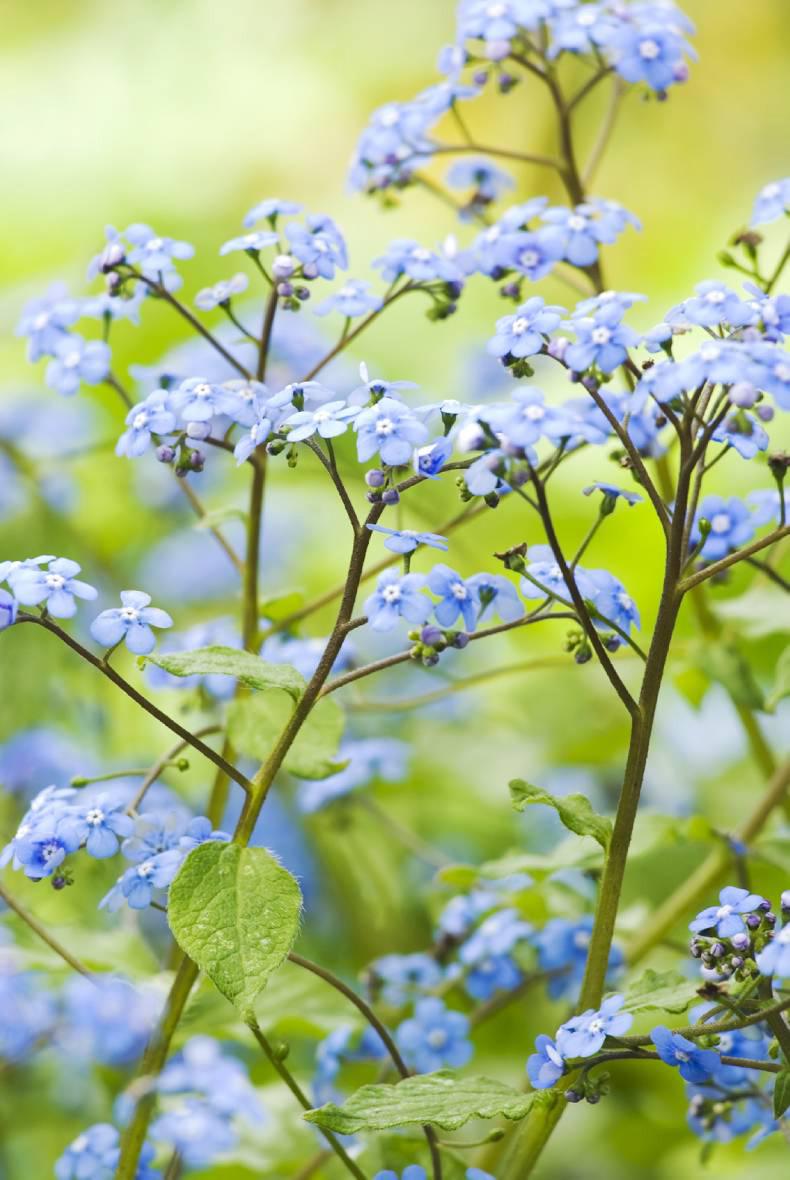
Forget-me-not is a native wild flower in Ireland and the rest of Europe. About six botanically different species grow here.
Some of these are very familiar as wild flowers of tilled ground, usually dry, well-drained, good soil. They are a good indicator of soil that is suitable for growing fruit and vegetables. If the soil is very fertile, the forget-me-not luxuriates with soft growth. In flower beds and rockeries, it is not unusual to see wild forget-me-nots flowering away happily and self-sowing their hard little black seeds. Most of the species that grow wild are annuals or short-lived perennials, surviving by shedding seeds.
The cultivated forms are also annual and have been bred and selected from the wild species, including some European species. Generally, these are larger with more numerous and bigger flowers. Traditionally, forget-me-not was a valued cottage garden flower and it was easy to root up a few seedlings or gather a pinch of seed and pass on this flower, as was the way with cottage-garden flowers.
Forget-me-not was also used quite a lot in the display flower beds of public parks, usually teamed with white, pink, orange or yellow tulips. The blue forget-me-not flowers formed a haze of blue as ground-level back-drop for the tulips, a lovely effect, still seen from time to time. While this formula is rarely used in a home garden, it can be very effective in pots and window boxes for April and May.
Forget-me-not is still very popular and there is now more uptake on a few perennial flowers related to forget-me-not, and having the same charming blue flowers. In fact, it is possible to have a succession of forget-me-not flowers from February to July. Three species may be used to stretch the season: omphalodes, brunnera and cynoglossum. All three are related closely to forget-me-not and, like forget-me-not, are members of the borage family, all of which, typically, have strong blue flowers – though not all have the small flat, light blue flowers of forget-me-not.
The show starts in spring with the flowers of navelwort, also called blue-eyed Mary, Omphalodes verna. This is a small plant with pointed wide leaves and pretty blue flowers – like forget-me-not but larger. It flowers for months from February and looks great with yellow daffodils in March. Indeed, it looks good with any spring bulb. It is followed by the larger species omphalodes cappadocica, which has large blue flowers over a carpet of leaves. Both kinds are happy in light shade, in leafy soil that is well-drained but not too dry.
Brunnera overlaps the omphalodes, beginning to flower in late spring and into early summer. The blue forget-me-not flowers are smaller than the blue-eyed Mary, carried in sprays but all the more alike because of that. The plant is taller than forget-me-not or omphalodes, reaching knee-height in flower. It has a tuft of large-leaved foliage, often silvered, as in the variety ‘Jack Frost’ and many others. The plant is often grown for its ground-covering foliage that tolerates a degree of shade. Some people go to the troubled of clipping away the flower-stems, which seems a pity.
The final one of the perennial trio is cynoglossum, or hound’s tongue, a reference to the long narrow leaves. It is taller and has bigger flowers than the others but still they are forget-me-not in style. It flowers from mid-summer onwards and likes a touch of shade – but not too much or flowering is reduced.
Although the flowers are larger, this member of the clan is somewhat rougher in appearance and better in a semi-wild location. All can be planted at any time and are very easy to grow.
Drooping sedge
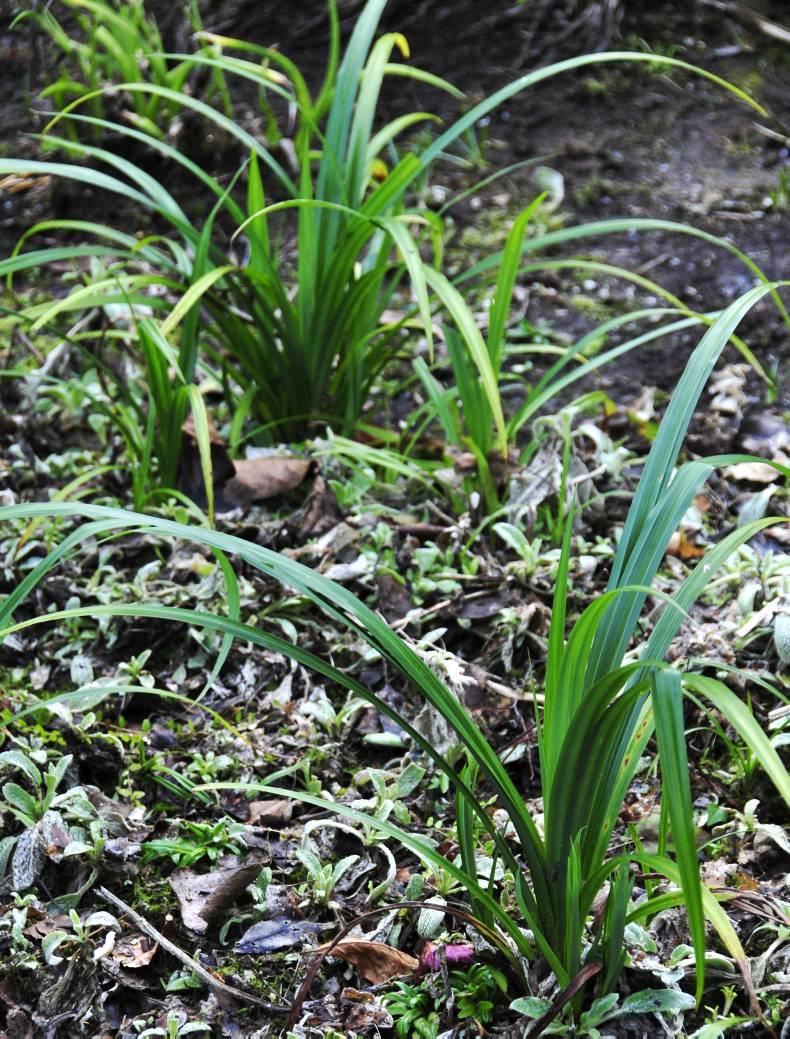
The drooping sedge is a tall grassy-looking plant that forms a large tuft of arching evergreen foliage. It looks very well as a seedling with its neat arching leaves, but it can grow taller than a man. It produces dangling female seed heads to 15cm longm which look well but also release lots of dark brown seeds and there are almost always some seedlings near a mature plant. The pendulous sedge is a native wild flower. It looks like a grass but the leaves are much harder. It is common in damp areas of woodland on heavy soil. It is often left growing in gardens and even can be deliberately planted. It can also become a weed, but it is a pretty weed, unless it gets too big.
>> This week
Trees, shrubs and roses
After a very wet planting season, take any opportunity to resume planting bareroot hedging, shelter and woodland trees. Rose bushes can be planted at any time. Bush roses are already showing good growth. Repeat-flowering climbers should be pruned right away, if not already done. Control weeds around young trees and shrubs.
Fruit, vegetables and herbs
The pruning of apple and pear trees and currant and gooseberry bushes should be completed as soon as possible. Fruit trees and bushes should be planted within the next few weeks. Sow seeds of early varieties of cabbage, cauliflower, carrots, lettuce and onions in a tunnel or glasshouse to plant out for an early crop in April.
Lawn
Lawns have grown more or less all winter as there have been many mild spells and relatively few frosty nights. It is still worthwhile to mow the grass at the first opportunity and to repeat it after a few weeks. This will leave the lawn area looking neat and tidy before real growth starts. Apply sulphate of iron if there is heavy moss growth.
Flowers
Lifting and dividing of herbaceous flowers can resume if the soil has drained. This is the best time to move perennial flowers in gardens on heavy soil, if dry enough. Take the old leaves off hellebores if there is much black spotting. Seeds of geraniums, lobelia, busy lizzie and bedding begonias can be sown in a heated propagator.
Greenhouse and house plants
With new crops to be planted out soon enough, it is a good idea to prepare the greenhouse soil by digging in plenty of well-rotted compost or manure and to balance this with potash. Greenhouse peach trees should have the first flowers gently pollinated with a small soft paintbrush or by tapping on the support wires on a sunny day.


SHARING OPTIONS