After months of semi-hibernation, the humble spud is often the first crop one thinks of planting directly into the ground or a pot. The eager beavers will already have their seed potatoes pre-sprouting (chitting) to encourage growth. Chitting can begin from January by placing seed potatoes in a bright, frost-free room. It is not essential, but can encourage earlier harvests.
From a practical point of view, soil conditions and temperature matter far more than the calendar. Knowing your local last frost date is key, and for many gardeners planting from April onwards is more straightforward as ground conditions improve.
Still, if the soil is workable and not waterlogged, planting some early potatoes around St Patrick’s Day can feel like a small act of faith and a more worthwhile activity than drowning the shamrock, let’s say.
Some might argue that potatoes, being cheap and widely available, aren’t worth the space in a kitchen garden.
But anyone who has lifted a freshly grown new potato in summer knows otherwise. The flavour, texture and satisfaction of eating potatoes straight from the soil is hard to beat.
Choosing varieties
Potatoes are generally divided into three categories based on how long they take to mature. First earlies are the ones to plant now. Taking roughly 100 days, they are ideal for small gardens and have the added bonus of being harvested before blight becomes an issue, whilst freeing up space for later crops. Reliable varieties include ‘Orla’, ‘Sharpes Express’ and ‘Vitabella’, all valued for flavour as much as yield.
Second earlies take about 120 days, and help extend the new potato season. ‘Nicola’ is a long-standing favourite, while red-skinned ‘Alouette’ performs well in Irish conditions. For something a little different, ‘Bleuet’ produces striking blue tubers that retain their colour when cooked.
Maincrop potatoes take around 160 days and are grown for storage. Choosing blight-resistant varieties is essential. ‘Connect’ is favoured by chefs and organic growers alike, while ‘Sevilla’ and ‘Sarpo Mira’ are valued for reliability, disease resistance and good yields.
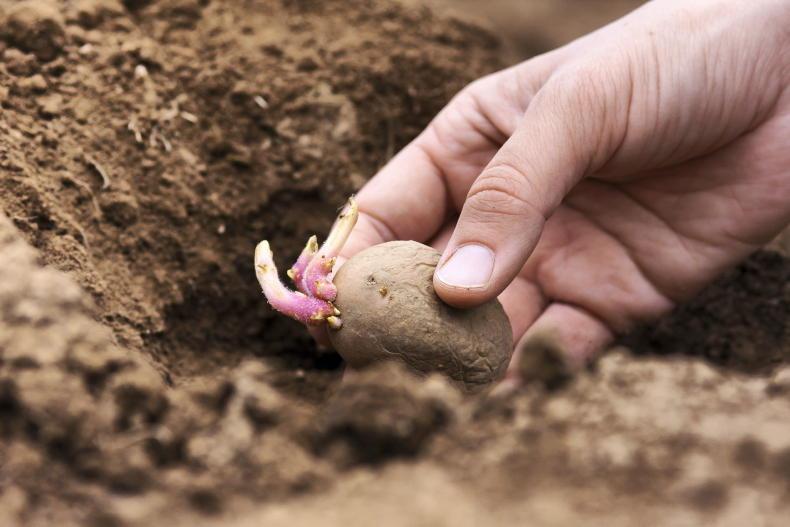
Planting potatoes in a bed. \iStock
Cultivation
Traditionally grown in lazy beds and drills, potatoes also adapt well to raised or standard beds provided the soil is fertile and free-draining. Choose a sunny, sheltered spot, as exposure to wind can be limiting.
Loosen the soil with a broadfork rather than digging deeply, then add plenty of organic matter such as compost or well-rotted manure. Fresh seaweed, responsibly gathered, makes an excellent mulch where available.
Plant tubers about 10cm deep, eyes facing upwards, spacing them 25-30cm apart with 60cm between rows. Potatoes are valuable in crop rotations and ideal for breaking new ground, leaving soil in good condition for follow-on crops such as leeks, garlic, broccoli or green manures.
Keep potatoes weed-free until their canopy closes and earth up plants as they grow, gradually mounding soil around the stems. This supports plants and prevents developing tubers from being exposed to light, which causes greening.
Water sparingly but deeply during dry spells, especially for early varieties. Straw or hay mulch helps retain moisture, while seaweed or silica feeds before flowering can strengthen growth and improve
blight resistance.
Keep an eye on the weather forecast and if frost threatens after shoots emerge, cover plants with soil or fleece.
Potatoes are generally robust, though slugs and wireworms can cause damage. Early varieties have an advantage here, spending less time in the ground.
Once potato plants start to flower they are generally ready to harvest but in some instances earlies will not flower so you need to rummage around the soil under one or two plants to see if tubers are of a useable size.
First earlies are kept in the ground and harvested as required as they do not store well once lifted. Use a garden fork in combination with your hands to carefully unearth the tubers, being mindful not to damage them in the process.
Potatoes can also be grown in large containers or grow bags. Restrict to one seed potato per large pot, keep watering consistent and continue to add compost.
Yields may be modest, but container growing is ideal for patios, it keeps extra-early crops under cover, and are a great way to sow seeds of hope this St Patrick’s Day without breaking your back or losing a whole day.
Q&A: Can I divide my chive plants?

Green chives in the garden. \iStock
My chive plants are growing well – how should I care for them, harvest correctly, and can I divide them now to spread them around the garden? – Sadie, Co Cork.
As perennials, chives benefit from a light seaweed feed this time of year and should be kept weed-free, as scutch grass can tangle into the roots. Harvest regularly to encourage new growth, always cutting a few centimetres above ground level with sharp scissors. Avoid cutting halfway up stems, which causes dieback. Early spring and into March is a good time to divide chives. Lift the clump, split into small sections, replant immediately, cut back and water well. Leave some clumps to flower in May as garden bees and cooks will thank you.
On heat or under cover: if you didn’t sow aubergines, chillis, sweet peppers or tomatoes last month, you can still do so in March. Beetroot, Brussels sprouts, kohlrabi, cauliflower, summer cabbages, onions, lettuce, celery and celeriac can be module sown indoors for later transplanting outside.
Direct sowing in tunnels: direct sow early crops like beetroot, carrots, dwarf peas, oriental salads, radish and white turnips
directly into tunnel beds. Keep fleece available for protection.
After months of semi-hibernation, the humble spud is often the first crop one thinks of planting directly into the ground or a pot. The eager beavers will already have their seed potatoes pre-sprouting (chitting) to encourage growth. Chitting can begin from January by placing seed potatoes in a bright, frost-free room. It is not essential, but can encourage earlier harvests.
From a practical point of view, soil conditions and temperature matter far more than the calendar. Knowing your local last frost date is key, and for many gardeners planting from April onwards is more straightforward as ground conditions improve.
Still, if the soil is workable and not waterlogged, planting some early potatoes around St Patrick’s Day can feel like a small act of faith and a more worthwhile activity than drowning the shamrock, let’s say.
Some might argue that potatoes, being cheap and widely available, aren’t worth the space in a kitchen garden.
But anyone who has lifted a freshly grown new potato in summer knows otherwise. The flavour, texture and satisfaction of eating potatoes straight from the soil is hard to beat.
Choosing varieties
Potatoes are generally divided into three categories based on how long they take to mature. First earlies are the ones to plant now. Taking roughly 100 days, they are ideal for small gardens and have the added bonus of being harvested before blight becomes an issue, whilst freeing up space for later crops. Reliable varieties include ‘Orla’, ‘Sharpes Express’ and ‘Vitabella’, all valued for flavour as much as yield.
Second earlies take about 120 days, and help extend the new potato season. ‘Nicola’ is a long-standing favourite, while red-skinned ‘Alouette’ performs well in Irish conditions. For something a little different, ‘Bleuet’ produces striking blue tubers that retain their colour when cooked.
Maincrop potatoes take around 160 days and are grown for storage. Choosing blight-resistant varieties is essential. ‘Connect’ is favoured by chefs and organic growers alike, while ‘Sevilla’ and ‘Sarpo Mira’ are valued for reliability, disease resistance and good yields.

Planting potatoes in a bed. \iStock
Cultivation
Traditionally grown in lazy beds and drills, potatoes also adapt well to raised or standard beds provided the soil is fertile and free-draining. Choose a sunny, sheltered spot, as exposure to wind can be limiting.
Loosen the soil with a broadfork rather than digging deeply, then add plenty of organic matter such as compost or well-rotted manure. Fresh seaweed, responsibly gathered, makes an excellent mulch where available.
Plant tubers about 10cm deep, eyes facing upwards, spacing them 25-30cm apart with 60cm between rows. Potatoes are valuable in crop rotations and ideal for breaking new ground, leaving soil in good condition for follow-on crops such as leeks, garlic, broccoli or green manures.
Keep potatoes weed-free until their canopy closes and earth up plants as they grow, gradually mounding soil around the stems. This supports plants and prevents developing tubers from being exposed to light, which causes greening.
Water sparingly but deeply during dry spells, especially for early varieties. Straw or hay mulch helps retain moisture, while seaweed or silica feeds before flowering can strengthen growth and improve
blight resistance.
Keep an eye on the weather forecast and if frost threatens after shoots emerge, cover plants with soil or fleece.
Potatoes are generally robust, though slugs and wireworms can cause damage. Early varieties have an advantage here, spending less time in the ground.
Once potato plants start to flower they are generally ready to harvest but in some instances earlies will not flower so you need to rummage around the soil under one or two plants to see if tubers are of a useable size.
First earlies are kept in the ground and harvested as required as they do not store well once lifted. Use a garden fork in combination with your hands to carefully unearth the tubers, being mindful not to damage them in the process.
Potatoes can also be grown in large containers or grow bags. Restrict to one seed potato per large pot, keep watering consistent and continue to add compost.
Yields may be modest, but container growing is ideal for patios, it keeps extra-early crops under cover, and are a great way to sow seeds of hope this St Patrick’s Day without breaking your back or losing a whole day.
Q&A: Can I divide my chive plants?

Green chives in the garden. \iStock
My chive plants are growing well – how should I care for them, harvest correctly, and can I divide them now to spread them around the garden? – Sadie, Co Cork.
As perennials, chives benefit from a light seaweed feed this time of year and should be kept weed-free, as scutch grass can tangle into the roots. Harvest regularly to encourage new growth, always cutting a few centimetres above ground level with sharp scissors. Avoid cutting halfway up stems, which causes dieback. Early spring and into March is a good time to divide chives. Lift the clump, split into small sections, replant immediately, cut back and water well. Leave some clumps to flower in May as garden bees and cooks will thank you.
On heat or under cover: if you didn’t sow aubergines, chillis, sweet peppers or tomatoes last month, you can still do so in March. Beetroot, Brussels sprouts, kohlrabi, cauliflower, summer cabbages, onions, lettuce, celery and celeriac can be module sown indoors for later transplanting outside.
Direct sowing in tunnels: direct sow early crops like beetroot, carrots, dwarf peas, oriental salads, radish and white turnips
directly into tunnel beds. Keep fleece available for protection.
SHARING OPTIONS