

Pots and planters give gardeners the opportunity to explore growing plants where there is no access to garden soil. That may be on patios, balconies or in yards where colour and interest is needed. It may also be the case that a specific soil type is required for your plants, for example, those with specialised interests like alpine growing.
Alpine plants are worth considering for troughs and planters as they are a long-term prospect and develop beautifully over the years. They require minimum maintenance to keep them in tip top condition.
Alpine plants are found at high altitudes, above the tree line and below the snowline in mountain ranges of the world. Here they have the best growing conditions – high light levels and continuous flowing water at the roots but never waterlogged.
The best alpine plants are those that form tight clumps or tufts as they tend to be easier to manage and do not run or invade other plants in a trough. The group of plants known as Mossy Saxifrages do well as they form small clumps resembling moss.
Saxifraga x arendsii – growing to 5cm wide and of a similar height – produces an abundance of pink or white flowers in spring.
It is slow growing and over time can spread, but can be trimmed back to the designated space. S. ‘White Star’ is equally small with clear white flowers, both of these have a long flowering season.
Sempervivum is commonly known as ‘Hens and Chickens’ because it always has tiny plantlets around its base, which can be easily removed and propagated. It also has the common name of House Leek. Sempervivum calcareum ‘Limelight’ is a tight growing round mat with light lemon-green foliage.
Adding to the beauty, the leaf tips are cherry red, particularly in winter. It also has a web of silvery white hairs which adds to the wonder of the plant. S. arachneum is fun especially for younger people as it is covered in light grey hairs resembling cobwebs. It looks wonderful after rain.
March into late-summer
It is likely we all know Sea Thrift from sea cliffs and paths, it is Armeria maritima and grows wild in Ireland.
There are several species that are worthwhile growing in troughs. A. caespitosa ‘Bevans Variety’ is a compact form growing to 5cm with rosy pink flowers produced from March to May, which is perfect for troughs.
Look out for A. caespitosa ‘Alba’ which has white flowers held on compact clumps. It is unusual by virtue of its flower colour.
Dianthus, known as pinks are familiar to all and are perfect for troughs. D. alpinus forms tight clumps no higher than 5cm with rich green narrow foliage and rich pink flowers with a darker eye.
D. alpinus ‘Dawn’ is to be treasured as a plant with a lovely dusky pink coloured petals and is a prostrate grower to 5cm.
Androsace sempervivoides is less of a cushion but more a spreader but still suitable for troughs. The pink flowers are held on top of green rosettes.
It is easily contained within the space and never gets out of control. Primula ‘Lady Greer’ is a must for your troughs with its dainty foliage and butter yellow coloured flowers. It is an Irish cultivar that arose in a Co Leitrim garden. It is named to honour Lady Olivia Greer of Curragh Grange, Co Kildare.
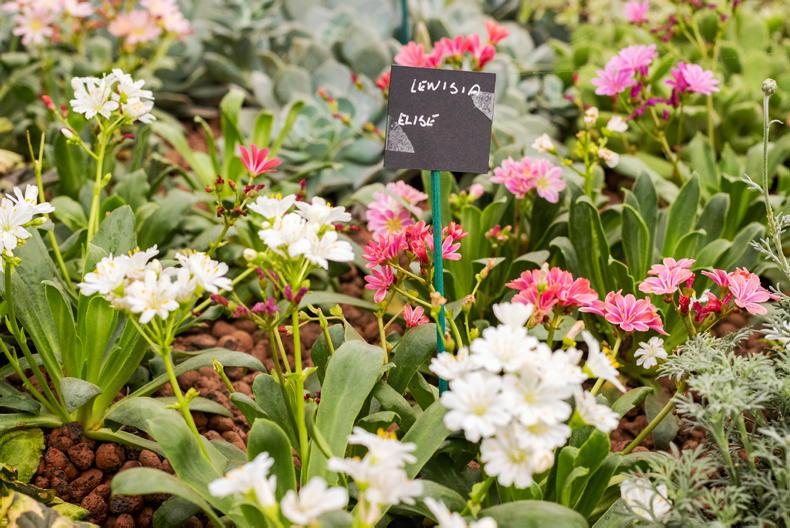
Lewisia cotyledon and any one of its cultivars are plants worthwhile and perfectly suitable for troughs as it struggles in open garden soil. The flowers come in a range of pastel shades.
Cultivation: trough gardening with alpines requires special attention to soil and drainage. In their native environment they are found on gravelly slopes with snow melt running freely underneath but never growing in stagnant water. These conditions must be replicated in your troughs, so a free draining compost is key.
This must be soil based, my recommendation is a mix comprised of two parts John Innes Potting compost, two parts composted fine bark or leaf mould, one part granite grit, and one part fine granite sand. Where drainage holes are situated in the trough these should be covered with small sections of slate.
When plants are planted, cover the surface with coarse grit tucking it in under the foliage of the alpines. The only maintenance required is removal of any weeds and monitoring of water requirements.

Q&A: What is the best app for plants?

Identifying plants with apps.
I’m working part-time for a gardener since retiring from dairy farming. Can you
recommend the best plant identifier app that is handy for gardening? – Tom Cork.
Identifying plants is getting easier with the use of gardening apps. If you are an iPhone user you will find a little circle containing an (i) under the image, that is an identifier. There is an app called PlantNet which is equally good.
For best results, get a clear, close-up shot of a distinctive part of the plant (leaf, flower, fruit).
Try to avoid other plants, people, or hands in the photo.
One word of caution, however, when you follow these apps and get an identification you always need to come back to text books to verify or simply Google the name to see if it corresponds.
I have seen some mistakes where a name is solely taken from the app. Best of luck with your identifications and enjoy.
Trees, shrubs and roses: check all plants for wind rock and stabilise. Check plant ties and secure if loosened. Continue
with bare root planting.
Maintenance: prepare for the gardening year, wash all pots and pans in soapy water, try to recycle plant labels. Keep a close eye on protected plants so no gaps are
appearing in fleece covering.
Lawn: ground is waterlogged at the moment.Avoid any traffic on any affected areas.
Greenhouse and house plants: continue to check heat especially in frosty weather, plan for cleaning greenhouse glass. Remove all debris from benches and beds. Wash glass.
Pots and planters give gardeners the opportunity to explore growing plants where there is no access to garden soil. That may be on patios, balconies or in yards where colour and interest is needed. It may also be the case that a specific soil type is required for your plants, for example, those with specialised interests like alpine growing.
Alpine plants are worth considering for troughs and planters as they are a long-term prospect and develop beautifully over the years. They require minimum maintenance to keep them in tip top condition.
Alpine plants are found at high altitudes, above the tree line and below the snowline in mountain ranges of the world. Here they have the best growing conditions – high light levels and continuous flowing water at the roots but never waterlogged.
The best alpine plants are those that form tight clumps or tufts as they tend to be easier to manage and do not run or invade other plants in a trough. The group of plants known as Mossy Saxifrages do well as they form small clumps resembling moss.
Saxifraga x arendsii – growing to 5cm wide and of a similar height – produces an abundance of pink or white flowers in spring.
It is slow growing and over time can spread, but can be trimmed back to the designated space. S. ‘White Star’ is equally small with clear white flowers, both of these have a long flowering season.
Sempervivum is commonly known as ‘Hens and Chickens’ because it always has tiny plantlets around its base, which can be easily removed and propagated. It also has the common name of House Leek. Sempervivum calcareum ‘Limelight’ is a tight growing round mat with light lemon-green foliage.
Adding to the beauty, the leaf tips are cherry red, particularly in winter. It also has a web of silvery white hairs which adds to the wonder of the plant. S. arachneum is fun especially for younger people as it is covered in light grey hairs resembling cobwebs. It looks wonderful after rain.
March into late-summer
It is likely we all know Sea Thrift from sea cliffs and paths, it is Armeria maritima and grows wild in Ireland.
There are several species that are worthwhile growing in troughs. A. caespitosa ‘Bevans Variety’ is a compact form growing to 5cm with rosy pink flowers produced from March to May, which is perfect for troughs.
Look out for A. caespitosa ‘Alba’ which has white flowers held on compact clumps. It is unusual by virtue of its flower colour.
Dianthus, known as pinks are familiar to all and are perfect for troughs. D. alpinus forms tight clumps no higher than 5cm with rich green narrow foliage and rich pink flowers with a darker eye.
D. alpinus ‘Dawn’ is to be treasured as a plant with a lovely dusky pink coloured petals and is a prostrate grower to 5cm.
Androsace sempervivoides is less of a cushion but more a spreader but still suitable for troughs. The pink flowers are held on top of green rosettes.
It is easily contained within the space and never gets out of control. Primula ‘Lady Greer’ is a must for your troughs with its dainty foliage and butter yellow coloured flowers. It is an Irish cultivar that arose in a Co Leitrim garden. It is named to honour Lady Olivia Greer of Curragh Grange, Co Kildare.
Lewisia cotyledon and any one of its cultivars are plants worthwhile and perfectly suitable for troughs as it struggles in open garden soil. The flowers come in a range of pastel shades.
Cultivation: trough gardening with alpines requires special attention to soil and drainage. In their native environment they are found on gravelly slopes with snow melt running freely underneath but never growing in stagnant water. These conditions must be replicated in your troughs, so a free draining compost is key.
This must be soil based, my recommendation is a mix comprised of two parts John Innes Potting compost, two parts composted fine bark or leaf mould, one part granite grit, and one part fine granite sand. Where drainage holes are situated in the trough these should be covered with small sections of slate.
When plants are planted, cover the surface with coarse grit tucking it in under the foliage of the alpines. The only maintenance required is removal of any weeds and monitoring of water requirements.
Q&A: What is the best app for plants?

Identifying plants with apps.
I’m working part-time for a gardener since retiring from dairy farming. Can you
recommend the best plant identifier app that is handy for gardening? – Tom Cork.
Identifying plants is getting easier with the use of gardening apps. If you are an iPhone user you will find a little circle containing an (i) under the image, that is an identifier. There is an app called PlantNet which is equally good.
For best results, get a clear, close-up shot of a distinctive part of the plant (leaf, flower, fruit).
Try to avoid other plants, people, or hands in the photo.
One word of caution, however, when you follow these apps and get an identification you always need to come back to text books to verify or simply Google the name to see if it corresponds.
I have seen some mistakes where a name is solely taken from the app. Best of luck with your identifications and enjoy.
Trees, shrubs and roses: check all plants for wind rock and stabilise. Check plant ties and secure if loosened. Continue
with bare root planting.
Maintenance: prepare for the gardening year, wash all pots and pans in soapy water, try to recycle plant labels. Keep a close eye on protected plants so no gaps are
appearing in fleece covering.
Lawn: ground is waterlogged at the moment.Avoid any traffic on any affected areas.
Greenhouse and house plants: continue to check heat especially in frosty weather, plan for cleaning greenhouse glass. Remove all debris from benches and beds. Wash glass.
SHARING OPTIONS