Gerry Daly’s ten tips on how to deal with moss this spring
1Dampness
Dampness is an important factor in the growth of moss. Moss is an ancient kind of plant that depends on spore germination and surface water. It needs water for continuing growth as it is very vulnerable to drying out. Improving drainage of the lawn reduces dampness.
2Shade
Areas of lawn that are shaded tend to take longer to dry out and the availability of moisture promotes moss growth. However, heavy shade eventually kills moss because it needs some light for growth. Reducing shade by pruning trees can make a big contribution to controlling moss.
3Shelter
Because moss is a very low-growing plant, it can survive well in exposed areas. Sheltered places provide ideal conditions, with slower drying of the soil surface and more moisture in the air. Reducing shelter, if that is possible, can help to reduce moss.
4Low soil fertility
Moss has a very low nutrient requirement compared with grass and it thrives in poor soils that are low in plant nutrients and where grass is weakened. Feeding a lawn with lawn fertilizer, or high-nitrogen fertilizer, promotes growth of grass and its ability to compete with moss.
5Acid soil and lime
Moss grows better on acidic soils and the upper layer of soil becomes acidified by rainfall. Dead grass thatch on the soil surface also tends to acidify the soil. Applying some ground limestone can help to reduce acidic soil conditions and improve grass growth.
6Moss control
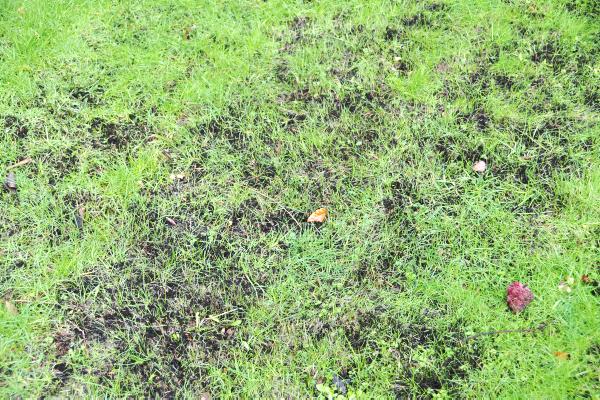
Moss can be controlled by applying sulphate of iron, also called ferrous sulphate. This pale-green fine salt can be applied directly, mixed with sand or dissolved in water. It acts by dehydrating the moss, turning it brown or black very quickly. It affects grass slightly, but it soon grows out. Almost all moss-control products are based on sulphate of iron, but there is also a product called Mo-bacter, an organic lawn feed with bacterial action.
7Moss and weed control
Combined feed, weed and moss control products, known as 3-in-1 products, are convenient and easy to use, ideal for relatively small areas, but they work out quite expensive over large areas, where feeding, moss control and weed control can be done separately.
8Raking and
scarifying
Raking out moss helps to reduce it, but does not clear it and it is slow, hard work. Scarifying is another term for raking out moss and it can be done with a motorised scarifier or a device fitted to a lawn mower blade. This is not essential and produces masses of moss and grass debris, which can be composted.
9Top-dressing
and re-sowing
After thorough raking or scarifying, with sulphate of iron applied before or after, it can be beneficial, though not essential, to top-dress the lawn with fine top-soil. This provides new rooting material for the grass and grass seed can be sown over the area.
10Return of moss
Moss will always return if the conditions are suitable. The aim should be to maintain the balance in favour of grass. Reduce dampness, shade, shelter and soil acidity, and increase nutrient levels.
Register for free to read this story and our free stories.
This content is available to digital subscribers and loyalty code users only. Sign in to your account, use the code or subscribe to get unlimited access.
The reader loyalty code gives you full access to the site from when you enter it until the following Wednesday at 9pm. Find your unique code on the back page of Irish Country Living every week.
CODE ACCEPTED
You have full access to the site until next Wednesday at 9pm.
CODE NOT VALID
Please try again or contact support.
Gerry Daly’s ten tips on how to deal with moss this spring
1Dampness
Dampness is an important factor in the growth of moss. Moss is an ancient kind of plant that depends on spore germination and surface water. It needs water for continuing growth as it is very vulnerable to drying out. Improving drainage of the lawn reduces dampness.
2Shade
Areas of lawn that are shaded tend to take longer to dry out and the availability of moisture promotes moss growth. However, heavy shade eventually kills moss because it needs some light for growth. Reducing shade by pruning trees can make a big contribution to controlling moss.
3Shelter
Because moss is a very low-growing plant, it can survive well in exposed areas. Sheltered places provide ideal conditions, with slower drying of the soil surface and more moisture in the air. Reducing shelter, if that is possible, can help to reduce moss.
4Low soil fertility
Moss has a very low nutrient requirement compared with grass and it thrives in poor soils that are low in plant nutrients and where grass is weakened. Feeding a lawn with lawn fertilizer, or high-nitrogen fertilizer, promotes growth of grass and its ability to compete with moss.
5Acid soil and lime
Moss grows better on acidic soils and the upper layer of soil becomes acidified by rainfall. Dead grass thatch on the soil surface also tends to acidify the soil. Applying some ground limestone can help to reduce acidic soil conditions and improve grass growth.
6Moss control
Moss can be controlled by applying sulphate of iron, also called ferrous sulphate. This pale-green fine salt can be applied directly, mixed with sand or dissolved in water. It acts by dehydrating the moss, turning it brown or black very quickly. It affects grass slightly, but it soon grows out. Almost all moss-control products are based on sulphate of iron, but there is also a product called Mo-bacter, an organic lawn feed with bacterial action.
7Moss and weed control
Combined feed, weed and moss control products, known as 3-in-1 products, are convenient and easy to use, ideal for relatively small areas, but they work out quite expensive over large areas, where feeding, moss control and weed control can be done separately.
8Raking and
scarifying
Raking out moss helps to reduce it, but does not clear it and it is slow, hard work. Scarifying is another term for raking out moss and it can be done with a motorised scarifier or a device fitted to a lawn mower blade. This is not essential and produces masses of moss and grass debris, which can be composted.
9Top-dressing
and re-sowing
After thorough raking or scarifying, with sulphate of iron applied before or after, it can be beneficial, though not essential, to top-dress the lawn with fine top-soil. This provides new rooting material for the grass and grass seed can be sown over the area.
10Return of moss
Moss will always return if the conditions are suitable. The aim should be to maintain the balance in favour of grass. Reduce dampness, shade, shelter and soil acidity, and increase nutrient levels.
If you would like to speak to a member of our team, please call us on 01-4199525.
Link sent to your email address
We have sent an email to your address. Please click on the link in this email to reset your password. If you can't find it in your inbox, please check your spam folder. If you can't find the email, please call us on 01-4199525.
ENTER YOUR LOYALTY CODE:
The reader loyalty code gives you full access to the site from when you enter it until the following Wednesday at 9pm. Find your unique code on the back page of Irish Country Living every week.
SHARING OPTIONS