


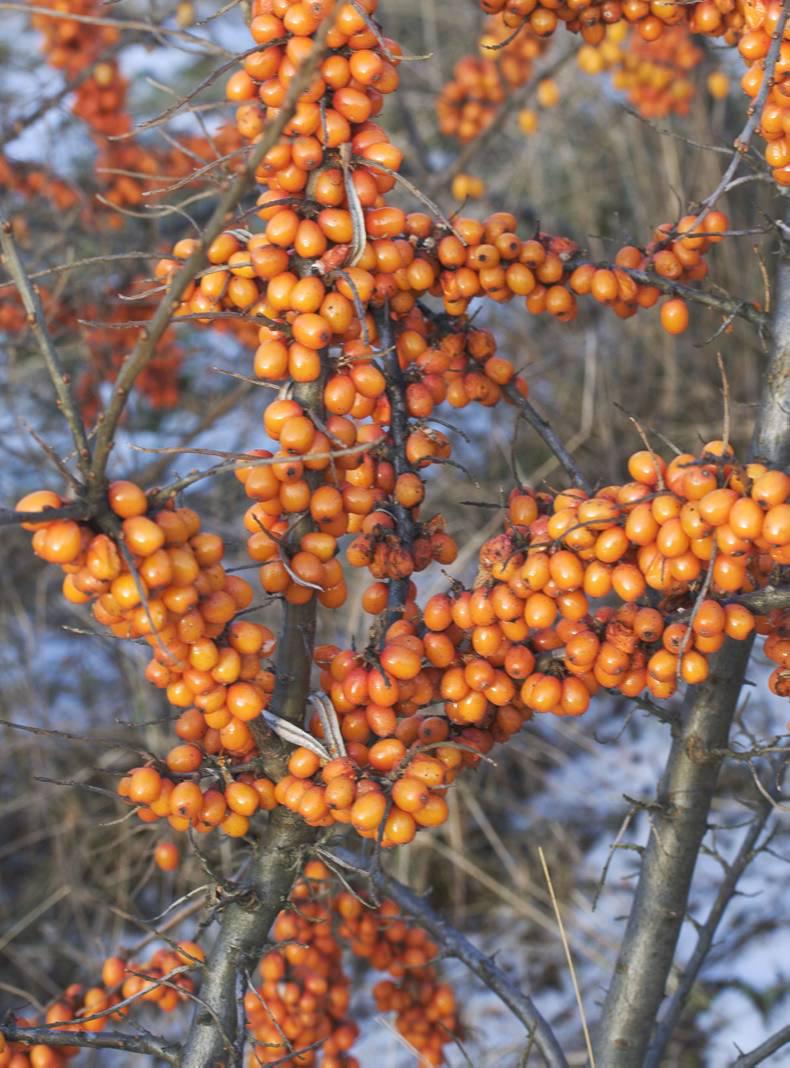
The sea buckthorn is a familiar sight at the coast in parts of the country, especially on the east and north coasts. When seen in those areas, it is normally growing on sand dunes, where it was planted in the 19th century to stabilise the dunes against wind erosion.
This small tree does exceptionally well when exposed to salt, sea gales and being blasted by sand. Where it was planted it has spread by suckering to make great hulking mounds of tough branches. It has also spread by seeds carried by birds to other areas, so it has become naturalised in many other places.
It is generally called ‘sea buckthorn’ although that is a confusing name. Buckthorn is a native bush found by inland lakes, not even in the same family and not particularly similar in appearance, and much rarer than the sea buckthorn. But the sea buckthorn is thorny and thrives by the sea, so, in those respects, the name is appropriate. The botanical name is hippophae.
At this time of year, hippophae makes a fine show of orange berries, carried in masses along the twigs in a good berrying year and more scattered in poorer years. Only the female plants carry berries, and the male kinds are now bare.
In some places, where only male plants were planted and spread, large areas can have no berries at all. In other areas, the plants are more mixed and berries result. Of course, if only female plants are planted, there is no pollen to set the berries. These berries have been in position and coloured since early autumn, but they are only properly revealed when the leaves fall.
The leaves are about five or six centimetres long and narrow, willow-like. They are scaly, silver or slightly bronzed and very like members of the elaeagnus family, which are also tough seaside shrubs. The massed male flower buds often take on a bronze burnish and can look attractive in their own way in winter and spring.
Used to counter coastal erosion, sea buckthorn is not often seen in gardens. It has a tendency to sucker from wide-spreading roots and can be invasive, where it is not wanted. It is armed with very sharp spines along the twigs. These are, if anything, even more formidable when dead and dry on older twigs. When established, it is impenetrable, although it can act as a safe haven for small animals that can slip under the canopy of twigs.
It can be used as an informal hedge, given light clipping, but only where it cannot sucker and spread. It can also be grown as a single-stem small tree to four or five metres, but needs training from an early stage, removing side shoots to encourage it to form a clear stem. Strangely, when grown as a single-stem tree, suckering does not seem to be as bad a problem.
Impervious to coastal exposure, it is also bone-hardy, growing as far north as Finland. It is native to Europe and as far east as China. It is also very tolerant of soil quality, managing to grow on pure sand and on heavy clay. It does not mind wet soil but not standing water.
The berries are widely used in fruit juices, as they are very high in Vitamin C and other vitamins. The juice, and tea infusions made from the leaves, have been used in herbal medicine in various countries and are being investigated for possible pharmaceutical value, as they exhibit some role in regulating the immune system. Sea buckthorn is raised from cuttings or lifted suckers, or from seeds. It is not often available in garden centres, except where seaside plants might be sold, because it looks a bit ungainly in a pot. But some nurseries, such as Future Forests in Cork stock bare-root transplants. CL


SHARING OPTIONS