


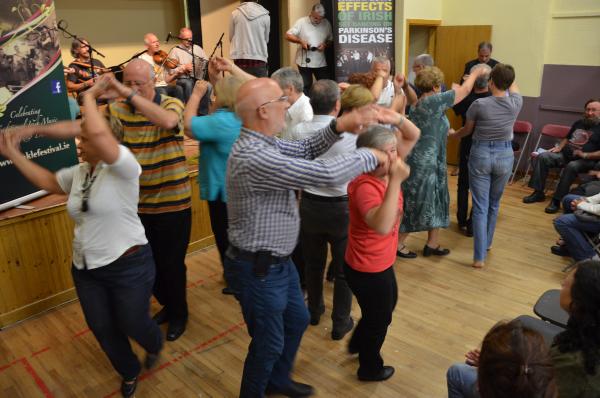


Picture the scene – in a pub in Feakle, Co Clare, Daniele Volpe, a visiting Italian doctor, is taking part in an Irish music session. Involved in developing physiotherapy for people with Parkinson’s disease in a Venice hospital, by chance he notices a man with Parkinson’s entering the pub. The man can’t walk very well. So imagine the doctor’s surprise when he sees the same man set dancing later on with no problems. What was happening?
“It was astonishing,” Dr Volpe told Irish Country Living.
“There was the man with Parkinson’s disease dancing right in front of me. I knew then that I had to study Irish set dancing and its application to persons living with Parkinson’s.”
Set dancing is superior to traditional physiotherapy in terms of improving people’s mobility and balance. That is what Professor Daniele Volpe, Italian neurologist and director of neurological rehabilitation at St Raffaele Archangelo Hospital in Venice, found in his preliminary study into the therapeutic effects of set dancing.
“The results of my pilot study confirmed my expectations. They showed that the typical steps of this dance (the reel step) help gait impairment in those with Parkinson’s disease. The music has a strong rhythm and an acoustic cue that bypasses the mismatch (in Parkinson’s patients’ brains) between the supplementary motor area and the basal ganglia,” he says.
“People with Parkinson’s move better when listening to this acoustic cue as it uses a different network in the brain that is not disrupted (by Parkinson’s disease).”
Dr Volpe was delighted that 90% of participants finished the programme of classes in Venice.
||PIC2||
“This was a very high figure, but that’s because Irish dancing is enjoyable and has a high social value,” he says.
“Overall, the pilot study showed that Irish set dancing is effective on mobility, balance and quality of life in Parkinson’s disease.”
Further research into the therapeutic value of set dancing for those with Parkinson’s is now taking place in Ireland and in Venice. It is being spearheaded by Dr Volpe, who has been joined by interested specialists from the University of Limerick, the Mater hospital, Dublin, and Melbourne University, Australia.
“The new studies are needed to ascertain the effectiveness of Irish set dancing compared with routine physiotherapy exercise over the long term,” he says.
“Fifty to 60 people will be involved in this research. I really hope that, in the future, Irish set dancing can help people with Parkinson’s disease worldwide in providing a non-pharmacological intervention.”
||PIC3||
Set dancing teacher
From a farming family, Joanne Shanahan from Templederry, north Tipperary, is a qualified physiotherapist and is now doing a Masters in Science at the University of Limerick. Being a set dancing teacher made her an ideal person to be involved in this second-stage research into the feasibility and benefits of set dancing classes for those with PD.
Study groups (of people with Parkinson’s learning to set dance) are now running in Limerick, Dublin and Roscommon.
“There were lots of questions initially,” Joanne says. “Would it be safe for Parkinson’s patients? Who with Parkinson’s was it suitable for? There were also feasibility aspects, like would people go to the classes and would they like them? This research is about answering those questions.”
A review of international literature relating to how different dance forms help people with Parkinson’s disease has just been completed and will soon be published by the group.
The feasibility study recently carried out in Limerick has found that set dancing is feasible and safe for people with Parkinson’s. Papers on both these topics will be published in medical journals soon.
“Those who participated in the classes seemed to enjoy them,” Joanne says, “and they spoke of their quality of life improving as well as seeing improvements in their physical endurance and Parkinson’s-related motor function, e.g. tremor, rigidity and hypokinesia (decreased bodily movement).”
Everyone who took part was medically assessed beforehand.
“It’s very much a multi-disciplinary (team) approach to making sure a person is able to take part – GP, physiotherapist and specialist are all involved in doing that assessment.”
So how exactly does set dancing benefit people with Parkinson’s?
“It’s an exercise and, firstly, exercise has lots of benefits for everyone,” she says.
“It increases your endurance and physical capacity as well as helping to prevent deterioration that might result from inactivity. People with Parkinson’s tend to have lower levels of physical activity because of their condition. What the exercise can do is help prevent stiffness and muscle wasting.”
But how exactly can people with Parkinson’s dance when they find it so difficult to walk?
“Like Dr Volpe says, it’s because the music is rhythmic,” Joanne says. “It has a clear, predictable beat. You know when you hear Irish céilí music you want to get up and move or you might start to tap your foot without even realising it.
“Dancing in time to the music means people can keep their movement flowing. Sometimes people with Parkinson’s can freeze when they’re moving and sometimes their steps get smaller as they walk, but by moving to the cue (beat), that is predictable. Some people are able to keep a more normal flow of movement and also increase the pace at which they are moving.
While it has been known for a long time that moving with a metronome can help people, set dancing is more real and enjoyable and it is a great form of exercise.”
The most common step that’s taught in the classes is the reel step.
“That’s because it is similar to walking in that the leg comes forward. There’s a push-forward beat that can be easier for people to tackle than the polka step.”
The dancing with partners aspects is a major factor, she says.
“Dancing with partners, as you do in set dancing, can provide security for people who have reduced balance. Balance is compromised in Parkinson’s so it’s another area we’re investigating.
Set dancing means they also have to do steps on their own, including turning movements.”
The set dancing classes for people with PD are modified to suit the individual’s needs.
“This is very important so that people are able for the level it’s being taught at. The tempo is slowed at the start and you have to make sure that people aren’t so challenged that they are at risk of falling. They must look like they are comfortable and safe when dancing and that they are enjoying it. The teacher would have to be aware of all these things.”
WHAT HAPPENS NEXT?
“Our research papers will be published and hopefully then more clinicians will see the results and consider set dancing as something they could introduce in their area,” she says.
She is also looking forward, to seeing how different dance steps in the various areas of Ireland will work out.
“There are different styles of set dancing. The basic reel step would be a skip but Co Clare would have a battering step which would be a completely different step. Connemara would have a slightly different reel step again for their set so it can vary from area to area.”
Joanne is delighted with how far the research has come, but she knows there is a lot more to be done. In the future she would like to see set dancing classes start in other areas of Ireland for those with Parkinson’s.
“I’d like to see it being done safely for everyone, that set dancing teachers have knowledge about Parkinson’s and about what changes they might need to make in the set dancing class.”
Conferences aimed at increasing dance tutors and physiotherapists’ knowledge have already taken place in Feakle.
There are an estimated 9,000 people with Parkinson’s Disease in Ireland. CL


SHARING OPTIONS