



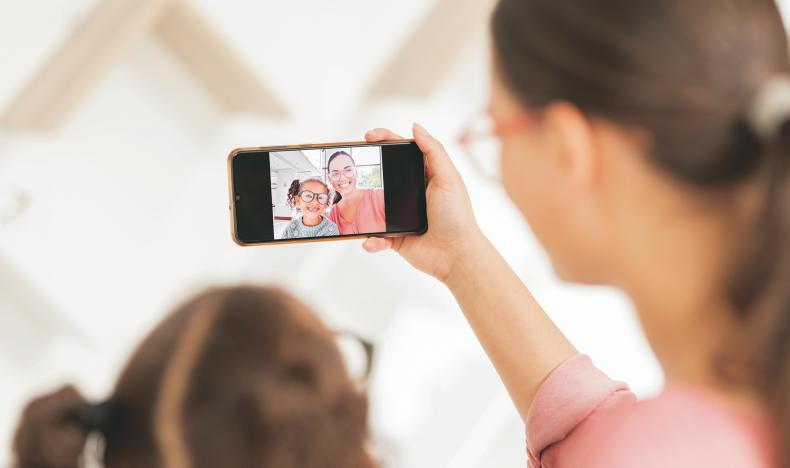
Ever feel you almost know someone’s child because you see them on social media? Whether it’s birthday party pictures or snaps of sporting achievements, it can sometimes feel like you’ve been given a front seat into intimate moments of someone’s childhood, sometimes without having even met them.
The practice of parents posting their children on social media is so common in the digital age that it’s been given a name: sharenting – a combination of the words ‘parenting’ and ‘sharing’. The milestones of a child’s development are turned into a flow of social media posts, which effectively assemble into a story arc of some of their most significant life chapters (first steps, first day at school etc), creating a permanent digital footprint.
This recently became a talking point on the back of a powerful campaign, ‘Pause Before You Post’ issued by the Data Protection Commission Ireland.
The video, which is 40 seconds long, introduces us to eight-year-old Éabha and her parents, who have shared information like Éabha’s name, age, and her football training schedule on their social media. Three strangers talk to Éabha and relay personal details about her life with an uncomfortable sense of familiarity, with the third male stranger downloading and saving one of the photos of Éabha posted by her father.
The guidance offered by Data Protection Commission Ireland to parents has ignited a national conversation around the ethical and security dimensions around sharenting.
Global trends
Dr Frances Rees, a lecturer in law at the University of Essex, is coordinator for the Ireland and UK Child Influencer Project.
She says that sharenting is a global trend that has grown since 2010 at an accelerated rate. Parents should be aware that it can potentially pose long-term risks for children – names, locations, school details all become part of a permanent digital footprint, and can expose children to identity theft, exploitation, and future cyber threats.
“The data thing is huge in terms of the amount of information that is being given out about children that identifies them and gives away the sorts of things that become security questions: main name, first pet, first school,” Dr Rees explains.
“So, it’s not that somebody might come along and snatch your child. We’re not talking about the child catcher here. We’re talking about digital theft. We’re talking about AI manipulation.”
The child safeguarding toolkit, which Dr Rees launched last year, maps six categories of risk facing children who have been shared online. These are financial risks, identity risk, family disruption, risks to the child’s education, health and safety, and impact on their dignity.
“Within each category there are more specific ones. Is there pranking or humiliation involved with the content or is the child’s location being shared that could put them at risk?” Dr Rees adds. “There’s a lot of different layers to it.” The more a parent shares about their child, the opportunity for risk, unfortunately, heightens.
“And if you think about some of the situations [that parents post], they’re not always very dignified,” Dr Rees continues. “For example, the hashtag #pottytraining has got 757,000 posts on Instagram. That’s potentially pictures of children that have gone to the toilet in their own homes. I wouldn’t want a photo of me on the toilet on the internet, so why are we deciding that it is OK for our children?”
A mother herself, Dr Rees has a personal stake in her research topic. “I’ve had a camera phone in my hand since my daughter was very young, and that has just been completely socially normalised,” she admits.
“It’s been socially normalised as a behaviour that we’re now questioning. My daughter is now 23 and I had photo albums from her fifth or sixth birthday on Facebook that I’ve shut down, but it was just what we did. We never really questioned it.”
She has spoken to mothers in similar situations, who have changed their posting habits.
“Unfortunately, some of those situations have been really, really unpleasant,” she reflects. “One mother went back on Flickr to try and find a throwback Thursday picture. She was looking at what was the most popular pictures of her child [on the platform], and one specific picture of her child had been downloaded over 8,000 times.
It was a photo of her son in swimming trunks on a beach. She never had in her mind the fact that 8,000 people would have downloaded it and kept it on a folder on their computer.
“While we don’t think about the 8,000 people that would like to download the photo of a child in their swimming trunks, those people are out there, and they can AI manipulate a situation in which the swimming trunks no longer exist.
“Unfortunately, that’s the world that we’re living in. If we’re putting inventory of our children out into the world, we have to be aware that this is a potential risk to them. Basically, it’s a machine that you’re feeding with imagery of your child.”
In terms of governance, sharenting sits at the crux of the freedom of speech debate. The onus is currently on parents to determine what and how much they share of their children. Dr Rees adds that brands and agencies using children to commercialise their content also have a responsibility.
She recognises that parents are in a difficult situation, with many activities taking place on social media. “There are certain cultural and sports situations, like Irish dancing and GAA, in which you’re almost being encouraged [to post] by the sporting body. It’s very hard sometimes to say no, and you’re almost tasked with withdrawing, which seems very unfair of this external expectation on you that you are going to have photos of your child running about in the field or in a little dress dancing up on a stage.
“If you want your child to succeed or be involved in this sport, sometimes this is what we have to do. I guess we, as parents in this space, have to think about what our own comfort levels are, how happy we are feeding the machine, and whether we’re going to have to push back in order to protect kids.”
Síle’s strict boundaries
Host of the Ready to be Real podcast and mother-of-two, Síle Seoige has strict boundaries around what she posts of her children online. When her son, Cathal (8) and daughter, Clíodhna (4) both turned three years old, Síle and her husband Damien decided that they would no longer post their photos online.
“I did share both of them, but I also made a conscious decision to stop. We felt, as a family, that kids change so much. A baby of six weeks and a toddler can look completely different from each other, and they’re not that recognisable, but when they start to settle into their features, they become extremely recognisable as people.
“I also didn’t want my children being recognised out in normal life.
We live in the west of Ireland, our privacy and our real life is very important to me. While I am very open in the job I do and the podcast that I create, I’m also extremely protective of my husband and my children. I think everybody deserves that, but particularly kids. They don’t have a say.
“I don’t think any of us aren’t aware of the danger involved in sharing images online anymore,” the podcaster continues. “A number of years ago, we weren’t aware. But I don’t think it’s good enough anymore that we just put our head in the sand, because this is the world in which we live.
“I do think it’s our responsibility, as parents, to protect our kids, and at the end of the day, more often than not, kids don’t have a say whether their photos or videos appear online.”
Having posted her children in the past, Síle totally understands being the ‘proud mammy’, adding that, just a few weeks after her son was born, she was “itching to show a picture of him”.
“I really feel that this is a big part of the conversation. We’re biologically programmed to adore these little beings that we are fortunate enough to bring into the world to guide and mind and love. We’re obsessed with them so the need to want to share them with the world is a very natural thing. But it’s being exploited by the social media giants,” she adds.
When asked for her thoughts on influencers using kids in the commercialisation of content (as someone with a sizeable 122k followers on social media), Síle says: “I think there’s a bit of pushback now, there are influencers and content creators who do have their kids on their page a lot, and it’s increasingly more uncomfortable for me to see them. These are beautiful, gorgeous children and they are adorable.
“One year ago, I might have felt: I love seeing these videos. But now, with all that I know, I can’t help but feel uncomfortable. I can’t help but think: please stop with the photos, because these are your most precious beings in the world, you’re putting their entire lives online, and they have no say because they’re so tiny. I’m becoming more and more uncomfortable with it.”
She adds that you can still create content and talk about motherhood – without showing your children. “More and more accounts are only showing the child from the back of the head or from the side. There are ways and means around it. There are plenty of accounts doing it very successfully.
“Everybody has to do what’s right for them as individuals. It’s not up to me or anybody else to make up your mind or shame you into thinking a certain way. But I certainly would suggest that you ask yourself: where is this image going to go? Where is this video going to go? And when you think about that in a real way, I think the answer is an obvious: well, I won’t share it.”
Momfluencer Julie Hayes
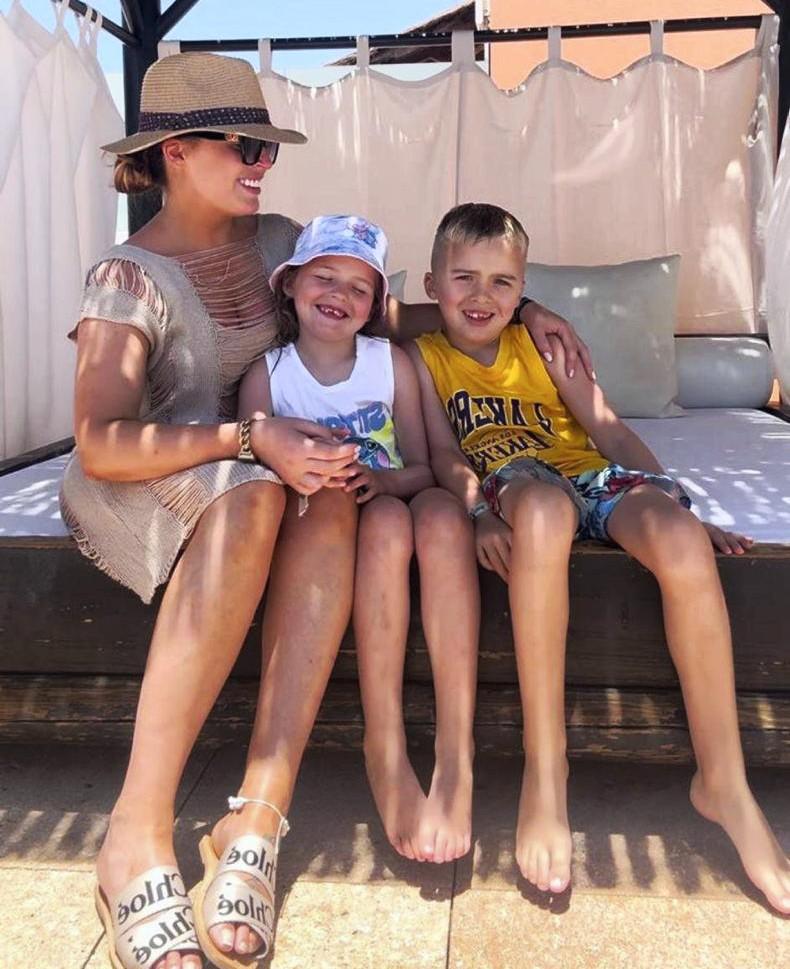
Momfluencer Julie Hayes (twins_and_me on Instagram) has a different perspective on sharenting. A single parent to twins, ErinRose and Fionn (8), Julie started cataloguing life as a single parent about six years ago.
She chose to share her twins online because she wanted to create content that reflected the highs and lows of being a single mother. She did not see it reflected in mammy content at the time, and her candour and honesty are, what she believes, helped her page to grow.
Julie says,“That’s how my page got so big, because it was quite relatable.” The Cork native says sharing her world has been “brilliant” and a “great opportunity”. She has just got mortgage approved, and the twins live a life full of hobbies.
“I was a single parent for eight years, and to be honest, it was a struggle. I found it very hard to find a home for us on my own, with only one income. I used go to work, then I needed babysitters for my kids and I just found my whole wages going to a childminder, and it just did not make sense for me anyway, personally.”
Julie started to share content online and then work with brands, and she says now her job is “brilliant” because it allows her to work at home while caring for her children. ErinRose and Fionn feature heavily in her content but Julie doesn’t “see huge dangers” about sharing them online.
“As they grew older, I did think to myself ‘will I take them off?’ because social media is getting very, very nasty. But if you came into my house in the morning and you asked my kids: what do you want to be when you grow up? Gone are the days where we would have said, I want to be a doctor. I want to be a teacher. They’re now saying: I want to be a TikToker, I want to be a YouTuber. That’s what kids want to be now.
“So when they do something, like this new trend of 6-7, they say: show your followers the 6-7, and let me do it in the camera. They’re just so confident.
“Everyone is different and I might change my mind in the morning and say: no, they’re not going on anymore. But the way they are at the moment is they’re asking me [to post them], I’m not asking them.”
Boundaries
Julie does have some boundaries, though. She never shares the twins’ school or where they are at a given time. “I would maybe share places [we have visited] after we leave.”
Although the twins get recognised when they’re out and about, Julie adds: “But then they’re never out on their own. They’re always with me, we come as a package.
“I’m six months pregnant now, and I’ll probably share my baby pictures online when the time comes, but I’ll have boundaries – like not sharing their crèche.”
In short





SHARING OPTIONS