



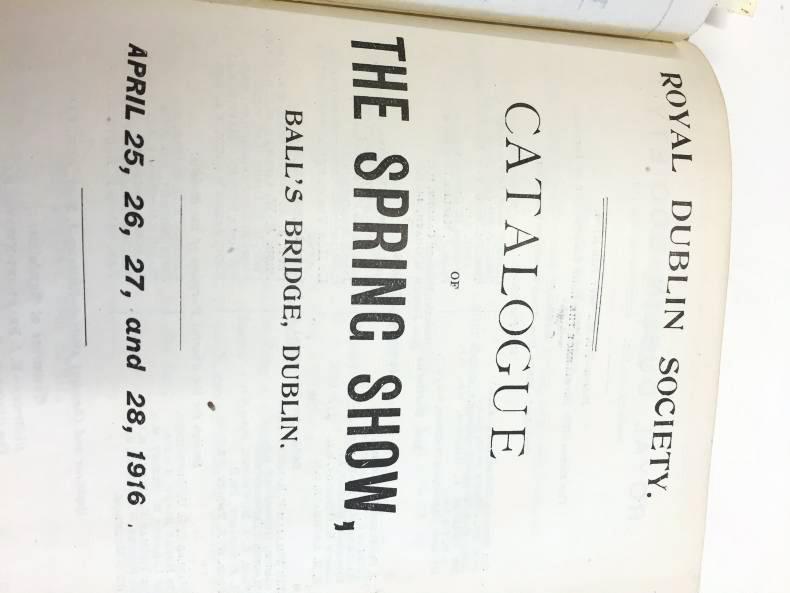
The 1916 Spring Show opened its Ballsbridge doors in a nervous Dublin southside suburb on Tuesday 24 April – the day after Easter Monday. It was the only major event to be held at the RDS that year.
In its annual report for 1916, the RDS reported that, “Owing to the continued occupation of the Society’s premises at Ballsbridge by the Military Authorities during 1915 and 1916, the usual agricultural shows, with the exception of the Spring Show, had again to be abandoned.”
The RDS was run mainly by landlords and larger farmers, many of whom were not supporters of the 1916 Rising. There was one notable exception: George Noble Count Plunkett, who was father of Joseph Mary Plunkett, one of the leaders of the Rising.
Count Plunkett was arrested immediately after the Rising as “a person suspected of hostile associations” and he was deported from this country by the duly constituted authorities.
A meeting of the RDS committee at the start of 1917 asked him to resign his membership because of his support for the Rising.
He declined and it then held a meeting of its 1,736 members to vote on seeking his removal as a member, a vote it won.
Count Plunkett later became a TD for Roscommon and was grandfather to one of the Irish Farmers Journal’s early writers and well-known TV farming broadcaster, the late Michael Dillon. After independence, Count Plunkett was re-elected to RDS membership and subsequently became president of the RDS.
Spring Show gets the ok to run
The British military occupied a section of the RDS premises during the period from 1915 to 1916. The reports in RDS documents say: “Recognising the importance to the country of the Spring Show, the military authorities have kindly agreed to give up for the week a large proportion of the grounds and thereby enable the society to hold a successful show of breeding cattle, dairy produce, implements and sundry exhibits.” The RDS records show the 1916 Spring Show recorded a loss of £1,350 probably due to a lower attendance and the fact that some exhibitors had to be refunded.
The show was a major livestock event and 912 animals were shown that week. Most of the cattle entered were already in place at Ballsbridge in the days before the Rising began on Easter Monday. However, the RDS records of the time show that 25% of the cattle never made it, as they were held up at various railway points. The Great Northern railway system was worst affected and 85 cattle were taken back to their farms.
The RDS went to great expense and trouble in trying to get feed for the cattle, as martial law was in place. There was great difficulty transporting feed to the Ballsbridge venue from the outskirts of a then much smaller Dublin city.
The agricultural committee met on 25 April, the first day of the show, and decided that despite the Rising the show would go ahead. It was decided that, with the assistance of the military authorities, efforts would be made to bring the stranded show cattle from Cabra to Ballsbridge.
The following day, with no immediate prospect of these animals reaching the Ballsbridge showground, it was agreed that the judging would go ahead without them.
Familiar names
Among the names still familiar to farmers that took part in the Spring Show were Paul and Vincent Ltd. As well as being an animal feed company, in 1916, it also distributed the Blackstone range of farm machinery, including the fertiliser spreader, swath turner and rickshifter, for moving cocks of hay intact.
Another to exhibititor was Massey Harris, with its 5ft cut binder with floating elevators complete with a transport truck for the price of £42. A Massey Harris spring tine harrow with 15 tines was priced at £5, while the company’s No 11 corn drill was advertised at £25.
Wexford hub
Philip Pierce of Wexford had sales offices in Paris and Buenos Aires, making it a true multi-national farm machinery company long before the concept was even invented. The Pierce range was so vast that the full listing of machines on view for the event took up almost a full page in the Spring Show catalogue.
The Wexford Engineering Company from the Star Iron Works also had an extensive display that included a three-row potato sprayer for £17 and 3s and the patented Star ricklifter for £10 and 15s. They also supplied a range of grass and seed sowers.
William Doyle and Co of Selskar Iron Works had an extensive range that included one- and two-horse mowing machines, Doyle’s Drill Hoe and their champion potato digger.
Henry Ford’s agents for Spring Show 1916 were Thompson’s Motor Car Company, which showed their Ford delivery van, priced at £130.
John Deere connection
We see the arrival of the Overtime Farm Tractor Co to Ireland in 1916. It had a re-branded Waterloo Boy, in the years before John Deere took over the Waterloo Tractor Company. This is the first record of the John Deere connection with Irish farming.
The Overtime Farm Tractor was rated at 24hp at the belt pulley and 12hp at the drawbar. They claimed that this tractor would pull a three- or four-furrow plough, ploughing seven acres per day. The Overtime Farm Tractor was priced at £255, so it was expensive at the time.
The Irish Agricultural Wholesales Society (now IAWS) was a major player in the farm machinery business back in 1916. The company based then and now in Dublin’s Thomas Street was Irish agent for Amanco and Petter oil engines as well as the Martin brand of farm-horse machinery.
Other names that are still part of modern Irish agriculture that took part in the 1916 Spring Show included McKenzies, now part of Atkins of Cork; Drummonds Seeds; and Lenehan’s of Capel Street in Dublin. Keenan and Sons of Fishamble Street, Dublin, were then among the leading suppliers of steel farm haysheds, and they had a big stand at Spring Show 1916. CL




SHARING OPTIONS