


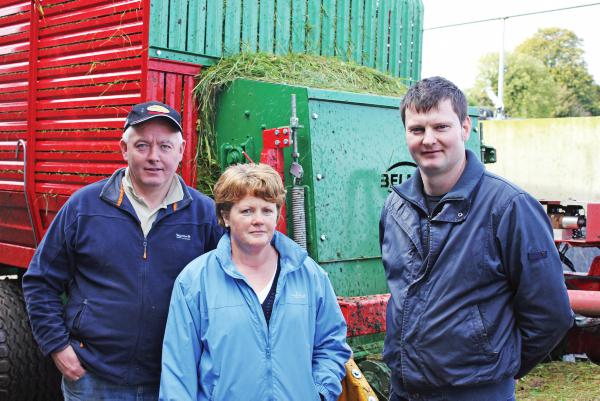
They are milking 61 cows on their home farm with plans to increase cow numbers to 100 cows in the near future.
Grazing ground is the main restriction to those expansion plans for Richard and Mairead. They have recently secured some additional grassland but on the condition that it is not grazed. This 10ha (25-acre) grassland farm is about 4km (three miles) away from their farmyard. This, coupled with the aim to get more fresh grass to the cows, has meant that the zero grazing option came more into focus for the Kings.
They also believe that cutting more fresh grass across a longer period of the year will give them higher milk solids and will mean lower amounts of pit silage will need to be made. They expect that the zero grazing approach will also them a longer season of using fresh grass.
Mairead runs the dairy enterprise while Richard runs a farm contracting business as well as providing all of the farm’s machinery needs. Richard aims to use his existing McHale F550 round baler from his contracting operations to bale any additional grass that gets ahead of the zero grazing system next season. Richard will also be aiming to provide a local zero grazing contractor service with his new machine.
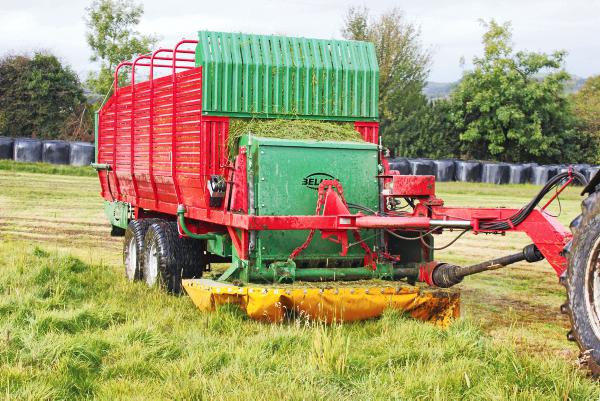
The arrival of the Belmac zero grazing machine will mean a significant change in their grass and silage management approach starting with the zero grazing machine this autumn. Older grass on the outside farm is being harvested with plans to re-seed most of the farm with grass varieties that will maximise the zero grazing opportunities.
The Kings looked at a number of machines on the market and selected the Belmac model for reasons of robust construction and the fact that it was available for immediate delivery. It carries a list price of €28,500, including VAT.
They selected the 70 model, which is geared towards carrying about four tonnes of fresh grass as they believed that this was enough for both the ground conditions on the grass fields and their expected cow numbers in the near future.
When I visited the King farm on the morning of Wednesday, 17 October, the country had woken up from a night of torrential rainfall. This was not the ideal condition in which to see a zero grazing machine in action, but it proved a point.
We set off on the 4km trip to get the machine into action. The transport width of the machine makes it suitable for narrow road conditions. The hydraulic drawbar behind his 40km/hour 95hp Landini 9880 tractor allows Richard to tuck the machine in close behind the tractor keeping it close to the tractor’s overall road width.
The robust looking drawbar is high mounted to give good clearance. Richard’s one concern in this area is the locking of the hydraulic drawbar. He is looking towards developing an additional manual type locking system for transport use for his own peace of mind.
He is also considering fitting a camera to the rear of the zero grazing machine because, when fully loaded, there is limited rear visibility of other road users. This will also help when accessing the field as the centre mounted position of the axle means that there is always going to be some rear swing on tight turns. The camera will give more visibility at the back of the machine to deal with tight turns.
Once in the field, the Belmac was impressive in action as it left little tracking on the ground surface apart from a muddy coloured light track mark that quickly washed away in the morning rain. The wide 500 series tandem axle tyres were more than suitable for what were not good ground conditions. While streams of water trickled down the tyres, there was no surface damage to be seen.
The hydraulic drawbar allows the mower section to be moved to the right of the tractor, so that the tractor wheels are not driving over the grass.
The high mounted drawbar contains two wide angle power shafts to cope with tight turning circles.
The grass is mown using a Galfre two drum mower cutting 2.1m metres (seven feet) in each run.
The mower is mounted on a floating frame which is pivoted from a position close to the front of the two tandem axles.
From the mower, the grass is then conveyed into the body of the machine by a hydraulic conveyor that it driven from the top pulling the grass upwards. The speed of the conveyor is variable and adjustable using the machine’s hydraulic system.
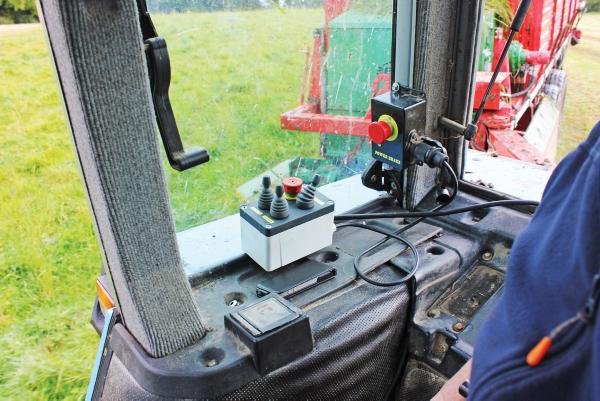
As the grass builds up in the trailer body of the machine, the operator engages a floor drive system to move it back to fill the machine to capacity. The machines’ controls are cab mounted; the drawbar and mowing height are operated by the tractor’s spool valves. The speed of the conveyor and engagement of the chain and slat floor are electro-hydraulic from a control box in the tractor cab.
As this machine is designed for zero grazing, there are no chopping knives fitted. This means that the length of the grass determines the length of what’s fed to the cows.
This is also a reason why it is not a power demanding machine. Their Landini 9880 is more than adequate in terms of power and relatively light in terms of weight at not more than four tonnes to make it a good combination on the hilly grassland farm.
For the Kings, next year will be the true test of the machine.
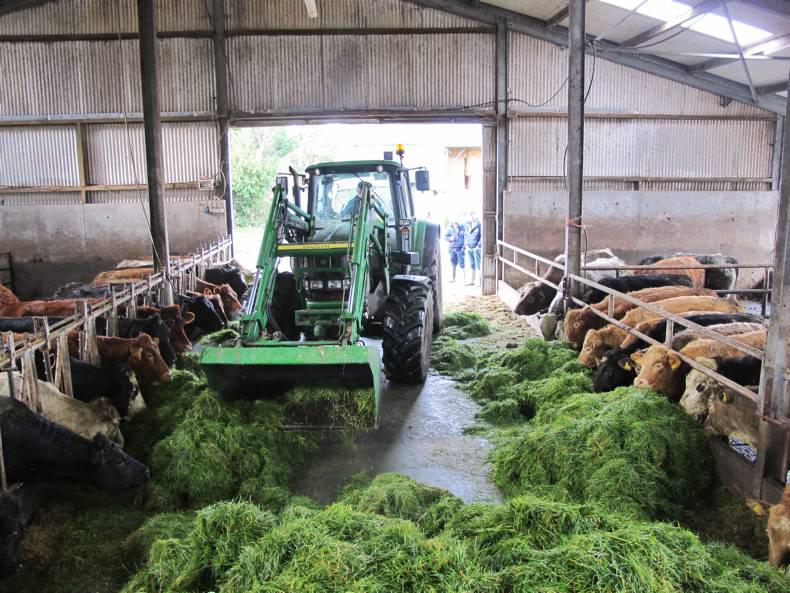
It will provide a test in terms of how early they can get out on swards of fresh grass and a test on how much fresh grass they will feed to the cows in addition to the regular but more restricted grazing area around the farmyard. Cows will spend more time being fed on freshly cut grass than before. The Kings believe that this will help them reduce the level of parlour meal feeding in this spring calving herd.
A key part of the ownership of the zero grazing machine is the ability to do some contract work with it. Richard aims to provide a local service consistent with meeting the demands that Mairead’s cow herd have on a daily basis.
Specifications
Belmac 70 zero grazing machine:
Power requirement: 90hp
Capacity: Four tonnes of fresh grass
Cutting width: 2.1m (7ft)
Mower type: Two-drum
Tyres fitted: 500/50 R17
List price: €28,500, including VAT.



SHARING OPTIONS