


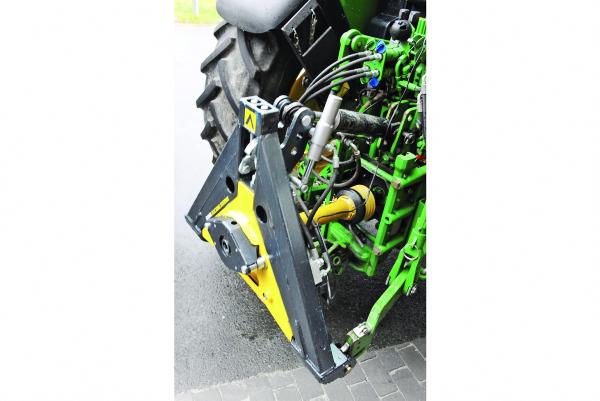
Designing a system that fully couples up an implement’s services automatically, and provides a robust quick hitch capable of handling draft implements, has been an age-old focus of engineers since the advent of the three-point linkage and, more particularly, the power take-off and external hydraulic services. But an Austrian farmer’s invention, now in full-scale production, may provide a solution.
Quick-hitches suited to light implements such as yard scrapers have been around for some time, but the Gangl Docking System (GDS) is rather different. It is said to be suited to all implement types, including those used in heavier tasks.
Not only that, but it also automatically connects the machine’s PTO and hydraulic services. This eliminates any need for the operator to leave the tractor seat, whether mounting or demounting the implement.
Johann Gangl is the Austrian beef farmer who designed the system. He created initial prototypes in his farm workshop over a number of years before finding investors to help create his company and put the system into production. By the end of 2012, initial direct sales are already likely to top 1,000 units across Europe and as far away as New Zealand. GDS is now looking to sign overseas importers.
There are two main elements to the system. A coupling module, into which is fitted the PTO shaft and hydraulic services, is mounted on the tractor’s three-point linkage. A counter frame is mounted on each implement, into which is installed the machine’s PTO stub and hydraulic hoses.
On the tractor end of things, a valve block on the hitch frame is pre-plumbed by the farmer into a spool on the tractor. This is operated to automatically detach implements by hydraulically unlocking the latch on the upper part of the triangle. Locking when coupling up is automatic, as the linkage is raised.
For connecting the PTO shaft to the stub on the implement, a diverter valve is operated to move the PTO shaft mating plate on the tractor back onto the shaft stub on the implement. It’s possible to simply engage/disengage the PTO to realign if the two won’t initially line up. Hydraulic services plug in when the linkage is raised, and must be in float to uncouple them.
A trial on our test day showed the company’s six-second claim for the time required to couple an implement to be a justified one. GDS calculates that, at current diesel prices and an example average consumption rate of 10 l/hr, when operator wages/hr are factored in to account for the reduction in unproductive time getting on and off the tractor, there is potential to save more than €4,000/year (£3,250/year) using the system, based on an admittedly hectic working day where five implement changes are made.
The system is available in four variants: As a simple linkage coupler with or without automatic locking; A version incorporating PTO; and a top spec model with PTO and a double-acting hydraulic coupling.
Subsequent upgrades after an initial purchase are possible. All versions use category II couplings found on mid-sized tractors (Cat III models are coming), and front linkage versions are also available.
Price for the coupling module is €2,300 to €4,700 plus VAT, depending on model (linkage only, linkage/PTO, linkage/PTO/hydraulic coupling), while each attachment element costs €230-€440, depending on complexity. The firm wants to boost production ten-fold by selling 10,000 units next year. GDS is talking to tractor manufacturers about offering the system as a factory/dealer-installed option. Patents have been applied for to protect key features.


SHARING OPTIONS