


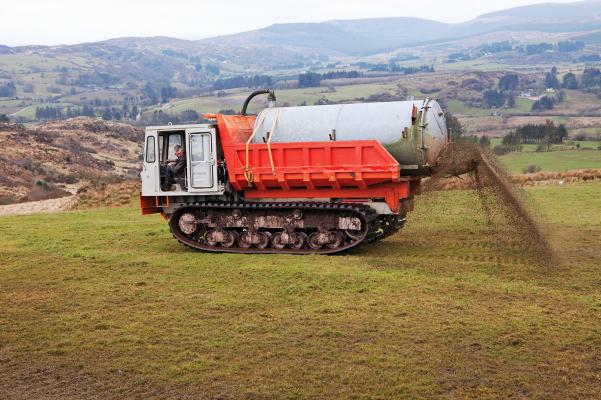
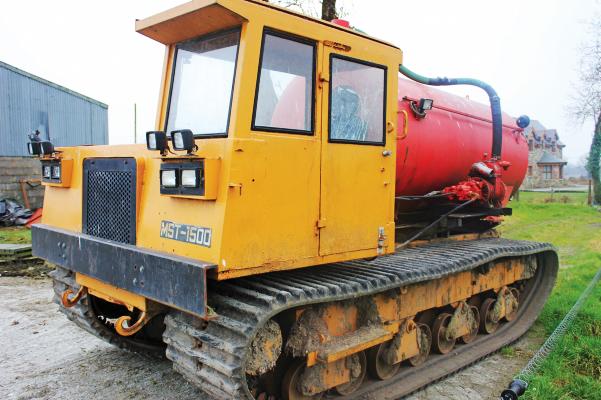
Tim has converted a rubber tracked dumper from his drainage machinery fleet into a self-propelled slurry tanker by simply fitting a 1,600-gallon capacity Rossmore galvanised slurry tanker into the dumper body.
The result has been a machine that can travel in virtually all ground conditions with little or no damage to the field surface. “The machine leaves almost no mark on the field surface and has been able to travel across fields in the hilly Macroom area with safety,” said Tim.
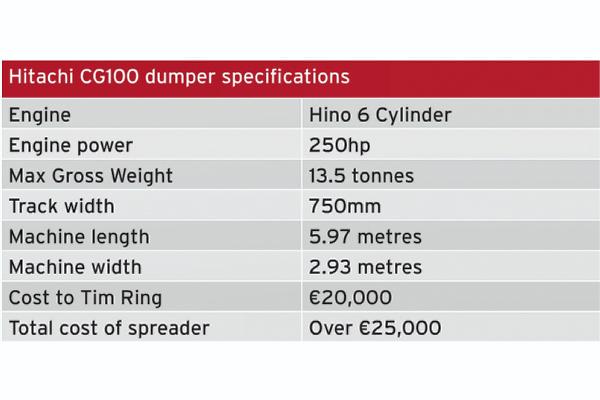
Tim paid €20,000 for the rubber tracked Hitachi CG100 dumper a number of years ago.
He has used the machine for shifting soil and rocks in conjunction with his Hitachi digger with good success. For this work it gives the minimum of soil structural damage compared with tractors and trailers.
The wet winter and early New Year caused spreading problems with his normal slurry kit of a 1,600-gallon tanker behind his New Holland TM 155 tractor. That’s when he thought about the dumper conversion which was carried out with the help of his twin brother, Christy, who runs a local tractor garage and his mechanic, Krzystos Szmeichel.
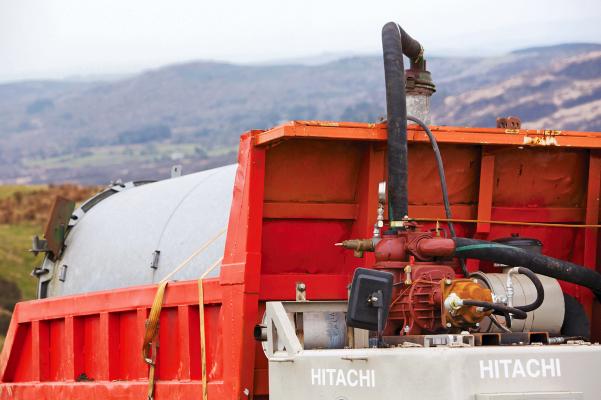
Tim bought a Rossmore tank and then an hydraulic drive vacuum pump kit from Major Equipment in Ballyhaunis, Co Mayo. The next step was to link the two together. The Rings used a new hydraulic valve chest to provide adequate hydraulic oil flow from the Hitachi’s system and to operate the engagement of the drive to the pump as well as opening the splash plate on the spreader rear.
The Hitachi dumper uses a hydrostatic drive system for forward and reverse travel, operated by twin levers. The machine can be driven at the maximum forward speed of about 13km/hr using a the high speed lever in the control box. For field work, Tim operates in the lower range and then speed is managed by the twin levers.
The adjustment of the hydraulic valves was critical in achieving the level of flow needed to power the vacuum pump. With some trial and error, they got the level of power needed from the 250hp 6-cylinder Hino engine that powers the Hitachi dumper, through the hydraulic system. They fitted a series of cable controls to operate the slurry spreader from the dumper cab.
The 9,000-litre capacity pump has plenty of capacity to load the tanker. Tim reckons that it takes between four and five minutes to fill the tank and about the same time to spread a full load. He has used the machine in the field with two standard tankers feeding it to maximise the output and reduce the travel needs of the rubber track machine. The tracked tanker then sucked slurry from the other machines and minimised their trafficking on the soft ground.
The key to operating the machine successfully is how you drive it, according to Tim. “It is important not to take sharp turns in the field as the tracks will cut up the field surface, even though they are light on the ground,” he said.
Replacement tracks for the Hitachi dumper are expensive so it is important to minimise road use, which can be wearing on the tracks. Tim said that each replacement track costs in the region of €6,000 each so it important not to be driving on the road with a full load as it will lead to premature track wear.
Following the success of the machine this year, where he spread more than 100,000 gallons of slurry from his 50- cow enterprise, Tim is considering whether to remove the dumper body that the vacuum tank is bolted to for next season’s slurry spreading campaign.
He is considering making a bracket to couple the tanker direct to the dumper chassis. The dumper body adds significant weight to the machine and its removal would make the machine even less obvious on the field in terms of compaction.
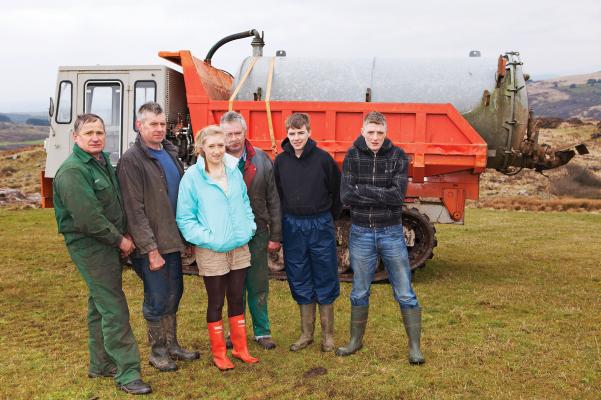
The tanker is currently bolted to the dumper body and shows some straps which Tim and Christy put in place as a further precaution for tank stability. Tim is considering offering the tracked tanker as a local slurry spreading service and he believes that he would require a rate of about €70 per hour to pay for the cost of the machine.
Why didn’t Tim consider an umbilical spreading system instead of the tracked dumper? “We already had the tracked dumper in the yard and we believe that you need the slurry to be very watery for the umbilical system which brings its own costs when it comes to agitation. For this reason the tanker system allows us to handle the slurry in poor ground conditions without the need for extra agitation power,” he added.
“The tracked machine with its 250hp Hino engine is no heavier on diesel than the other New Holland tractor that we run,” said Tim Ring, so this option is sure to get more work towards the end of 2013 if we get a repeat of the weather.
Spreader that leaves no mark
At the other end of the country and in equally difficult ground conditions, Leitrim contractor Cathal McCrann has a Mitsubishi MSL 1500 tracked dumper converted with an 1,100-gallon tanker to spread slurry in his local area.
Cathal’s machine, which is a little smaller in size than Tim Ring’s, leaves no mark on the field surface. Cathal uses a trailed buffer tank in the spreading field to supply the tracked tanker, which gives better output. The buffer tanker is supplied by two conventional tankers.
He uses a Mastek umbilical slurry spreading system (not SlurryKat as recently mentioned in the Journal) in addition to the tracked tanker, and finds that the tracked tanker is even lighter on the ground due to the length of the rubber tracks.
Cathal has plans to incorporate the Mastek umbilical system, complete with the reeling unit, onto the tracked machine for next season. This, he believes, would give higher output while retaining the light footprint on the field in the Longford and Leitrim area.





SHARING OPTIONS