




Volvo T24: One tractor spotted was a Volvo T24. This particular model was a show piece on the Volvo engine stand. According to a company representative, the tractor is one of two that is on loan from the Volvo Museum in Gothenburg, Sweden for Agritechnica. The details are sparse, but it was manufactured between 1952 and 1958. Rated at 28hp, it has five forward gears and one reverse gear. This series of tractor was to the Swedish farming industry what the Massey Ferguson 35 was to the Irish and English farmers of the time. The BM (Bolinder/Munktell) brand was bought by Volvo in 1950 and eventually the Volvo name disappeared when Valmet bought them in 1979 as VOLVO BM concentrated on construction equipment. Today, Volvo is a worldwide brand recognised for both construction and automotive equipment.
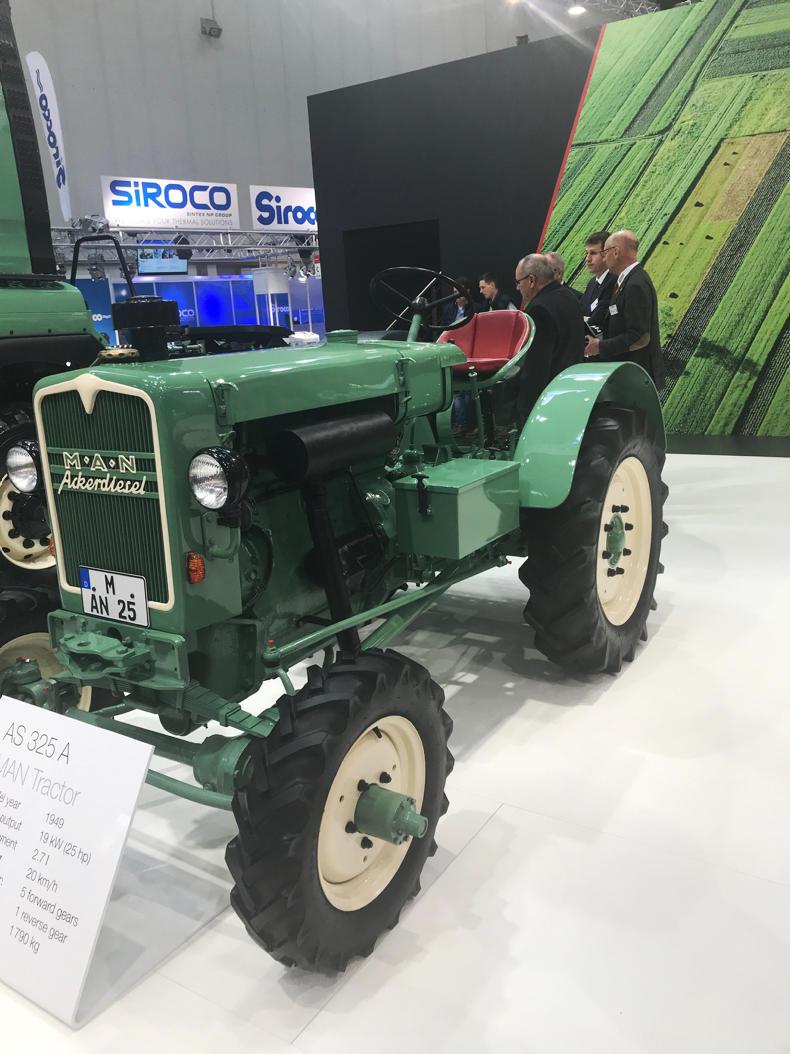
MAN AS325A: Next up was this MAN AS325A. Before World War II many of the tractors built were for larger farming enterprises such as the AS250 (50hp), which at the time was considered a large tractor. However, they were too big and were not economical at the time for use on the smaller and medium-sized farms in the west of Germany. So after the war, MAN had to develop a new, smaller type of tractor and attempt to rebuild its production facilities which were destroyed in the years previous.
This series began production in 1948 but in small numbers due to the shortfall in materials after the war. The AS325A pictured was built in 1949. This model was replaced in 1950 with a stronger AS330A which continued in production for many years. The AS325A came with a ZF A15 (Zahnradfabrik Friedrichshafen) transmission with five forward gears and one reverse gear with a maximum forward speed of 20km/h.
MAN pioneered the introduction of four-wheel drive tractors which nowadays can be found everywhere. All models produced from 1949 onwards were four wheel drive. Before this, four wheel drive was optional.
These four wheel drive tractors went practically unrivalled by standard tractors for a period of time on the German tractor market. They had a maximum rated output of 25hp from a 2.7 litre, four cylinder diesel engine, while the body weighed in at 1,790kg.
As a manufacturer and developer of diesel engines, MAN is affiliated with the agricultural industry since the early 1920s. The innovative power units were first installed in its own farming machines, ranging from motorised ploughs to tractors, but were later mostly sold to other manufacturers.
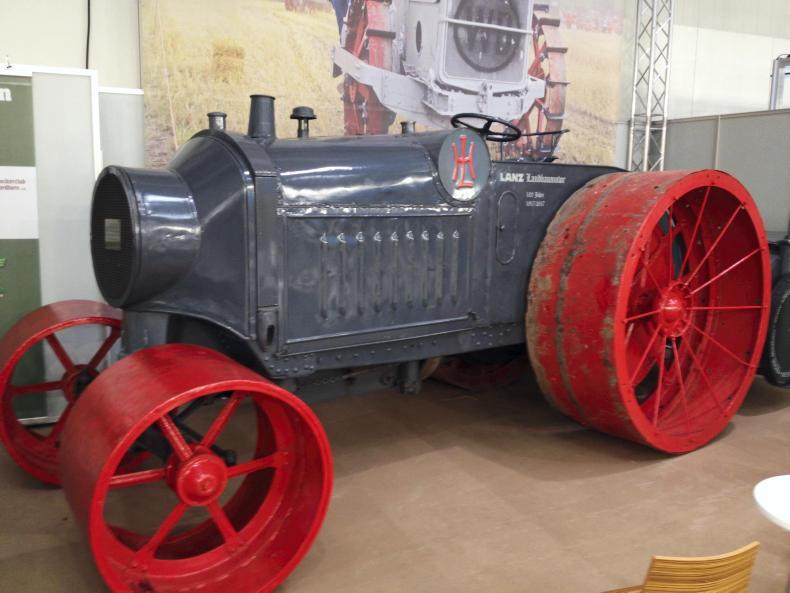
Lanz Landbaumotor: In 1859 at the current location of John Deere’s German tractor factory in the city of Mannheim, Heinrich Lanz founded his company to build harvesting equipment and steam engines. In 1911 he obtained the patents for a rotary cultivator designed by a Hungarian man, Karl Koszegi. This was modified to become the Lanz Landbaumotor, which appeared in 1912. The Landbaumotor was also available as a road tractor without the rear-mounted cultivator attachment, and was used to haul guns during World War I. Lanz’s first lightweight tractor, the Model HL Bulldog, appeared in 1921 and was designed by the talented engineer Dr Fritz Huber.
It featured a 12hp horizontal, single-cylinder hot-bulb engine that was suitable for burning a variety of low-grade fuels, and was also available as a horse-drawn stationary power unit. This tractor was followed in 1923 by two other Bulldog models: the 8hp HM “Mops” (a smaller version of the HL 12), and the HP “Allrad”, a four-wheel drive articulated machine with equal-sized wheels.
Lanz returned briefly to multi-cylinder designs with the elegant-looking FMD “Feldmotor” and FHD “Felddank”, but in 1925 they settled once more on the single-cylinder horizontal engine design for their new HF and HR Bulldog tractors.
The Lanz Bulldog went through various modifications over the next 30 or so years, but the basic design remained the same until the takeover of Lanz by John Deere in 1956. Today the Mannheim factory produces thousands of tractors annually that are shipped all over the world.



SHARING OPTIONS