


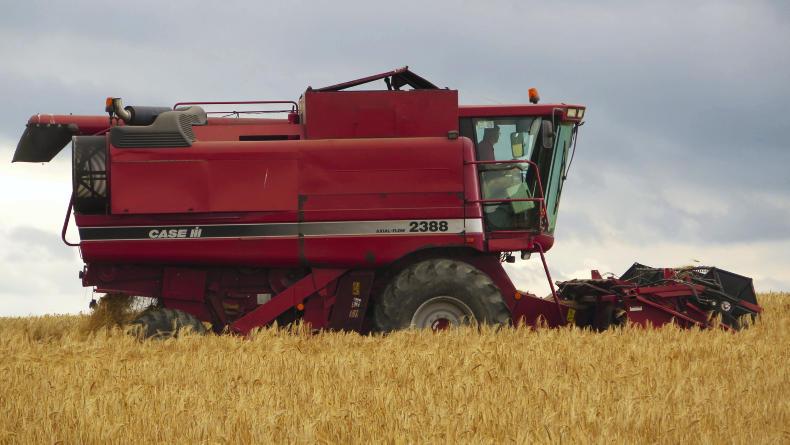
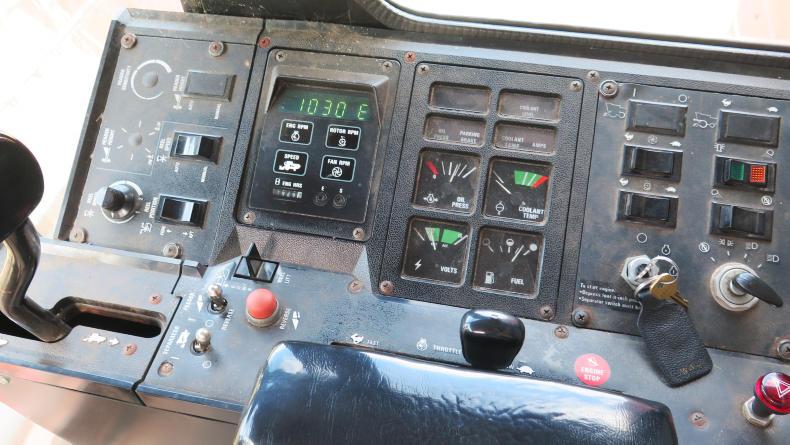
Over my many years writing about farm machinery, the arrival of the Case IH Axial-Flow combine harvester has been one of the more interesting developments that I have witnessed. The concept of a rotary combine threshing mechanism was probably not entirely new to International Harvester when the first Axial-Flow combines appeared on this side of the Atlantic in the early 1980s.
 When International Harvester introduced the Axial-Flow to Ireland, it claimed that the machine offered a revolutionary way to harvest cereal crops. It claimed that the system of using a single large rotary threshing device without the need for straw walkers would give more efficient grain separation, a cleaner grain sample, less grain damage and faster harvesting speeds.
What is different about the Axial-Flow is that the conventional transverse threshing drum is replaced by a single large spiral rotor that spirals the crop rearwards, threshing it a number of times. The Axial-Flow system also does away with the need for a concave and for straw walkers.
Before the Axial-Flow had been offered to Irish farmers, it had been tested in England during the harvest of 1979 by the National Institute of Agricultural Engineering (NIAE) in Silsoe, Bedfordshire, in a confidential trial to compare its performance with a conventional International Harvester 953 combine.
Four of the six trials were carried out to compare the Axial-Flow 1460 performance with that of the IH 953, while the other two were designed to optimise the adjustment of the Axial-Flow to English crop conditions.
The results of the trials in spring barley suggested that with the machine set for 1% losses, the Axial-Flow could outperform the conventional machine by up to 40%.
There were some problems with the comparison in the wheat crops. The NIAE found that throughout the trials, the rotor in the Axial-Flow was quiet and vibration free.
They felt that the irregularities in the crop were apparently smoothed out in the rotor, giving efficient separation.

They also looked at the impact of the Axial-Flow on the quality of the straw. They found that in a baling comparison in undersown spring barley, under dry conditions, the bales were of similar density behind both combines.
They found that individual bales were more variable behind the Axial-Flow after rain because as the straw is discharged in a narrow stream at higher speeds, the swath is more compact and lies lower in the stubble, thus drying more slowly and less evenly.
First memories
My first memories of the Axial-Flow, then an International Harvester (IH) product, was in 1980, when I had the opportunity to visit the Cotswolds region of England in early July of that year to see the machine harvesting a crop of winter barley.
The concept had been introduced at the Smithfield Show in 1979 and this was also my first visit to what was then one of Europe’s most prestigious farm machinery shows. IH had already sold many hundreds of the Axial-Flow combines in North America since it was introduced in 1977.
On the Cotswolds farm, the ground conditions were dry and the crop was reasonable by European standards.
The US-built header struggled to take in the crop and, as lumps of soil entered the single large rotary threshing device, the results were obvious for all to hear.
As the day went on, the operators were getting more in tune with the machine’s capacity and, as we left the field for home, for me there was an obvious message that the Axial-Flow was here to stay.

Irish farmers got an opportunity to see the Axial-Flow machine in action almost one month later when the first demonstrations were held by then-Meath International Harvester dealers Reilly Brothers of Navan Road, Kells, Co Meath, on Eugene Reilly’s farm. The demonstrations were run over four days from August 11 to 15 in a field that’s opposite the Headford Golf Club in Kells.
The event attracted a large attendance, but the conditions were far from ideal. The weather was mixed. The winter barley crop had an unhealthy crop of weeds present and the land had not been rolled due to difficult spring sowing conditions.
Despite these challenges, the machine, which was fitted with a 16ft-wide (4.8m) header, performed reasonably well. As usual, there were many present who said that it wouldn’t catch on. And, in some senses, it didn’t.
Very soon, the discussion invariably focused on the quality of the straw after such rotary threshing.
What was clear from the machine’s performance was its threshing ability in certain conditions. The threshing process was through the long Axial-Flow drum that stretched over the full length of the machine.
My lasting impression was based on how smooth the rotary thresher performed, giving the machine a constant regular hum.
This was in contrast to conventional combine harvesters at the time, where the combination of the smaller threshing drum and the cranking of the straw walkers gave a less regular sound and movement to the machine.
There followed demonstrations of the Axial-Flow in Cork and Waterford as the 1980 season went on. The second Axial-Flow demonstration took place on John Perrott’s farm at Brinny, Upton, Co Cork, followed by a third one on Martin Galvin’s farm at Portlaw, Co Waterford.
An interesting aside to the Axial-Flow story was the changes that were taking place with regard to the International Harvester brand in Ireland.
International Harvester had been represented in Ireland for more than 30 years by the JH Saville company, which had a large premises at Santry, Dublin. Saville closed its Irish operations in 1980 and IH began dealing directly from Doncaster, England, with its Irish dealers.
Costs and crop returns 1980
The cost of the IH 1460 Axial-Flow combine in 1980 was £49,881 when fitted with the 16ft header. The machine was powered by a Cummins DT436 six-cylinder engine rated at 170hp.
A Sperry New Holland 8080 had a list price of £45,992, while the Claas Dominator 106, with a similar width header, had a list price of £57,343. In a general sense, the new Axial-Flow 1460 was priced competitively in an effort to break into the market.
Cereal crop prices for 1980 also make for interesting reading. In the Irish Farmers Journal of 30 August 1980, John Dardis reported that Bailieboro Co-op and Coyles of Ashbourne were paying the highest prices of £90/t (€114.30). Wexford Farmers Co-op and Ballyclough Co-op were each paying the lowest price of £85/t (€108). Feed wheat prices were £95/t (€120) ex-field.
The Axial-Flow users club
Sales of Axial-Flow were relatively slow in Ireland right up until the Case and International Harvester brands were merged in 1985 to become Case IH.
Ireland’s most successful Axial-Flow dealer was Maher Tractor Sales in Dunshaughlin, Co Meath, run by John and Derek Maher.
John and Derek Maher started selling Case IH Axial-Flow combines in 1990. Over that period and until they ceased to be Case IH dealers, the Mahers sold close to 30 combines to farmers and contractors across the eastern Meath, Dublin and Kildare region.
In 1991 alone, John recalls that they sold seven, their best single year of sales. Over the years, they have sold new and secondhand machines, some of which were imported for customers.
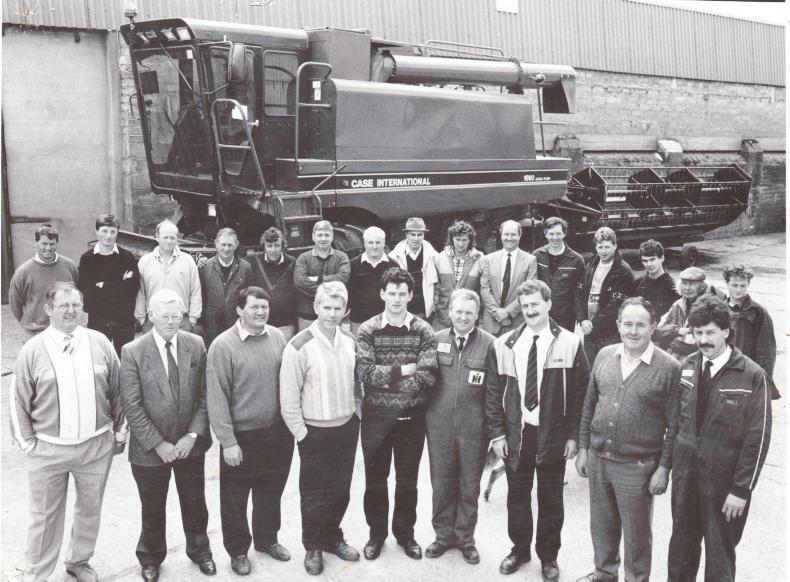
In 1992, they started the Axial-Flow Club, along with Padraig and John Rooney of Rooney’s Farm Machinery, in Naul, another Case IH dealer, in order to bring together the more than 20 users of the machines. Each year, at the start of the season, they would jointly organise a full day servicing course for operators on the premises of one of the club members (photo below).

Case IH provided its combine expert for the day and Maher provided its technical support. This training day provided all of the operators with an opportunity to exchange information in a learning environment.
John Donegan and his late father, Paddy, provided the yard for much of the training for the club at the time.
How the users liked their combines
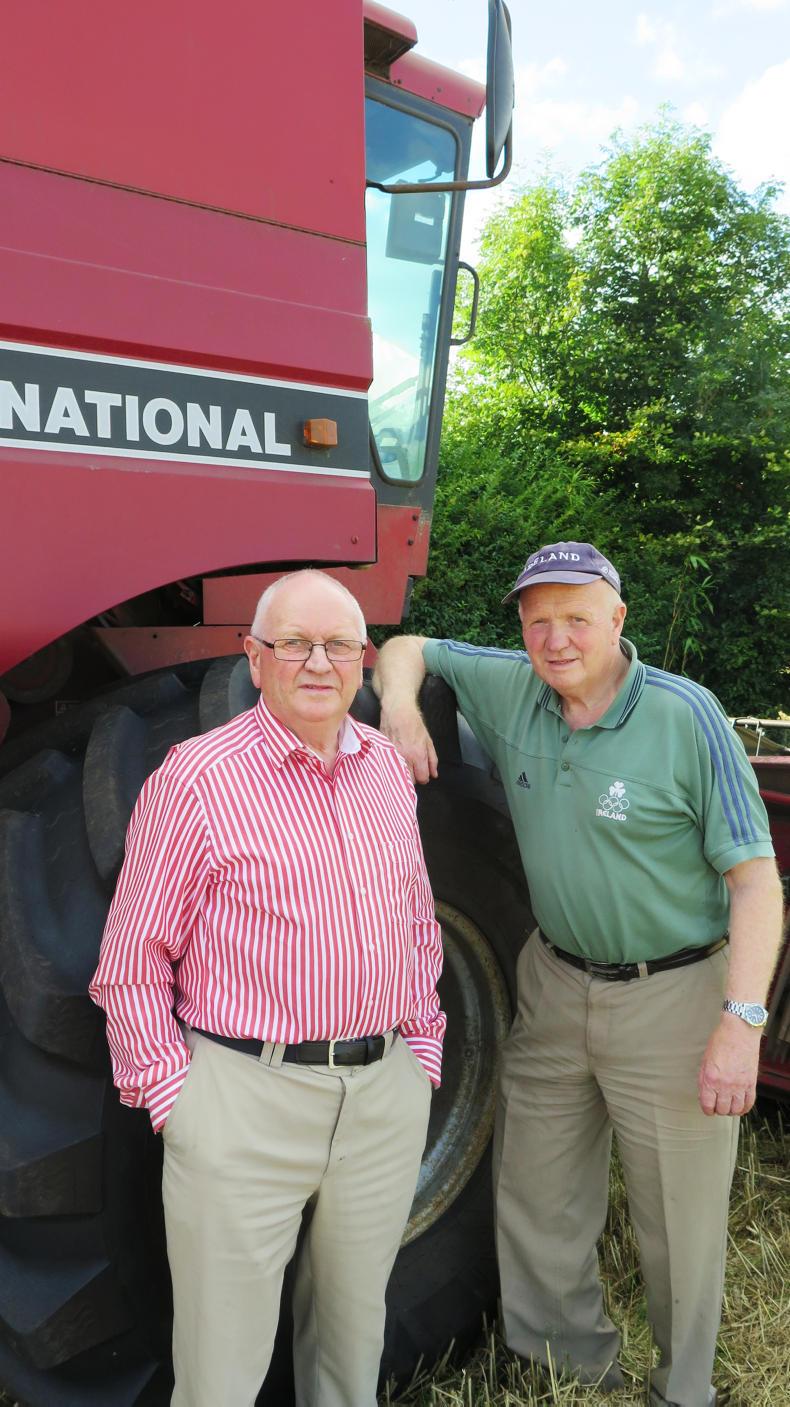
 Billy and Tom Rafter from Naul (photo) were among the first farmers to buy an IH Axial-Flow combine. Tom remembers seeing the machine in action at Reilly’s demonstration in 1980 and was convinced that this was the best machine for their harvesting conditions.
Tom contacted his brother, Billy, with whom he was in farming partnership, and they spent more time investigating the machine and its features. Their first model was a 1460, which they bought from Rooney’s Garage, Naul.
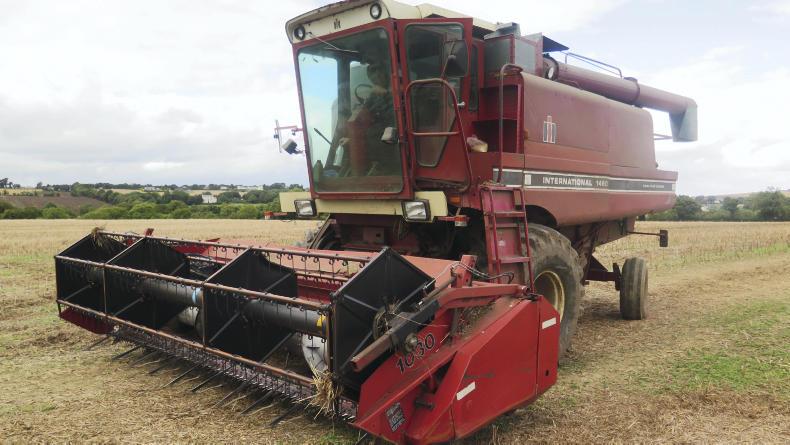
They changed the machine to a newer 1660 model in 1992 and they continue to use this combine for their scaled-down farming operations to the present day. The Axial-Flow has given them good service and proved to be a reliable machine over its many years of service.
The early models were fitted with a US-built header that gave problems. This was soon replaced by a European-built header supplied to IH by Danish combine maker Dronningborg.
Over the past 24 years since the 1660 arrived on their farm, they have only changed the knife drive goggle box and replaced a front tyre.
Billy and Tom agree that the Axial-Flow is a low running-cost machine and has stood the test of time in their farming operations.
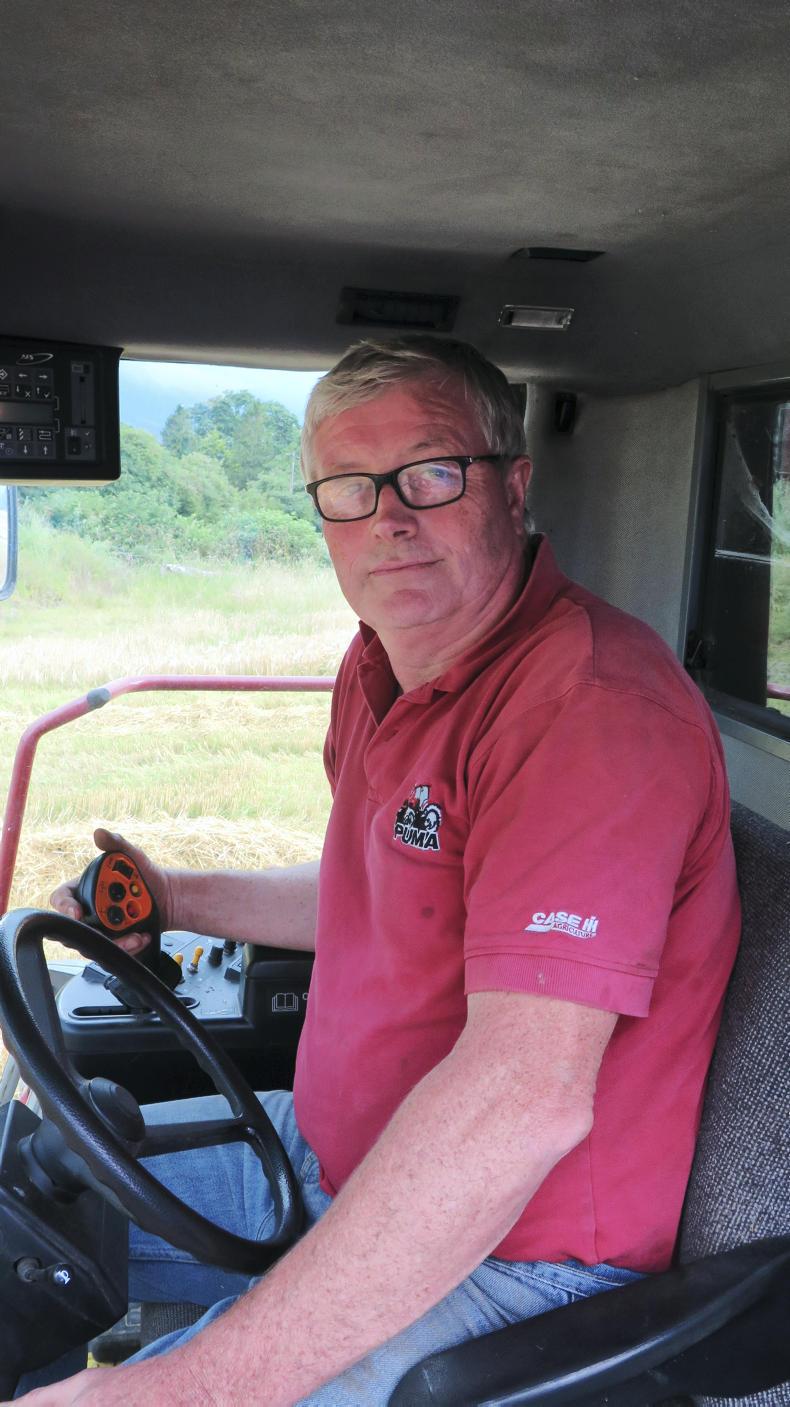
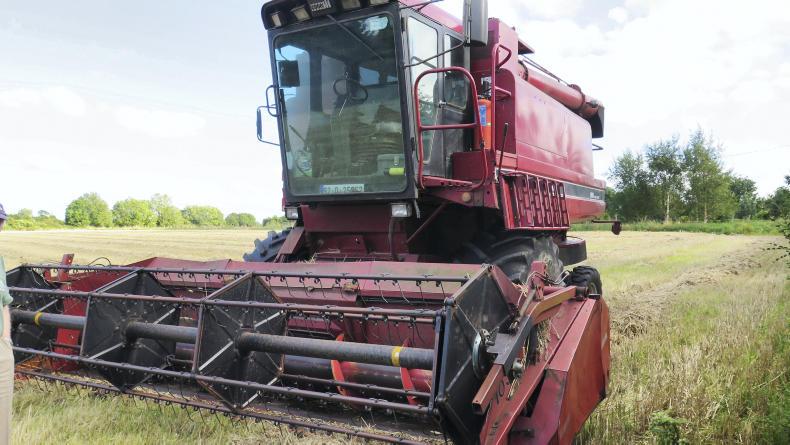
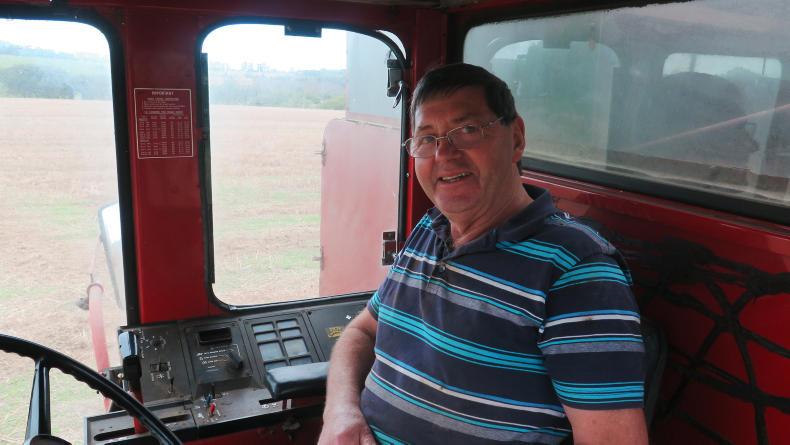
Peter Howard (photo below) operates one of the original 1460 Axial-Flow combines on his farm at Stamullen, Co Meath. Peter is not the original owner of this early 1980s combine – it had worked on more than four farms in the Dublin and Meath region before Peter got his hands on.

Peter is a keen technician of farm machinery and used his talents to get the ageing Axial-Flow back to its best. He has made a number of replacement parts for the combine, always opting for more durable stainless steel where possible.
He also relocated the fan from the side of the combine to the rear, as he felt that it was getting caught in trees and hedges. He has also modified the lights a little.
Peter has retained all of the original operational features of the machine, which he rates highly as a strong and durable machine. Over the years, he has got replacement parts for it from across Europe and America, where Axial-Flow parts are plentiful.


SHARING OPTIONS