


The number of forest sales in Ireland is still small and, as a result, comprehensive information on forest valuation is difficult to determine.
Forest sales are likely to reflect land sales generally, which are extremely low in Ireland – averaging less than 0.25% in any year – compared with the EU where just under 2% of land classed as “utilised agriculture area” changes hands annually.
However, forest sales are increasing due to a major rise in private planting, especially since 1986. In this 30-year period, private landowners – mainly farmers – planted 277,000ha, increasing forest cover from 1% to 5% of the land area for the private sector.
It is obvious from an important new study, The Irish Forestry Land Market, that a small number of these forests are being traded. Carried out by the Society of Chartered Surveyors Ireland (SCSI), the study shows that 75% of all forests sold were under 30 years old, which coincides with major afforestation in Ireland. The SCSI collected data from its own members, as well as companies involved in forestry investment and management.
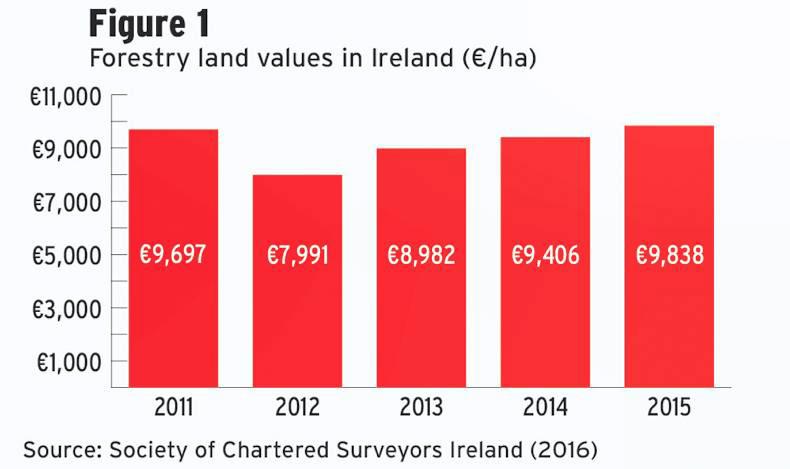
The average price paid for forests last year was €9,838/ha, which is marginally higher than 2011, when €9,697/ha was achieved. Prices dropped in 2012 to €7,991/ha, but there has been a gradual increase since then (Figure 1).
“There is considerable variability in values across the data set, with the majority of transactions occurring between €7,000 and €12,000 /ha,” the report states.
The SCSI acknowledges that “this variability in values and the relatively low sample sizes involved should be taken into consideration when analysing the estimated annual average price per hectare”.
The average yield class for all forests is 22 (m3/ha/annum) compared with 16 in Coillte and an estimated 20 in private conifer plantations. The average forest size is 19ha, while the average age of forests is 16 years. As expected, properties sold comprise either conifers – mainly Sitka spruce – or a mix of both conifers and broadleaves. The study explores issues such as the relationship between prices and key variables and maintains that there is a strongly positive relationship between price and area.
“The lack of a statistically significant association between price and variables, such as forestry age, yield class and quality of access, suggest the size of the property is the overriding factor determining the property sale price,” the study claims.
Supply and demand
Despite the strong interest from potential buyers, forestry is still a small transactional market. The study states that “the majority of sites coming to the market in a given year are small holdings, usually being sold through probate, or as a result of forced sales or family separation”.
The study maintains that the market has matured in recent years and forestry is now viewed by many as a credible investment alternative. “As an asset class, forestry tends to exhibit less volatility and even during recession or downturns in the economy it continues to grow and put on volume increment,” said Stephen Kavanagh, chairman SCSI, rural professional group.
“Demand is especially strong from mature investors and high net worth individuals that already have a knowledge and understanding of the forestry sector and are looking to diversify their existing investment portfolio with long-term pension planning in mind.”
Outlook
In the short to medium term, the outlook for the Irish forestry land market is relatively positive due to a variety of factors, the study predicts.
“The improvement in the domestic economy, growth in employment and ongoing high levels of consumer confidence helps maintain a favourable climate for transactional activity. This is further supported by the generous grants and premiums available to the forestry sector.”
The study is confident that “the immediate demand for timber products is also favourable”, with ongoing demand for roundwood for use in sawmills, panel mills and for the provision of wood-biomass energy.
“Growth in construction in the residential and commercial property sectors will help drive demand for timber products in Ireland. Timber exports should also continue to benefit from the favourable international economic climate,” the study maintains.
“Timber prices have performed very well in recent years, although there was a moderate drop in average prices during 2015, which may partly be due to a reaction to exchange rate dynamics and the stronger euro in the latter half of 2016.”
Valuation
What the SCSI has achieved is the first significant forest valuation in Ireland based on actual sales. “To date, the valuation of immature Irish forestry plantations has been primarily based on discounted cashflow analysis,” maintained Stephen Kavanagh.
“This is primarily due to the dearth of information in relation to their market value from official, state or private sources,” he said. “As property valuers and surveyors, we know the bedrock of all valuations is based on the reliability and accessibility of comparative market data.”
He acknowledged that “the analysis would benefit further from more transactional data” but the SCSI plans to update the survey continuously. “This publication is the beginning of a process which will assist a wide range of stakeholders including chartered valuation surveyors, auctioneers, farmers, private forestry investors, banking, financial, pension and institutional investors in Irish forestry,” he said.


SHARING OPTIONS